
UK AI Sovereignty and US Tech Reliance
TL;DR: The UK's critical AI infrastructure runs on US-controlled platforms, creating a "Cognitive Sovereignty Paradox." With 95% of UK banking dependent on foreign hyperscalers and multiple legal mechanisms (DPA, IEEPA, CLOUD Act) enabling service denial, businesses face existential risk. This comprehensive analysis explores the threat landscape and identifies sovereign alternatives from Locai Labs, Civo, and Faculty that enable true digital independence.
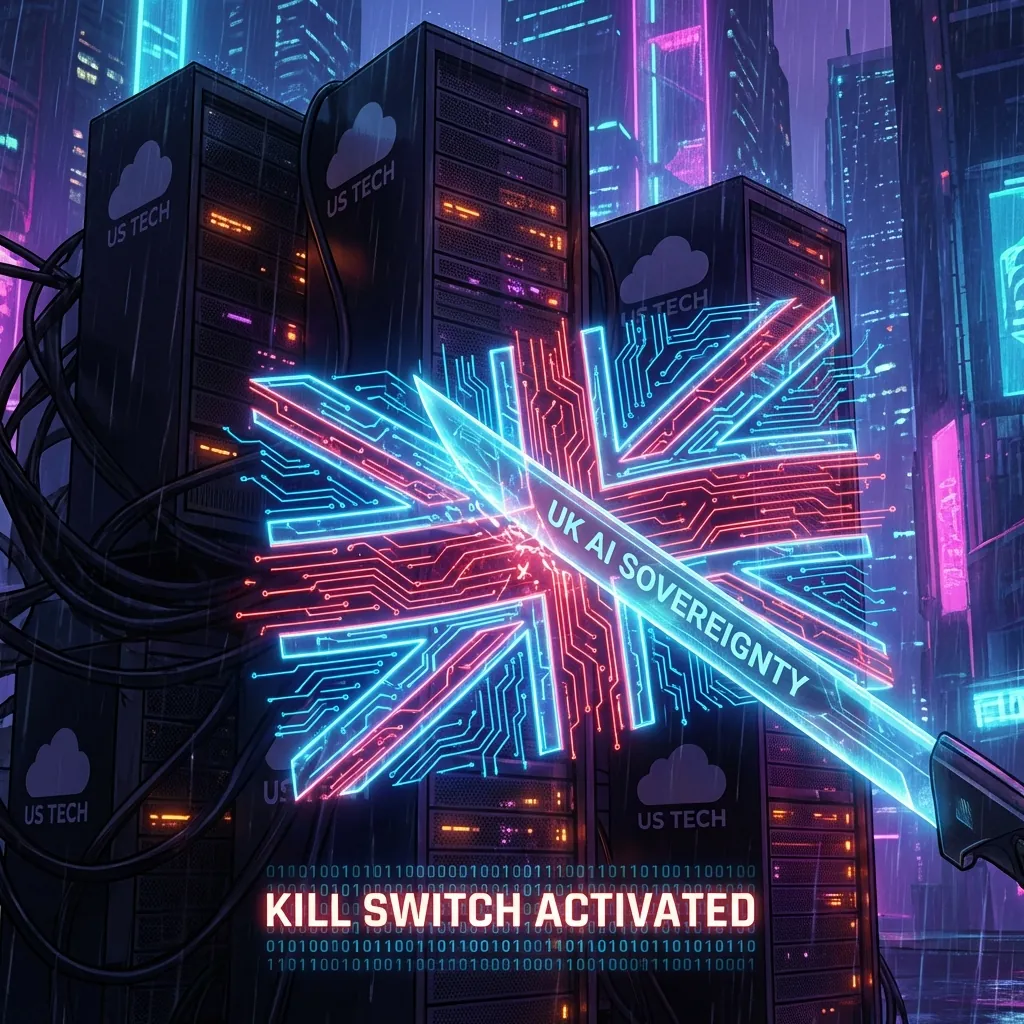
Table of Contents
1. The Fragility of Interconnected Intelligence
The integration of Artificial Intelligence into the fabric of the United Kingdom's economy represents a profound transformation. As AI becomes the foundational "engine" for decision-making—automating everything from banking fraud detection to NHS patient logistics—the UK has effectively outsourced its national cognition to US-domiciled hyperscalers. For more on this, see our guide on The UK's AI Kill Switch: Protecting Digital Sovereignty from US Tech Reliance.
The vulnerability is not limited to a binary state of war. In an era of aggressive technological mercantilism, the US administration possesses statutory tools to utilise its dominance in AI as a lever of geopolitical influence. Whether through the Defense Production Act (DPA), the International Emergency Economic Powers Act (IEEPA), or the extraterritorial reach of the CLOUD Act, the mechanisms to sever the UK's "digital lifeline" are already codified in US law.[1]
"The prevailing assumption that the 'Special Relationship' insulates Britain from digital coercion is a strategic error. A targeted service denial would result in the immediate paralysis of dependent sectors."
The Scale of Dependency
of UK Banking fraud detection relies on US-hosted GPU inference
UK protection against US CLOUD Act data seizures for Azure/AWS users
UK AI startups fail instantly if US API keys are revoked
UK AI Infrastructure Dependency Trajectory
US dependency (red) has reached critical levels. The sovereign capability target (teal) represents the strategic decoupling path required for resilience.
2. The Mechanics of Denial: Legal and Technical "Kill Switches"
The "Kill Switch" is not a dramatic button press. It is a legal and technical cascade that bypasses UK sovereignty laws through multiple mechanisms:
2.1 The Defense Production Act: Prioritisation as Denial
The DPA of 1950 allows the US President to require companies to prioritise government contracts over all other obligations. In a crisis scenario, the US government could designate computational capacity of major AI providers (Microsoft Azure, AWS, Google Cloud) as a "scarce defense resource."[2]
Mechanism: The Department of Defense issues a "rated order" requiring 100% of GPU capacity for US military use. To comply, providers must "shed load" by terminating UK commercial workloads. The DPA protects companies from liability for breach of contract when complying.[3]
2.2 IEEPA: Economic Coercion
The International Emergency Economic Powers Act grants the President sweeping powers to regulate international commerce during declared emergencies. An Executive Order under IEEPA could prohibit "US persons" from providing services to specific foreign sectors or entities.[4]
This was the mechanism used to force Adobe, Oracle, and GitHub to restrict access in sanctioned jurisdictions. Even absent war, a US administration could threaten IEEPA sanctions to force UK policy alignment on unrelated issues.
2.3 Technical Implementation
| Mechanism | Description | Speed | UK Impact |
|---|---|---|---|
| IAM Revocation | Centralised invalidation of OAuth tokens and API keys | Minutes | Immediate "401 Unauthorised" errors; failure of AI agents |
| Geo-Blocking | IP filtering of UK traffic at CDN edge | Minutes | Inability to access SaaS dashboards or inference endpoints |
| License Server Denial | On-premise software requires periodic handshake | 24-72 Hours | On-premise appliances brick after license verification fails |
| Model Weight Deletion | Deletion of fine-tuned models in cloud storage | Minutes | Loss of proprietary IP; inability to revert versions |
3. The Legal Trap: Data Residency vs. Sovereignty
A critical misconception: Data Residency ≠ Data Sovereignty. While residency addresses latency and compliance optics, it offers zero protection against US extraterritorial authority. For more on this, see our guide on Digital Sovereignty - AI Insights for UK Business.
3.1 The US CLOUD Act
The Clarifying Lawful Overseas Use of Data Act fundamentally reshaped cloud computing law. It mandates US service providers comply with legal orders to produce data within their "possession, custody, or control," regardless of physical location.[5]
Scenario: A US judge issues a warrant to Microsoft headquarters demanding data from a UK bank stored in the "UK South" (London) data centre. Microsoft is legally compelled to decrypt and transmit the data to US authorities, creating direct conflict with UK GDPR.[6]
3.2 The "Bricked Datacentre" Reality
If the UK government attempted to physically seize US-owned data centres on British soil to prevent data loss, the utility would rapidly degrade. Modern hyperscale facilities are peripherals of a global "control plane" hosted in the US.
The "Dead Hand": If connection to the US control plane is severed, the local facility loses its operational intelligence. UK engineers would possess "an expensive pile of bricks" they cannot authenticate, update, or reconfigure because management software and keys are controlled remotely.[7]
4. Sector-Specific Vulnerability Audit
4.1 Finance and Banking: Systemic Paralysis
Over 95% of UK banks utilise US cloud providers for critical functions.[8] Real-time fraud detection relies on AI inference models analysing transactions in milliseconds. Service revocation would force reversion to rules-based systems incapable of handling modern transaction volumes, effectively freezing payment processing.
4.2 Government and NHS: Critical Service Disruption
The NHS has entered significant partnerships with Palantir and Microsoft for data management.[9] The "Federated Data Platform" requires continuous software updates from US servers. In a service denial scenario, ability to track bed availability, schedule surgeries, and manage supply chains would degrade rapidly. For more on this, see our guide on Sovereign AI: Why Local LLMs Are the Future for UK Business Data.
4.3 Defence and Intelligence
While MoD and GCHQ maintain air-gapped networks for classified work, the administrative "enterprise" layer increasingly depends on cloud services. The UK utilises "sovereign" partitions of US clouds (Azure Government), but maintenance often relies on US nationals subject to US law. A DPA order overrides any commercial "sovereign" guarantee.[10]
4.4 SMEs and Startups: Existential Threat
Thousands of UK startups are "wrappers" around OpenAI's GPT-4 or Anthropic's Claude. They don't own model weights—they rent intelligence via API keys.[11] API revocation renders their products non-functional instantly, causing immediate insolvency.
5. Critique of Current "Sovereign AI" Initiatives
5.1 Stargate UK: Sovereignty or Subsidiary?
"Stargate UK" involves Nscale, Microsoft, OpenAI, and NVIDIA.[12] While Nscale provides physical facilities, the core value—OpenAI's models on NVIDIA hardware orchestrated by Azure—remains US property. If the US orders OpenAI to cease UK licensing, the facility retains power but loses intelligence. Critics label this "sloppy seconds from Silicon Valley" that reinforces dependence rather than building autarky.[13]
5.2 Isambard-AI: Silicon Supply Chain Risk
The Isambard-AI supercomputer at Bristol uses 5,448 NVIDIA GH200 chips with HPE Slingshot interconnects.[14] While physically sovereign, it's entirely dependent on NVIDIA's proprietary CUDA software. A US export ban or DPA order cuts off replacement parts and patches, leading to rapid obsolescence. The system integrator, HPE, is a US company subject to US law.
6. Mitigation Strategies
Strategy 1: The "Private AI" Stack
For critical sectors (Finance, Defence, CNI), the robust defence is adopting Private AI architecture—running models within organisational perimeters, potentially air-gapped.
Architecture of Independence:
- Model Layer: Use "Open-Weight" models (Mistral, Llama 3) where weights are downloaded and owned, not accessed via API. Once downloaded, they cannot be remotely revoked.
- Inference Layer: Host models on internal servers or sovereign private cloud, ensuring 100% uptime regardless of external connectivity.
- Data Layer: Training/fine-tuning data remains in UK-based storage, never leaving sovereign boundaries.
UK Sovereign Solutions:
- Locai Labs – Provides "L1-Large," an open-weights model with "Forget-Me-Not" technology enabling continuous learning without cloud connection. Ranks #1 on Arena Hard v2 benchmark.[15]
- Storm ID (AI Workbench) – Purpose-built platform for UK public sector compliance, deploys LLMs on-premise or UK private clouds ensuring data never leaves UK trust boundary.[16]
- NCC Group (Escode) – Provides Software Escrow for AI. UK companies mandate US vendors deposit source code and model weights; if service terminates, materials release to UK client for continuity.[17]
Strategy 2: Sovereign Cloud Infrastructure
Escaping the "Hyperscaler Trap" requires UK alternatives not subject to US CLOUD Act: For more on this, see our guide on Sales Tech Insights.
- Civo – UK cloud provider with "UK Sovereignty Guaranteed." Offers FlexCore for cloud parity allowing identical workloads in public cloud or private on-premise hardware. Hosts data strictly within UK, offers NVIDIA GPU instances. As UK-headquartered firm, provides stronger legal shield against US warrants.[18]
- OVHcloud – Major European provider with UK data centres. Aggressively markets immunity from US CLOUD Act (non-US subsidiaries), offers AI training on H100s.[19]
Strategy 3: Financial and Contractual Shields
Political Risk Insurance (PRI):
Standard cyber insurance contains "War Exclusions" (Lloyd's LMA5564) that void coverage for state-backed actions.[20] Companies should seek PRI policies specifically covering:
- Contract Frustration – Coverage for government actions rendering contracts impossible
- Licence Cancellation – Protection when foreign government blocks service provision
- Selective Discrimination – Coverage for targeted actions against specific sectors
Contractual Exit Strategies:
- Termination Assistance: Mandate data return in open formats (SQL, JSON, Parquet) within specific timeframes
- Escrow Triggers: Include "release conditions" for geopolitical service discontinuation, not just bankruptcy
- Portability Mandates: Align with EU Data Act principles removing switching barriers[21]
7. Strategic Playbook for UK Companies
| Action | Description | Timeline |
|---|---|---|
| 1. Audit & Classify | Identify all AI dependencies. Classify workloads as "Critical" (must survive Kill Switch) or "Non-Critical" | Immediate |
| 2. Sovereign Fallback | Deploy parallel "Private AI" stack using open-weight models (Mistral) on sovereign infrastructure (Civo/Storm ID/On-Prem) | 6-12 Months |
| 3. API Gateway Routing | Implement AI Gateways (LiteLLM) to route traffic. If US API fails/blocks, auto-reroute to local sovereign model | 3-6 Months |
| 4. Hardware Diversification | Pilot non-NVIDIA hardware (Lumai, Graphcore IPUs) to build expertise in non-CUDA workflows | 12-18 Months |
| 5. Financial Shielding | Purchase Political Risk Insurance covering "export restriction" and "licence cancellation" | Immediate |
| 6. Software Escrow | Mandate escrow arrangements for critical SaaS/AI vendors, ensuring code/weight access upon termination | Immediate |
Key Takeaways
- The UK faces a "Cognitive Sovereignty Paradox"—increasing AI adoption deepens vulnerability to US control mechanisms
- Multiple legal tools (DPA, IEEPA, CLOUD Act) enable service denial without requiring declared war
- Data residency in UK facilities provides zero protection—control planes remain US-subject
- Genuine sovereignty requires owning the full stack: models (Locai Labs), infrastructure (Civo), and contractual protections (escrow/PRI)
- "Stargate UK" and similar initiatives deepen dependency rather than building true autarky
References & Citations
[1] 22 CFR Part 124 - Agreements and Defense Services, eCFR
[2] Defense Production Act of 1950, as Amended - FEMA
[3] 50 USC Ch. 55: Defense Production - US House Office of Law Revision Counsel
[4] The International Emergency Economic Powers Act - Congressional Research Service
[5] CLOUD Act vs. GDPR - Exoscale Analysis Explore more options in our Best AI Cybersecurity Solutions for UK Businesses roundup.
[6] Clarifying Lawful Overseas Use of Data Act - AWS Compliance
[7] SAP Admits Thousands of Illegal Exports - US Dept of Justice
[8] Private AI Cloud Infrastructure - NexGen Cloud
[9] NHS Data Platforms Partnership Analysis - UK Parliament Committee
[10] Launching the AI Model Arena - GOV.UK
[11] The next chapter for UK sovereign AI - OpenAI For more on this, see our guide on Articles by SME Tech Advisor Team | AI Insights Blog.
[12] North East England tech partnership - GOV.UK
[13] Silicon Valley Invests in UK-US Alliance - Alan Turing Institute
[14] Isambard-AI supercomputer facts - TechFinitive
[15] Locai Labs launches UK's first foundational LLM - Tech.eu
[16] Storm ID AI Workbench - Storm ID
[17] NCC Group Escode - Escode Software Escrow
[18] Secure UK Sovereign Cloud Platform - Civo
[19] OVHcloud AI Training - OVHcloud
[20] Lloyd's cyber war exclusion - Clifford Chance Analysis
[21] EU Data Act switching and portability - Kennedys Law
Ready to Build Your Sovereign Stack?
Don't wait for the connection to be cut. Explore UK sovereign AI platforms and build resilience today.