
AI Fleet Management in 2026: EV Charging Optimisation, HMRC Compliance and Autonomous Route Planning for UK Logistics
Quick Summary
UK fleet operators face a dual compliance crisis in 2026: the ZEV mandate now requires 33% of new car registrations and 24% of new van registrations to be zero-emission, while HMRC has simultaneously banned flat-rate home charging reimbursements, requiring fleet operators to calculate and evidence exact kilowatt-hour consumption per driver - a task mathematically impossible for any fleet of 20 or more vehicles to manage via manual spreadsheets, with non-compliance triggering backdated Class 1A National Insurance Contributions at 13.8% on all undocumented energy reimbursements plus the potential destruction of Benefit-in-Kind exemptions worth hundreds of thousands of pounds in salary sacrifice savings annually.
AI vehicle telematics platforms - principally Geotab (tracking 5.8 million vehicles globally, supporting 300+ EV models), Samsara (AI dashcams with real-time driver behaviour scoring), and Webfleet (tachograph automation and DVSA Earned Recognition dashboarding) - resolve the HMRC compliance problem by integrating directly via API with UK smart chargers including Ohme, Hypervolt, and myenergi zappi to extract exact kWh per charging session, applying geofenced business versus personal mileage classification algorithms, and automatically pushing precise reimbursement figures to Sage, Xero, or SAP payroll, while AI-managed depot load balancing software eliminates peak-tariff charging spikes by scheduling off-peak energy absorption at 25p/kWh versus the 81p/kWh punitive public rapid charger average.
The hard ROI case for fleet AI in 2026 is unambiguous: a 50-vehicle fleet switching from unmanaged public charging at 40p/kWh blended to AI-optimised depot and home charging at 25p/kWh saves £32,143 annually with a 3 to 5 month payback period; predictive maintenance cuts unscheduled downtime by up to 50% and maintenance costs by 10 to 20%; AI dashcam evidence secures insurance premium reductions of 10 to 25%; and the government Depot Charging Scheme funds 70% of chargepoint civil infrastructure up to £1 million until March 2027, while operators that deploy Geotab's EV Suitability Assessment tool discover that typically 45% of their diesel fleet can be electrified immediately using existing home charging infrastructure, requiring zero depot capital expenditure.
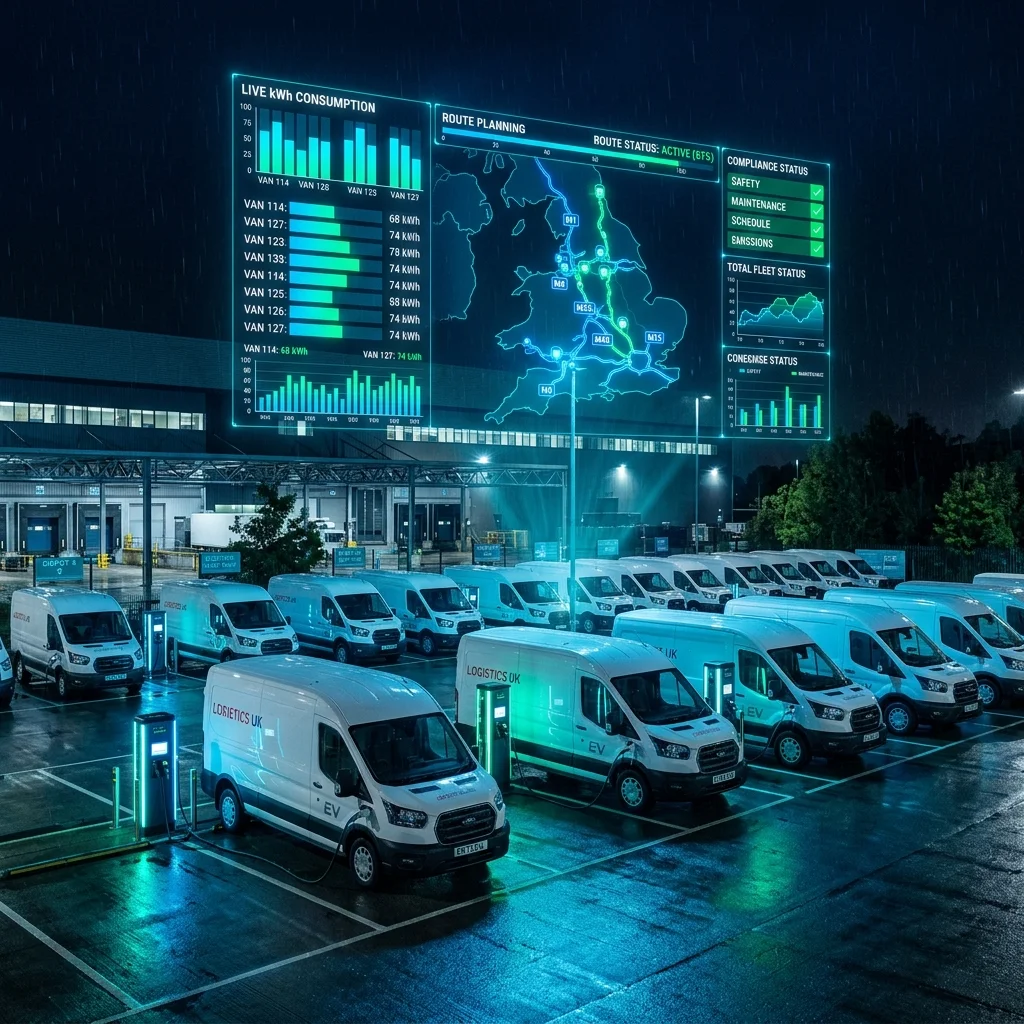
Table of Contents
The UK commercial transport sector in 2026 operates at a critical, highly pressurised intersection of stringent environmental legislation, complex taxation reform, and fundamentally strained electrical grid infrastructure. With over 2.8 million plug-in vehicles now navigating British road networks, the transition from internal combustion engine fleets to electric vehicles has irreversibly evolved from an optional corporate sustainability initiative into a strictly regulated, capital-intensive operational mandate.
For UK logistics operators, delivery companies, field service organisations, and supply chain enterprises managing fleets of twenty or more vehicles, this transition presents a compounding operational crisis. The convergence of the Zero Emission Vehicle mandate and the 2026 HM Revenue and Customs prohibition on flat-rate home charging reimbursements has created immediate, severe compliance friction. Fleet operations managers relying on legacy GPS tracking and manual spreadsheets face a mathematically impossible administrative burden when reconciling volatile energy tariffs with exact kilowatt-hour consumption.
Artificial intelligence and advanced vehicle telematics no longer represent optional efficiency upgrades. They have become the critical, non-negotiable orchestration layer for maintaining profitable, legally compliant, and operationally viable EV fleet operations.
The 2026 UK EV Fleet Mandate: Understanding the Dual Compliance Pressure
The regulatory landscape governing UK fleet operations is defined by two primary enforcement mechanisms operating in tandem: the Department for Transport's ZEV mandate, which actively forces electrification upon the automotive supply chain, and HMRC regulations, which govern the taxation, reimbursement, and benefit status of the electricity used to power those fleets.
The ZEV Mandate and Commercial Realities
The UK's Zero Emission Vehicle mandate establishes legally binding, escalating annual targets for the proportion of new car and van registrations that must produce zero tailpipe emissions. By 2026, the mandate dictates that 33% of all new car registrations and 24% of all new van registrations must be strictly zero-emission - a steep escalation from the 22% and 10% targets established at the mandate's inception in 2024. This trajectory continues relentlessly, culminating in 80% for cars and 70% for vans by 2030.
For commercial fleet operators, the ZEV mandate directly dictates the availability, pricing, and composition of lease and purchase vehicles on the open market. The Vehicle Emissions Trading Scheme (VETS) converts ZEV sales into compliance certificates, and manufacturers failing to meet these thresholds face severe financial penalties of £15,000 per non-compliant car. In 2026, the borrowing cap for the ZEV allowance target has been restricted to a mere 25%, drastically down from the 75% permitted in 2024, significantly reducing the flexibility available to manufacturers.
Consequently, logistics directors must secure EV allocations in an increasingly tight market, forcing the integration of EVs into duty cycles and routes previously dominated by diesel assets, whether the underlying charging infrastructure is fully mature or not.
The HMRC Flat-Rate Reimbursement Ban
The most urgent administrative pain point for UK fleets in 2026 is the total abolition of flat-rate pence-per-mile reimbursements for home EV charging. Prior to 2026, employers operated under a concessionary regime where flat-rate reimbursements - often ranging between £15 to £70 monthly - were permitted without rigorous evidentiary requirements. Effective from 2026, the provision of flat-rate reimbursements for domestic EV charging is explicitly prohibited.
The technical justification is clear: because the technological ability to measure actual kWh consumption is now ubiquitous, the justification for financial approximation has been removed. Under the new rules, the actually incurred electricity costs must be proven and billed exactly to the kWh. Employers are presented with two compliance pathways: they can either reimburse based on individual proof, where employees submit their specific domestic electricity contract tariffs to calculate exact costs, or they can apply the 2026 nationwide uniform average total electricity price established at 34 pence per kWh. Crucially, this choice must be exercised consistently for the entire calendar year; monthly switching to exploit tariff fluctuations is strictly forbidden.
HMRC has also reformed the Advisory Electric Rate (AER) to better reflect public charging realities. The AER now explicitly distinguishes between charging locations, providing 8 pence per mile for home charging and 14 pence per mile for public charging. However, the 14 pence public rate frequently falls drastically short of the true cost of ultra-rapid public infrastructure, which can range from 79p to 85p per kWh - resulting in real-world costs of 15 to 23 pence per mile. Without AI telematics to dynamically route drivers to cheaper chargers, employees end up subsidising their employer's business travel by hundreds of pounds annually, leading to driver dissatisfaction and potential industrial relations friction.
Benefit-in-Kind and Payroll Implications
Reimbursing employees for charging an electric company car at home does not automatically trigger a taxable fuel benefit, provided the reimbursement is strictly and demonstrably for electricity used for business mileage. However, the evidentiary burden of proof rests entirely on the employer. If a fleet operator cannot cleanly separate business kWh consumption from personal kWh consumption, the entire reimbursement risks being classified as taxable earnings, triggering Benefit-in-Kind liabilities and demanding employer Class 1A National Insurance Contributions on the undocumented energy value.
The BiK rate for EVs remains highly incentivised compared to ICE vehicles but is on a steady upward trajectory. Set at 4% for the 2026/27 tax year, it will rise by 1% annually to reach 7% by 2028/29. For enterprises with 500 employees sacrificing £6,000 annually via salary sacrifice, the National Insurance savings are substantial - avoiding 13.8% in employer NICs generates over £414,000 in direct payroll savings per year. Protecting these lucrative savings requires immaculate, AI-driven compliance data to prevent HMRC reclassification.
AI Telematics: Solving the HMRC Compliance Problem


Power up with Lindy
"Lindy handles the admin while you handle the vision. It's like having a clone, but more efficient."
The era of commercial drivers submitting physical photographs of charging station receipts or estimating their home electricity usage on spreadsheets is definitively over. AI vehicle telematics platforms have emerged as the definitive solution for establishing an unbroken, HMRC-compliant digital audit trail that removes human error and prevents tax liability.
How the Telemetry Works
Modern AI fleet management architecture relies on combining standard GPS tracking and OBD-II diagnostics with highly specific EV telemetry. Unlike traditional ICE vehicles, EVs require continuous, high-frequency monitoring of the battery's State of Charge, State of Health, and internal auxiliary energy consumption. Because there is currently no single, universally adopted data standard across all commercial EV manufacturers, enterprise telematics platforms deploy sophisticated AI middleware to normalise this data across mixed OEM fleets, translating disparate manufacturer APIs and CAN bus signals into a single unified operational dashboard.
To automate financial compliance, the system must achieve highly accurate charging location discrimination. It accomplishes this through a combination of high-fidelity GPS geofencing and charging session fingerprinting. When an EV is plugged in, the AI cross-references the vehicle's coordinates with the driver's registered home address, mapped corporate depot locations, and known public charging hubs - preventing a driver from fraudulently claiming a high-cost public charging session when the vehicle was actually tethered to their subsidised home wallbox.
Smart Charger API Integration and Reimbursement Logic
To meet the strict 2026 HMRC exact-kWh requirement, fleet AI platforms integrate directly via APIs with leading domestic smart chargers prevalent in the UK market, such as Ohme, Hypervolt, and the myenergi zappi. When a driver plugs their company vehicle into their home charger, the AI platform executes a secure, multi-point verification protocol: first confirming vehicle identity and exact State of Charge via the onboard telematics unit; second requesting the total kWh dispensed from the smart charger's cloud service API; third calculating the precise financial cost using either the driver's specific energy contract or the HMRC average rate.
The system then overlays this raw charging data with advanced journey classification algorithms. By analysing the time of day, historical route patterns, geofenced client locations, and corporate calendar integrations, the AI automatically segments the total energy consumed into business versus personal mileage. This calculation is then automatically pushed via secure API to enterprise payroll systems like Sage, Xero, or SAP - providing an impenetrable audit trail that entirely satisfies HMRC scrutiny without requiring any manual HR intervention.
The 2026 Fleet AI Compliance Matrix
| Compliance Requirement | 2026 Rule | AI Telematics Solution |
|---|---|---|
| Home charging reimbursement | Flat-rate banned - actual kWh metering required to prevent BiK taxation | Automated smart charger API integration mapping exact kWh to specific driver utility tariffs |
| ZEV mandate reporting | 33% of new car and 24% of van registrations must be zero-emission | Fleet composition analytics and EV Suitability Assessments for phased procurement |
| Route planning (EV range) | No specific regulation, but high operational risk of stranded assets | AI State-of-Charge-aware dynamic routing integrated with live public charger availability APIs |
| Driver hours (WTD) | Strict enforcement of European Drivers' Hours Regulation | Automated digital tachograph remote downloads and real-time infringement alerts |
| P11D charging benefit | Unjustified energy reimbursements trigger 13.8% employer NICs | Geofenced business vs. personal mileage splitting to isolate exempt business energy use |
UK Fleet Telematics Platform Comparison
| Platform | EV Support Depth | HMRC Reporting Capability | Depot Load Management | Smart Charger Integration | Est. UK Pricing (Per Vehicle/Month) |
|---|---|---|---|---|---|
| Geotab | Full (300+ EV models) | Comprehensive (Home kWh logs) | Yes (via diverse API partners) | Multiple UK brands | approx. £16 - £40 |
| Samsara | Full (Battery health/SoC) | Strong (Customisable reports) | Yes (Analytics driven) | Yes (via API ecosystem) | approx. £20 - £50 |
| Webfleet | Strong (Range/Routing) | Partial (Mileage log focus) | Yes | Evolving | approx. £10 - £35 |
| Verizon Connect | Moderate (Mixed fleets) | Basic (Standard reporting) | Limited natively | Basic | approx. £12+ |
Geotab is widely regarded as the industry benchmark for open data architecture, tracking over 5.8 million vehicles globally with exceptional EV-specific analytics across 300+ models. Samsara leads in AI-powered safety cameras and highly intuitive driver applications with deep energy analytics. Webfleet dominates European heavy logistics with exceptional tachograph management and commercial routing capabilities.
Smart Depot Charging: AI Optimisation at Scale
While AI-driven home charging resolves the reimbursement complexities for distributed workforces, centrally located fleets returning to a primary logistics hub face a severe physical infrastructure bottleneck. Unmanaged depot charging presents existential risks to both operational continuity and corporate profit margins.
The Depot Charging Problem and Grid Constraints
The physics of commercial fleet charging are unforgiving. If a fleet of fifty electric delivery vans returns to a depot at 16:00 and simultaneously initiates charging, the resultant electrical power draw will almost certainly exceed the site's Available Supply Capacity. This sudden spike triggers protective trips on high-voltage commercial fuses, instantly halting all charging operations and potentially causing localised grid instability.
Furthermore, this unmanaged charging behaviour perfectly coincides with the evening peak tariff period - typically 16:00 to 20:00. In the UK commercial energy market, drawing massive electrical loads during these hours maximises exposure to highly volatile wholesale electricity pricing and incurs punitive maximum demand charges from the Distribution Network Operator. Simply upgrading a depot's grid connection to brute-force enough capacity to handle unmanaged charging is rarely viable; it can involve years of delays in DNO connection queues and require massive, prohibitive capital expenditure.
AI-Managed Depot Charging and Dynamic Load Management
To circumvent multi-million-pound grid upgrades, operators are deploying AI-driven dynamic load management software. These platforms act as a localised digital conductor, orchestrating the distribution of available electrical power across the fleet by constantly evaluating three dynamic variables: the specific vehicle's current State of Charge, the scheduled departure time of the vehicle for its next operational shift, and the real-time cost of grid electricity.
Instead of delivering maximum power to all vehicles simultaneously, the AI establishes an intelligent, rolling priority charging schedule. Vehicles scheduled for long-distance routes early the following morning receive priority energy throughput. Conversely, vehicles slated for shorter subsequent routes, or those not scheduled to depart until the following afternoon, have their charging deliberately delayed until the off-peak, lowest-carbon grid periods - typically between 00:00 and 06:00. This system integrates seamlessly with dynamic time-of-use tariffs such as Octopus Agile, enabling the fleet to absorb energy exactly when the UK grid has an excess of renewable generation and wholesale prices collapse, sometimes even going negative.
AI vs Unmanaged EV Fleet Charging: The Financial Impact
UK fleet charging data reveals that the blended average unit rate for unmanaged, public-reliant commercial charging is approximately 40p/kWh, while public rapid chargers alone average a punitive 81p/kWh. Highly optimised off-peak depot and home charging, orchestrated by AI, can reduce the blended rate to 25p/kWh, or even as low as 6-7p/kWh on dedicated nocturnal EV tariffs.
| Fleet Size | Annual Unmanaged Charging Cost (Avg 40p/kWh) | Annual AI-Optimised Cost (Avg 25p/kWh Blended) | Annual Financial Saving | Est. Payback Period for AI Software |
|---|---|---|---|---|
| 20 vehicles | approx. £34,285 | approx. £21,428 | approx. £12,857 | 4 - 6 months |
| 50 vehicles | approx. £85,714 | approx. £53,571 | approx. £32,143 | 3 - 5 months |
| 100 vehicles | approx. £171,428 | approx. £107,142 | approx. £64,286 | 2 - 4 months |
These figures assume 15,000 miles per vehicle annually at an average efficiency of 3.5 miles per kWh.
Grid Connection, Microgrids, and Government Funding
Beyond smart scheduling algorithms, AI facilitates the integration of depot Battery Energy Storage Systems and commercial solar photovoltaics, effectively creating localised, self-sustaining microgrids. During peak grid pricing events, the AI can direct the depot infrastructure to consume stored energy from the battery storage system rather than purchasing expensive grid power. Through Vehicle-to-Grid technology and active participation in localised DNO flexibility markets such as the Piclo Flex platform, logistics operators can actually earn revenue by discharging surplus fleet energy back to the grid during critical peak demand events.
To accelerate this capital-intensive transition, UK operators have access to the government's £1 billion investment package. The Depot Charging Scheme, running until March 2027, funds 70% of chargepoint and civil infrastructure costs - up to a maximum of £1 million - for businesses installing charging for vans, coaches, and HGVs. Additional funding mechanisms facilitated through Innovate UK and Scottish Enterprise provide further capital relief for complex microgrid engineering.
AI Route Planning and Optimisation for EV Fleets
Migrating a logistics operation from diesel to electric necessitates a fundamental, ground-up rewrite of routing algorithms. Traditional ICE routing operates on the assumption that fuel is universally available and refuelling takes a negligible five minutes. AI-powered EV route planning requires a fundamental change in methodology: charging stops must be strategically planned based on physics, not opportunistically assumed based on geography.
The EV Route Planning Challenge
Range anxiety at an enterprise scale is not a psychological barrier - it is a matter of strict mathematical complexity. Manufacturer-claimed WLTP range degrades significantly when subjected to real-world logistics variables. AI route optimisation engines must process a vehicle's payload, because adding two tons of cargo drastically reduces effective range. The AI must also factor in external ambient temperature, as freezing winter conditions radically increase battery heating demands and cabin HVAC usage. Topography and the specific driver's historical acceleration and braking patterns must also be integrated into the consumption model.
Traditional manual planning leads directly to panic-charging, where drivers deviate from routes to charge prematurely out of fear of stranding, heavily disrupting tight multi-drop delivery sequences, destroying service level agreements, and forcing reliance on expensive public rapid chargers.
Dynamic Routing and Public Network Integration
Modern AI route optimisation platforms continuously adapt to live operational conditions. If an AI detects heavy congestion via live GPS traffic feeds that will force the vehicle to consume more energy than originally anticipated, it automatically recalculates the route sequence to intersect with an available, high-speed public charger that fits within the delivery time windows.
This autonomous capability is underpinned by massive data aggregation. Platforms like Zapmap Spark provide unified APIs that feed directly into enterprise fleet software. The Zapmap Search API aggregates data from over 95% of the UK's public charge points, providing live, real-time availability status on over 75% of them. The routing AI does not merely guide a driver to a geographical location - it dynamically guides them to a specific charger that it knows is currently unoccupied, fully operational, and capable of delivering the required kW output at a price point pre-approved by the transport manager.
Unified API payment gateways allow drivers to initiate and terminate charging sessions across dozens of disparate charge point operator networks directly from their routing app, without requiring multiple RFID cards or corporate credit cards, instantly transmitting the digital receipt back to the telematics platform for accurate profit and loss accounting. Allstar Business Solutions famously utilised Zapmap Spark's API to power the Allstar Co-Pilot app, offering seamless cross-network payments and live mapping to fleet drivers across the UK.
Proactive Fleet Electrification AI
Crucially, AI is not only managing existing EVs but actively dictating future corporate procurement strategies. Advanced analytical tools such as Geotab's EV Suitability Assessment ingest months or years of historical diesel telematics data to model a fleet's electrification readiness. The AI assesses every single duty cycle, route length, elevation change, and dwell time across the entire fleet, then identifies which specific ICE vehicles can be seamlessly replaced by an EV today without disrupting operations.
EV Fleet Electrification Readiness Matrix
This matrix illustrates how an AI platform categorises a theoretical 100-vehicle ICE logistics fleet for phased EV procurement, based on the ingestion of historical telematics duty-cycle data.
| Electrification Status | Criteria Identified by AI | Operational Action Required | Percentage of Fleet |
|---|---|---|---|
| Green (EV-Ready) | Daily mileage under 120 miles. Dwell time over 10 hours overnight at drivers' homes. Payload consistently under 80% capacity. | Immediate EV procurement. Deploy home smart chargers. Rely on HMRC automated API reimbursement. | 45% |
| Amber (EV-Feasible) | Daily mileage 120-180 miles. Consistent return to central depot. Moderate to heavy payloads. | Upgrade depot ASC. Implement AI dynamic load balancing software. Procure extended-range EV variants. | 35% |
| Red (Not Viable Yet) | Daily mileage over 200 miles. Highly unpredictable routes. Maximum payloads. No fixed overnight dwell location. | Retain ICE or Hybrid temporarily. Monitor public ultra-rapid network expansion. Plan for 2028 procurement. | 20% |
AI Safety, Driver Behaviour, and DVSA Compliance
Beyond energy management and route optimisation, AI telematics platforms serve as the vanguard for strict regulatory compliance and risk mitigation, directly interfacing with the requirements of the Driver and Vehicle Standards Agency and complex UK employment law.
DVSA Compliance Automation and Earned Recognition
The UK's commercial transport sector operates under strict Operator Licence conditions, governed heavily by the Working Time Directive and European Drivers' Hours regulations. AI telematics platforms have digitised this landscape entirely. Systems like Webfleet's Tachograph Manager and Samsara's Smart Compliance allow transport managers to execute remote tachograph downloads without ever recalling vehicles to the depot. The AI continuously analyses the streaming digital tachograph data, issuing proactive real-time alerts to dispatchers before a driver breaches their legal continuous driving limit - shifting the logistics operation from reactive auditing to proactive violation prevention.
This continuous, pristine data stream is vital for participation in the DVSA Earned Recognition scheme. This voluntary programme requires operators to digitally share key performance indicator data regarding driver hours and maintenance records directly with the DVSA via an approved IT system. The audit standards are exacting - operators must maintain a 100% KPI success rate on safety inspection records being completed correctly and within the stated frequency, alongside a stringent 95% MOT initial pass rate. In return, Earned Recognition fleets are subjected to significantly fewer roadside inspections, protecting critical delivery schedules and dramatically increasing asset utilisation.
AI-Powered Driver Monitoring and Predictive Maintenance
Advanced enterprise telematics packages now routinely feature inward and outward-facing AI dashcams. These systems utilise machine learning edge-computing within the cab to detect high-risk driver behaviours in real-time, such as mobile phone usage, severe fatigue, unbelted driving, harsh braking, and tailgating. When an event occurs, the AI captures the high-definition footage, analyses the context, and uploads it immediately to the cloud for incident reconstruction. This drastically accelerates insurance claims processing and unequivocally exonerates drivers from fraudulent crash-for-cash schemes, saving operators hundreds of thousands of pounds in third-party claims.
Combining EV telemetry with historical breakdown data allows AI to execute highly accurate predictive maintenance. By tracking battery degradation patterns, subtle tyre wear indications via traction control feedback, and auxiliary system health, predictive algorithms can forecast component failures days or weeks before they result in catastrophic roadside breakdowns. Industry data suggests AI-powered predictive maintenance can reduce overall maintenance costs by 10% to 20% and decrease unscheduled downtime by up to 50% - a critical advantage in high-tempo logistics.
Privacy, UK GDPR, and Employment Law Constraints
The deployment of inward-facing AI monitoring inside the commercial cab triggers immediate legal considerations. Under Article 8 of the European Convention on Human Rights (incorporated via the Human Rights Act 1998) and the UK General Data Protection Regulation, employees retain a fundamental right to privacy in the workplace.
Fleet managers cannot arbitrarily deploy AI monitoring to surveil staff. They are legally required to conduct a formal Legitimate Interest Assessment to balance the commercial interest of the business against the fundamental privacy rights of the driver. The impending enforcement of the UK's Data (Use and Access) Act 2025 dictates that automated decision-making regarding employee performance or safety infractions must retain meaningful human oversight. Any AI-driven driver coaching programmes must be totally transparent, proportionate, and strictly firewalled from punitive employment decisions unless explicitly documented in negotiated corporate policy.
Building the ROI Case for Fleet AI
Procuring enterprise-grade AI fleet management software represents a significant capital and operational expenditure, often ranging from £15 to £50 per vehicle per month. For transport managers seeking authorisation from their financial directors, the ROI case must be built on hard, verifiable metrics that combine aggressive cost reduction with catastrophic risk avoidance.
Hard ROI Metrics
Energy Cost Arbitration: Unmanaged reliance on public infrastructure costs fleets an average of 81p/kWh, while AI-optimised home and depot charging drops to a blended rate of 25p/kWh or lower. An AI platform that correctly routes and schedules charging can generate cash savings of over £1,000 to £1,300 per vehicle annually through tariff optimisation and off-peak utilisation alone.
Administrative FTE Reduction: The 2026 HMRC mandate forbidding flat-rate home charging reimbursements requires exact kWh calculations per driver. Managing this manually for a 100-vehicle fleet requires hundreds of hours of HR and payroll reconciliation. AI platforms that execute automated API calls to home chargers and push exact financial figures directly to payroll eliminate this administrative overhead entirely.
Predictive Maintenance Savings: Cutting unscheduled downtime by 50% and overall maintenance costs by up to 20% through predictive AI alerts prevents missed delivery penalties and costly emergency asset replacements.
Insurance Premium Mitigation: Fleets that provide insurers with indisputable, AI-classified telematics data demonstrating safe driving behaviour, alongside rapid exoneration footage for not-at-fault collisions, routinely negotiate insurance premium reductions of 10% to 25%.
Soft ROI and Risk Avoidance
The hidden, often unquantified value of AI telematics lies in catastrophic risk mitigation. A failure to accurately segregate business from personal energy use invites a devastating HMRC audit, resulting in backdated National Insurance penalties at 13.8% and the destruction of BiK exemptions for the entire workforce. Similarly, continuous violation of driver hours due to poor manual oversight can lead to the Traffic Commissioner revoking a company's Operator Licence - an event that effectively ceases all commercial operations overnight.
Fleets utilising gamified AI driver scoring and targeted coaching report significant drops in driver turnover - up to 50% reduction - which is a massive financial victory in a transport industry plagued by chronic labour shortages. For organisations tracking Scope 1 emissions, telematics automatically generates the precise, auditable carbon reduction data required for corporate ESG reporting.
Vendor Evaluation Framework
When UK logistics operators evaluate AI fleet platforms in 2026, they must assess vendors against rigorous criteria tailored specifically to the British regulatory environment. Must-have capabilities include:
- Direct API integrations with UK domestic smart chargers (Ohme, Hypervolt, myenergi) for exact-kWh extraction - Automated HMRC-compliant reimbursement reporting - EV-specific telemetry capturing live State of Charge across multiple OEMs - Automated remote digital tachograph downloading - Depot dynamic load balancing capabilities - Integration with UK public charging aggregators such as Zapmap Spark for live availability routing - DVSA Earned Recognition dashboarding
Operators should also demand transparent pricing models that clearly distinguish between software licences and hardware acquisition costs, which can vary significantly based on ruggedisation requirements and the inclusion of AI dashcams.
Looking for the Best AI Agents for Your Business?
Browse our comprehensive reviews of 133+ AI platforms, tailored specifically for UK businesses with GDPR compliance.
Explore AI Agent ReviewsNeed Expert AI Consulting?
Our team at Hello Leads specialises in AI implementation for UK businesses. Let us help you choose and deploy the right AI agents.
The transition to AI-managed EV fleet operations in 2026 is no longer a strategic choice for UK logistics operators - it is a regulatory imperative driven simultaneously by the ZEV mandate, the HMRC flat-rate reimbursement ban, and the unforgiving economics of unoptimised depot charging. The question is not whether to invest in AI telematics, but which platform best aligns with the specific duty cycles, depot infrastructure, and payroll architecture of your operation.
Platforms like Geotab, Samsara, and Webfleet have matured significantly in their EV-specific capabilities, offering comprehensive State of Charge monitoring, automated HMRC reimbursement reporting, and real-time public charging network integration. The financial case is compelling: a 50-vehicle fleet can save £32,143 annually through AI-optimised charging alone, with payback periods as short as three months.
The operators who move decisively now - deploying AI telematics, securing Depot Charging Scheme grants, and implementing EVSA-driven procurement strategies - will establish an insurmountable operational advantage over competitors still managing EV compliance with spreadsheets and flat-rate approximations.
Key Takeaways
- HMRC flat-rate reimbursements are banned from 2026: UK fleet operators must now calculate exact kWh consumption per driver for home charging reimbursements, using either actual electricity tariffs or the 2026 standard rate of 34p/kWh - with the choice locked in for the entire calendar year
- The ZEV mandate is non-negotiable: 33% of new car and 24% of new van registrations must be zero-emission by 2026, with the borrowing cap reduced to 25%, forcing logistics directors to secure EV allocations in an increasingly constrained market
- AI telematics is the only scalable compliance solution: Smart charger API integration with platforms like Ohme, Hypervolt, and myenergi zappi provides the exact-kWh audit trail HMRC requires, automatically pushing reimbursement figures to Sage, Xero, or SAP payroll systems
- Unmanaged depot charging is financially catastrophic: Without AI dynamic load balancing, 50-van fleets draw power during peak tariff periods at 81p/kWh; AI-optimised off-peak charging reduces blended rates to 25p/kWh, saving £32,143 annually for a 50-vehicle fleet
- Government funding covers 70% of depot infrastructure costs: The Depot Charging Scheme provides up to £1 million for chargepoint and civil infrastructure until March 2027, dramatically reducing the capital barrier to depot electrification
- AI routing must replace traditional logistics planning: EV route optimisation must account for payload weight, ambient temperature, topography, and real-time public charger availability via APIs such as Zapmap Spark, which covers 95% of UK charge points
- Geotab's EVSA tool enables phased, data-driven procurement: Historical diesel telematics data identifies which vehicles are immediately EV-ready (typically 45% of a fleet), which require depot infrastructure upgrades (35%), and which should retain ICE assets until 2028 (20%)
- DVSA Earned Recognition requires AI-quality data: Operators must maintain 100% KPI compliance on safety inspection records and a 95% MOT initial pass rate - standards only achievable through automated tachograph remote downloads and real-time infringement alerts
- AI dashcams generate measurable insurance savings: Indisputable AI-classified telematics evidence and rapid exoneration footage routinely secure insurance premium reductions of 10% to 25%, directly offsetting telematics platform costs
- UK GDPR and DUAA 2025 require Legitimate Interest Assessments: Inward-facing cab monitoring requires a formal LIA, transparent driver coaching policies, and meaningful human oversight of any automated performance decisions to avoid regulatory sanction

TTAI.uk Team
AI Research & Analysis Experts
Our team of AI specialists rigorously tests and evaluates AI agent platforms to provide UK businesses with unbiased, practical guidance for digital transformation and automation.
Stay Updated on AI Trends
Join 10,000+ UK business leaders receiving weekly insights on AI agents, automation, and digital transformation.
Related Articles
UK Logistics AI in 2026: A 48-Hour Implementation and Compliance Guide
Broader n8n route optimisation, DUAA compliance frameworks, and Data Act 2025 considerations for UK logistics and supply chain operations
Making Tax Digital & AI: The Complete Guide for UK Accountants
HMRC's digital-first compliance architecture and how AI automates payroll reconciliation - directly relevant to fleet kWh reimbursement workflows
UK B2B AI Agents 2026: Implementation and Data Act Survival Guide
The DUAA 2025 automated decision-making framework and Legitimate Interest Assessment requirements that govern AI driver monitoring deployments
AI and the UK Construction 88% Problem
AI telematics and fleet tracking in field service and construction site logistics, with GDPR-compliant worker monitoring frameworks
📚 Explore More Resources
Recommended Tools
Lindy
"The personal assistant that actually listens."
$59/month
7-day trial
Affiliate Disclosure


Reclaim.ai
"Take back your calendar. Save 26% with NEWYEAR26."
$13/month
Save 26% with code NEWYEAR26
Affiliate Disclosure
Ready to Transform Your Business with AI?
Discover the perfect AI agent for your UK business. Compare features, pricing, and real user reviews.