
AI Search & ChatGPT Ads: The Real Economics for UK Firms
Why Google is pulling back AI Mode and why ChatGPT ads earn 64% less than search. Data-backed guide to AI search, zero-click SEO and GEO for UK businesses.
The short answer
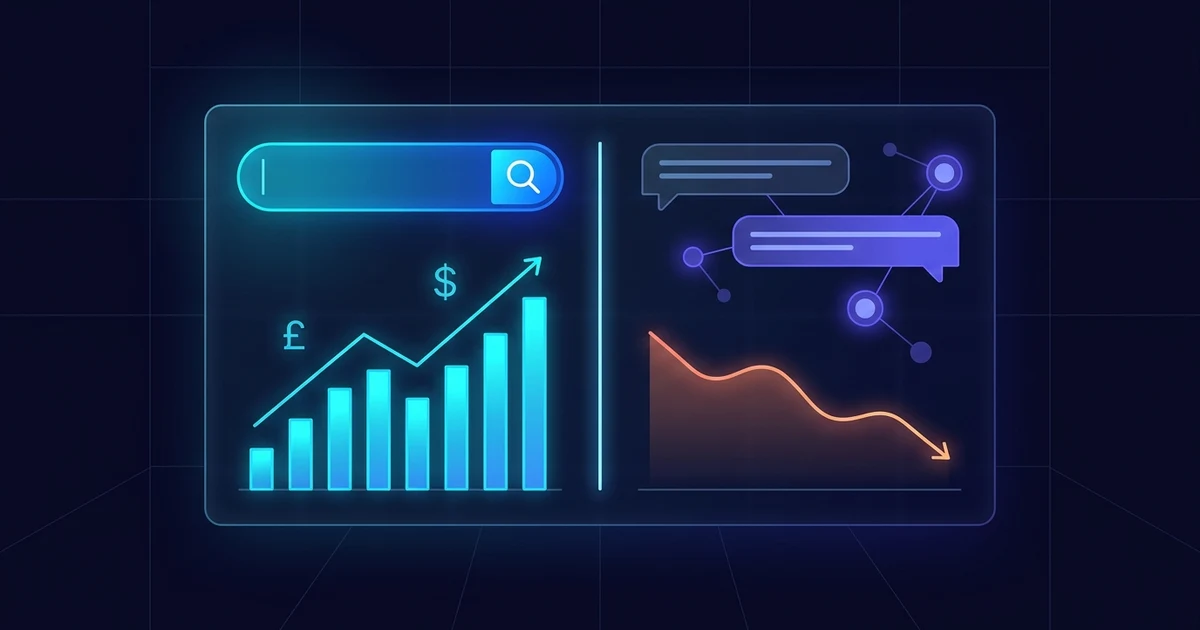
Generative AI search is hitting a commercial wall: Alphabet's Q3 2026 search growth slowed to 12% ($1.4bn below estimates) as executives admitted AI Mode monetises worse than classic search, while a 60-week study of 1,898 retail sites found ChatGPT ads generate $0.89 per visit (0.37% conversion) versus $2.45 (1.17% conversion) for Google Search.
Because only 6.9% of ChatGPT prompts carry purchase intent and AI Mode drives zero-click rates towards 93%, advertisers are paying $1.72 to $22.00+ per click for traffic worth $0.26 at search-parity, while covert native ad frameworks like AdsWorldEngine and AdSteer clash with FTC and UK ASA/CAP Code disclosure rules.
For UK SMEs and marketing teams, the winning strategy is clear: keep core PPC budgets on proven bottom-of-funnel search, measure conversions rather than top-of-funnel pageviews, and invest in Generative Engine Optimisation (structured schema, GBP pricing, and original UK evidence) to capture AI citations that convert at 0.9% CTR.
On this page
Right, let's talk about the awkward maths that nobody in Silicon Valley wants to put on a keynote slide.
For the past two years, every UK marketing director and SME founder I have spoken to has been told the exact same story: traditional search is dead, ten blue links are history, and your entire customer acquisition budget needs to pivot into conversational AI search and ChatGPT ads immediately.
Except something strange happened in late 2026. Google quietly started hiding its own "AI Mode" buttons on high-intent queries. OpenAI's much-hyped advertising rollout ran straight into a wall of brutal unit economics. And the empirical data coming out of independent retail studies now shows that a paid click from ChatGPT brings in 64% less revenue per visit than a traditional Google Search click.
If you run a UK business or manage a PPC budget in pounds and pence, this is not academic gossip. It changes where you spend your next £10,000, how you judge agency pitches on "AI search visibility", and why your organic traffic might be dropping even while your conversions hold steady.
Let us unpack what the actual numbers say, why the economics of generative AI search are broken right now, and what British businesses should do about it.
Google's Quiet Retreat from Full-AI Defaults
Start with what happened on the Google Search Engine Results Page (SERP) in November 2026.
For months, Google pushed conversational AI into every corner of search. Then, on 13 November 2026, search analyst Glenn Gabe spotted something jarring: the dedicated "AI Mode" tab had vanished from his main navigation bar, and the "Ask anything" follow-up prompt that usually sat at the bottom of AI Overviews had been stripped out for his test cohort. As Gabe posted on X at the time, he was suddenly seeing tests with no AI Mode tab in the SERP.
Barry Schwartz at Search Engine Roundtable confirmed the pattern the same day, noting that Google had already been spotted testing the removal of AI Mode buttons from the Google homepage earlier that month. Ad-tech commentators immediately connected the dots. These tests kicked off right after Alphabet's Q3 2026 earnings call, and they were not cosmetic tweaks.
Why Removing "Ask Anything" Protects Ad Inventory
Think about how Google actually makes money.
In a classic search session, you type a query, scan a page loaded with Shopping carousels, local service ads, and top-of-page sponsored links, click something, or refine your search. Every time you type a new query, Google loads a fresh SERP and serves a fresh batch of paid inventory.
Conversational AI breaks that loop. When a user stays inside a multi-turn chat box asking five follow-up questions in a row, they never trigger five new page loads. They sit inside one rolling thread. The ad load collapses.
By removing the "Ask anything" box, Google deliberately severs the conversational loop. If you want to ask a follow-up question, you are nudged back to the standard search bar, where traditional paid text ads and Shopping units still print money.
The Q3 2026 Admission and the Compute Cost Squeeze
If anyone doubted that the UI tests were driven by revenue anxiety, Alphabet's Q3 2026 earnings call settled the argument.
Alphabet reported that overall search revenue growth had slowed to 12%, down from 17% the previous quarter. That deceleration meant search revenue missed analyst estimates by $1.4 billion (roughly £1.1 billion), knocking Alphabet's share price down 7% in after-hours trading before losses widened to 11%.
Initially, executives pointed to foreign exchange headwinds and post-World Cup media spending normalisation. Then Philipp Schindler, Google's Senior Vice President and Chief Business Officer, said the quiet part out loud. As Search Engine Roundtable reported from the call, Schindler told investors: "It's worth noting that the strong growth in AI Mode queries had an impact because of the lower monetization we were seeing in AI Mode."
Here is the technical headache sitting underneath that quote:
- Traditional search is dirt cheap to serve. Analysts estimate the compute cost of a standard search query at roughly $0.00845.
- AI Overviews cost more, even with custom chips. Google has worked hard on its Tensor Processing Units (TPUs) to bring the base inference cost of a standard AI Overview down to around $0.0097 per query.
- Full AI Mode multiplies the bill. Multi-turn conversational AI requires continuous context retention, long-form token generation, and heavy safety filtering on every turn.
- Query structure kills ad density. Users type queries into AI Mode that are often twice as long and far more complex than traditional keyword searches, leaving fewer clean hooks for commercial ad auctions.
Google essentially swapped a high-margin, low-compute product for a low-margin, high-compute product. Until AI Mode ads can match traditional search yield, Alphabet has every financial incentive to gate conversational AI away from your most profitable, ready-to-buy searches.
ChatGPT Ads: What the 60-Week Retail Data Actually Shows


Power up with ClickUp
"Is your team drowning in tabs? ClickUp saves 1 day a week per person. That's a lot of Fridays."
If Google, with two decades of ad-auction engineering and global merchant data, is struggling to make generative AI search pay, imagine trying to build an ad network from scratch inside a chatbot.
OpenAI launched its US advertising pilot inside ChatGPT in early 2026 to help fund the enormous server bills generated by hundreds of millions of free users. On the surface, advertisers piled in. Underneath, the commercial returns have been dismal.
The sharpest evidence comes from a 60-week working paper by Maximilian Kaiser (Vienna University of Economics and Business) and Christian Schulze (Frankfurt School of Finance & Management), titled Can Advertising Fund Free AI? Evidence from ChatGPT's International Advertising Rollout. They tracked first-party sales across 1,898 online retail websites representing $16 billion in annual sales and nearly 10 billion visitor sessions, using the EU's regulatory delay as a natural control group against the US rollout.
The numbers, summarised in E-Commerce Research's breakdown of the study and Everything PR's coverage, are stark:
| Economic Metric | Traditional Search (Google Ads) | Conversational AI (ChatGPT Ads) | Commercial Gap |
|---|---|---|---|
| Average Conversion Rate | 1.17% | 0.37% | -68.3% relative drop |
| Revenue Per Visit (RPV) | $2.45 | $0.89 | -64% revenue shortfall |
| Fair "Parity" Cost Per Click | Market baseline | $0.26 (value-based ceiling) | N/A |
| Actual Market Cost Per Click | Varies by sector | $1.72 to $22.00+ | Overpriced by 6x to 80x+ |
| Annual Compute Cost Per Free User | Fractions of a cent | ~$5.00 | Structurally higher overhead |
| Current Annual Ad Return Per Free User | N/A | ~$1.00 | -$4.00 annual deficit per user |
| 2030 Target Ad Return Per Free User | N/A | $40.00 | Requires a 40x jump in yield |
Let those numbers sink in for a second.
A paid Google Search visitor generated $2.45 in revenue per session and converted at 1.17%. A paid ChatGPT visitor generated $0.89 per session and converted at 0.37%. On top of that, people clicking through from ChatGPT ads placed orders that were $79 smaller on average than search visitors.
Paying Search Prices for Display-Grade Traffic
Based on return on ad spend (ROAS), Kaiser and Schulze calculated that a ChatGPT ad click is worth roughly $0.26 (around £0.20) to an advertiser if it is to match Google Search's value for money.
Instead, the largest tracked account in the academic study paid $1.72 per click. And crowdsourced campaign data analysed by SparkToro's Rand Fishkin showed real-world ChatGPT CPCs in B2B and SaaS verticals routinely hitting $3.00 to $22.00 per click (roughly £2.35 to £17.30).
Advertisers are paying bottom-of-funnel search prices for traffic that behaves like top-of-funnel social discovery. Kaiser and Schulze concluded that ChatGPT ads currently deliver less than a sixth of the value of Google Search ads. Worse, aggressively cramming more ads into chat threads risks driving users away altogether.
This creates a massive headache for OpenAI's balance sheet. Financial projections leaked to the Financial Times in late 2026 indicated OpenAI expects roughly $278 billion in cumulative negative free cash flow between 2026 and 2030 as it scales compute. Internal targets reportedly aim for over $100 billion in annual ad revenue by 2030, which requires squeezing about $40 per free user per year out of advertising.
Right now, serving a free user costs around $5 a year in inference compute, while current ads bring in roughly $1 a year. You cannot fix a 40x revenue gap simply by showing the same low-converting banner twice as often.
Why Chatbots Fail at Bottom-of-Funnel Conversions
Wait. Why are ChatGPT ads converting so badly? Is it just bad targeting, or is something deeper going on?
Short answer: it is human psychology. People do not open a chatbot with their wallet out.
In late 2026, Rand Fishkin at SparkToro teamed up with data provider Verso to analyse 118,000 real ChatGPT prompts from more than 12,000 US users. The findings, covered by Search Engine Journal and SparkToro's own write-up, blew a hole in the idea that ChatGPT is replacing commercial search.
Only 6.9% of ChatGPT conversations showed direct purchase intent.
Where did the other 93.1% go?
- 16.1% went to image creation and visual design
- 14.0% went to general information and entertainment
- 12.2% went to everyday admin and productivity tasks
- And across the analysed sample, 87.9% of AI responses did not name a single brand, product, or business
Think about your own behaviour. When you type "best accounting software for UK limited company pricing" into Google, you want a shortlist of vendors so you can click out, compare plans, and start a trial. You are trying to leave Google as fast as possible.
When you open ChatGPT or Claude, you are trying to stay inside the workspace. You want help drafting an email, summarising a PDF, or thinking through a problem. Dropping a "Sponsored: Try Acme CRM" card underneath a brainstorm is like sticking a billboard inside someone's notebook. As PPC.co's analysis of Fishkin's data pointed out, advertisers are treating ChatGPT like Google Search when it actually behaves much more like paid social awareness.
Zero-Click Search vs High-Intent Citations: The Publisher Paradox
Now let us look at the other side of the coin: what happens to your website's organic traffic when AI answers the question on the results page?
Clickstream tracking from SparkToro and Datos already showed that 58.5% of Google searches ended without a click to an external site before full conversational AI scaled up. According to late-2026 industry benchmarks compiled by Omnibound, Semrush data puts the zero-click rate inside Google's full AI Mode at 93%.
A behavioural study by the Pew Research centre found that users clicked a traditional organic link only 8% of the time when an AI Overview appeared, compared with 15% without one. Brand recall took a hit too: 76% of users could name a source website after a normal search, dropping to just 56% after viewing an AI Overview.
That sounds bleak. Pack up the blog, cancel the SEO retainer, right?
Not so fast. Because on 5 November 2026, SEO consultant Cyrus Shepard of Zyppy published the results of a 28-day experiment that flipped the conversation on its head.
Shepard used Google's Search Console controls to opt his site completely out of AI Overviews and AI Mode for four weeks, then measured what actually happened to his traffic. As Search Engine Journal reported on the Zyppy study, the results were nuanced:
- AI features drove disproportionate clicks. While AI Overviews and AI Mode accounted for only 10% of the site's total search impressions, they generated roughly 21% of total clicks.
- Citation CTR beat standard organic. Links cited directly inside an AI Overview earned a click-through rate of roughly 0.9% (ranging between 0.7% and 1.1%), more than double the site's standard organic CTR of 0.4%.
- The 2.3% "Halo Effect". Even standard blue links sitting below an AI Overview received a 2.3% engagement lift when the brand was simultaneously cited inside the AI summary above.
Here is the zero-click picture in one place:
| Metric / Behaviour | Source & Period | Measured Impact | What It Means for UK Firms |
|---|---|---|---|
| Standard SERP Zero-Click Rate | SparkToro / Datos (2024-2025) | 58.5% | Majority of basic lookups already stay on Google. |
| AI Mode Zero-Click Rate | Semrush (Sept 2025) | 93.0% | Top-of-funnel informational clicks have largely dried up. |
| Organic Click Rate (with AI Overview) | Pew Research (July 2025) | 8.0% (vs 15.0% without) | Generic blog traffic gets halved when AI summarises it. |
| Source Brand Recall | Pew Research (July 2025) | 56.0% (vs 76.0% without) | Uncited or generic content builds almost zero brand memory. |
| AI Citation CTR | Zyppy Opt-Out Study (Nov 2026) | ~0.9% (vs 0.4% organic) | Being named as a source inside AI answers converts strongly. |
| AI Citation "Halo Effect" | Zyppy Opt-Out Study (Nov 2026) | +2.3% lift | AI citations build trust for your regular listings below. |
This is why lazy, generic content marketing is finished, while authoritative, verifiable content is more valuable than ever. If you are still publishing 800-word fluff pieces to chase informational keywords, AI Mode eats your lunch. We explored this exact split in our guide on AI content vs human content for UK SEO - volume alone no longer wins; verifiable authority does.
Native AI Ads, the "Fake Friend Dilemma", and UK Regulation
If banner ads below a chat response perform poorly, the obvious temptation for AI platforms is to weave sponsored recommendations directly into the AI's own sentences. In academic circles, this is called Generative Engine Marketing (GEM).
And honestly? It is an ethical and regulatory minefield.
The Fake Friend Dilemma
Traditional search has clear guardrails. You see a little bold Sponsored label above a Google result, and your brain puts its sceptic hat on. Behavioural researchers call this the Persuasion Knowledge Model: once you recognise an ad, you evaluate it critically.
Conversational AI bypasses that defence. People treat chatbots like helpful colleagues, tutors, or advisers, building what researchers call "relational trust".
In a widely cited paper (arXiv:2506.06447), researcher Jacob Erickson calls the covert insertion of ads into chatbot replies the "Fake Friend Dilemma". You think the AI is giving you impartial advice tailored to your situation; in reality, it is steering its answer to satisfy a commercial sponsor. Erickson even flags worst-case scenarios where vulnerable users asking about mental health or personal struggles could be subtly nudged towards sponsored pharmaceuticals or alcohol brands by an assistant they trust.
The moment users catch an AI doing that, relational trust collapses overnight.
Inside the Middleware: AdsWorldEngine, AdSteer, and GEM-Bench
Computer scientists are already building technical frameworks to try to thread this needle without ruining user trust:
- AdsWorldEngine (arXiv:2608.13833) treats ad insertion as a gated agentic pipeline. An "Opportunity Gate" checks whether the conversation is sensitive or purely informational; if so, it suppresses ads completely to avoid the Fake Friend trap. Ads only trigger during concrete, multi-turn purchase planning, where an "Orchestrator" agent selects a relevant offer.
- AdSteer (arXiv:2611.04147) operates directly on the model's next-token logits using a Finite State Machine, nudging word choice so a paid mention reads naturally without breaking grammar or inventing fake claims.
- GEM-Bench (arXiv:2509.14221) scores these ad-injected answers across accuracy, naturalness, perceived bias, and user trust.
Notice the irony here. Running gated opportunity checks and token-level steering middleware on billions of daily prompts adds even more compute overhead to every query, squeezing platform margins further.
Why Regulators Are Closing the Door on Covert AI Ads
Even if the engineering works, the law is stepping in.
In the US, the Federal Trade Commission (FTC) has made its position clear across its AI and super-intelligence guidance and 2025-2026 endorsement updates: any sponsored recommendation or paid product mention inside an AI chat answer is an advertisement and must be clearly and conspicuously disclosed. It cannot wear the same formatting as organic text, and the AI cannot phrase a paid placement as neutral advice. In March 2026, the FTC underscored its enforcement appetite with an $18 million settlement against Air AI over deceptive AI marketing claims, alongside state-level disclosure laws like California's AB 3211.
For UK businesses, the same principle applies under home-grown rules. The Advertising Standards Authority (ASA) and the CAP Code already require marketing communications to be "obviously identifiable" as such, regardless of whether they appear in a newspaper, on TikTok, or inside an AI chat widget. If you pay for a sponsored placement in a conversational interface targeting British consumers, or deploy your own customer-facing AI sales agent that promotes partner products for commission, hiding commercial intent inside friendly prose risks breaching UK consumer protection and advertising rules.
And here is the catch-22 for the AI platforms: the moment you slap a bold Sponsored badge right next to a chatbot's recommendation, the illusion breaks. Users immediately put their guard back up, and click-through rates drop right back down to the 0.37% conversion levels Kaiser and Schulze documented.
What This Means for UK Businesses: 5 Practical Moves
Enough theory. If you are a managing director, head of marketing, or founder at a UK SME, you probably have one question: "Where do I put my budget in 2027?"
Here is a practical, no-nonsense playbook based on what the data actually proves.
Keep Your Core Budget on Proven Bottom-of-Funnel Search
Do not pull money out of profitable Google Search, Shopping, or high-intent Bing campaigns to chase hype around ChatGPT ads. With ChatGPT clicks converting at a third of search rates and CPCs running 6x to 80x above fair value, treating conversational AI as a direct-response channel right now is a quick way to burn cash.
If you want to test AI ad inventory, treat it strictly as an experimental brand-awareness line item with a hard monthly cap, and measure assisted conversions rather than expecting immediate last-click ROAS.
Audit Your Organic Traffic by Intent, Not Vanity Volume
If your top-of-funnel "what is X" blog posts have lost 40% to 50% of their clicks, do not panic and fire your content team before checking your revenue metrics.
Look at two numbers in Google Analytics 4 and Search Console:
- Are commercial and comparison pages (pricing, calculators, UK case studies, implementation guides) holding or growing their conversions?
- Is your branded search volume rising?
Because of the 93% zero-click rate in AI Mode, raw organic sessions are becoming a poor proxy for demand. High-intent visitors who do click through from an AI citation convert at roughly double standard rates.
Shift from Keyword Stuffing to Generative Engine Optimisation (GEO)
You cannot buy your way into cheap chatbot clicks yet, which makes earned citations inside AI answers far more valuable.
Generative Engine Optimisation (GEO) is not magic; it is structured clarity:
- Lead with verifiable UK facts. Publish original pricing benchmarks in GBP, UK regulatory context (ICO, FCA, ASA, NHS), and concrete data tables rather than vague opinion pieces.
- Make your site machine-readable. Clean schema markup (
FAQPage,Product,Organization,Article), fast static or server-rendered pages, and emerging standards likellms.txtmake it easy for crawlers and AI agents to parse your authority accurately. See our breakdown on making your website machine-readable with llms.txt and MCP. - Build off-site consensus. LLMs weigh third-party corroboration heavily. Genuine customer reviews, UK trade press mentions, and listings in curated sector directories carry far more weight in AI citations than repeating a keyword twenty times on your own homepage.
Rebalance Your Revenue Stack Around Owned Channels
When search engines hoard 58% to 93% of clicks at the top of the funnel, relying on a single acquisition channel is dangerous.
Use high-intent search and AI citations to capture leads into channels you actually control: email newsletters, B2B outbound lists (compliant with UK GDPR and PECR), webinars, and direct CRM nurturing. We mapped out five working architectures for doing this in our AI lead generation flywheel guide for UK revenue teams.
Watch Disclosure Rules on Your Own AI Tools
If your business uses AI chat agents on its own website to recommend products, quote services, or route affiliate links, keep disclosures crystal clear. Under UK CAP Code rules and consumer protection law, users must know when a recommendation is commercially sponsored or affiliate-backed, and your bots must never invent product claims or pricing guarantees.
Quick Decision Checklist for Your Next Marketing Review
Before you sign off next quarter's digital spend, run through these five checks with your team or agency:
- CPC sanity check: Are we paying more than £0.25-£0.50 equivalent for experimental chatbot ad clicks without proven conversion tracking? If yes, pause or cap spend.
- Conversion vs traffic check: Did our organic leads drop, or only our informational blog pageviews? Never cut a channel based on top-of-funnel impressions alone.
- Citation audit: When you ask ChatGPT, Perplexity, and Google AI Overviews who the top UK providers are in your niche, does your brand appear? If not, check which competitors are being cited and why.
- Machine-readability check: Do your key service pages include structured JSON-LD schema, clear GBP pricing, and plain-English answers that an LLM can quote without misrepresenting you?
- Channel diversification: What percentage of your pipeline comes from Google organic/paid versus email, direct, referrals, and outbound? Aim to ensure no single algorithm update can cut your leads in half.
Conclusion
The commercial bottleneck in generative AI search is not a temporary teething problem that next month's model update will magically fix. It is a structural collision between compute costs, user psychology, and advertising law.
Conversational AI is brilliant at synthesising messy information and helping people think. That very strength keeps users inside the chat window, slashes ad impressions, and puts them in a research mindset rather than a buying mindset. Google's quiet retraction of AI Mode entry points and the brutal unit economics revealed in the Kaiser-Schulze study both point to the same conclusion: the industry cannot simply copy-paste the old search ad model onto a chat box.
For the foreseeable future, digital discovery is splitting into two distinct lanes. Conversational AI will dominate early-stage research, comparison, and ideation, while traditional link-based search will remain fiercely protected as the primary engine for commercial transactions. UK businesses that respect that divide - protecting their bottom-of-funnel search budgets while earning authoritative AI citations - will quietly outperform competitors chasing shiny new ad formats that do not pay back.
Key takeaways
- Google is protecting its cash cow: Alphabet's Q3 2026 search growth slowed to 12% ($1.4bn miss), with executives admitting AI Mode monetises worse than classic search while costing more per query in compute.
- ChatGPT ads are currently overpriced: Across 60 weeks of retail data covering 1,898 sites, ChatGPT paid visits earned $0.89 per session (0.37% conversion) versus $2.45 (1.17% conversion) for Google Search, making fair click value roughly $0.26 against real-world CPCs of $1.72 to $22.00+.
- Intent drives the gap: Only 6.9% of ChatGPT prompts show purchase intent, and 87.9% of responses mention no brand at all. Users treat chatbots as thinking partners, not shopping malls.
- Zero-click is real, but citations convert: AI Mode pushes zero-click rates towards 93%, yet websites cited inside AI Overviews saw a 0.9% CTR (more than double standard 0.4% organic) plus a 2.3% halo lift on regular links below.
- Covert native AI ads face a dead end: Frameworks like AdsWorldEngine and AdSteer add compute cost and run straight into FTC and UK ASA/CAP Code disclosure rules that break conversational trust the moment an ad is labelled.
- Action for UK SMEs: Keep core budgets on proven high-intent search, measure leads rather than raw informational clicks, and invest in Generative Engine Optimisation (structured data, GBP pricing, original UK evidence) to win high-converting AI citations.

TTAI.UK Team
AI Research & Analysis Experts
Our team of AI specialists tests and evaluates AI agent platforms to provide UK businesses with practical guidance on digital transformation and automation.
Recommended tools
ClickUp
"One app to replace them all. Yes, even that messy one."
£10/month
Free plan
Affiliate Disclosure

Close
"Built by sales people, for sales killers."
£39/month
14-day trial
Affiliate Disclosure
📄 Sources & Research References (15 sources)
- [1] no AI Mode tab in the SERP (seroundtable.com)
- [2] Search Engine Roundtable reported from the call (seroundtable.com)
- [3] $0.0097 per query (thirdpolemarkets.com)
- [4] E-Commerce Research's breakdown of the study (ecommerceresearch.org)
- [5] Everything PR's coverage (everything-pr.com)
- [6] Search Engine Journal (searchenginejournal.com)
- [7] SparkToro's own write-up (sparktoro.com)
- [8] PPC.co's analysis of Fishkin's data (ppc.co)
- [9] late-2026 industry benchmarks compiled by Omnibound (omnibound.ai)
- [10] Search Engine Journal reported on the Zyppy study (searchenginejournal.com)
- [11] arXiv:2506.06447 (arxiv.org)
- [12] arXiv:2608.13833 (arxiv.org)
- [13] arXiv:2611.04147 (arxiv.org)
- [14] arXiv:2509.14221 (arxiv.org)
- [15] AI and super-intelligence guidance (ftc.gov)