
LangGraph vs CrewAI vs AutoGen: Multi-Agent Frameworks for UK Developers 2026
Quick Summary
Single-agent LLM systems hit structural limits on complex enterprise workflows - context degradation, prompt dilution, and zero internal quality control - while adversarial multi-agent architectures achieved 92.1% success rates on financial reconciliation tasks versus 60% for single agents, with 89% of UK firms treating AI as a copilot reporting zero measurable productivity improvement.
The three dominant open-source Python frameworks serve distinct UK markets: LangGraph's graph-based state machine with native interrupt nodes satisfies Data Act 2025 automated decision-making safeguards for regulated sectors; CrewAI's role-based metaphor gets UK SMEs to production in days with Flows powering 12 million daily executions; AutoGen (AG2 v0.4) provides native Azure UK South/West data residency for Microsoft-stack enterprises.
UK compliance demands self-hosting agent state on UK infrastructure (Hetzner UK, OVHcloud London, or AWS eu-west-2), LangSmith or AgentOps observability for ICO audit-ready decision trails, and mandatory human-in-the-loop mechanisms for any automated decision with legal effect on individuals under the DUAA 2025 - framework choice should be driven by these regulatory requirements before capability comparisons.
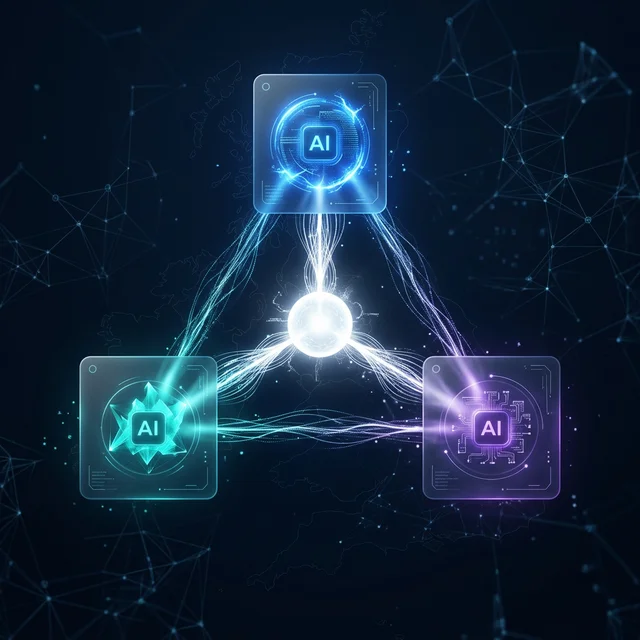
Table of Contents
There's a shift happening in how UK engineering teams think about AI. Not a subtle drift - a decisive architectural break from the past three years.
The monolithic AI assistant is dead. Or at least it should be, if your team has tried to push one into production for anything genuinely complex.
Here's what actually happens when you give a single large language model a sprawling enterprise workflow: it hits context limits, loses track of early instructions, tries to be five different things simultaneously, and produces output that's mediocre at each of them. There's no internal quality control. No second opinion. No mechanism to catch a cascading error before it executes a tool call against your live database.
The solution that UK engineering teams are deploying in 2026 is multi-agent orchestration - and the framework you choose to build it will define your AI architecture for years.
TopTenAIAgents.co.uk has analysed the three dominant open-source Python frameworks - LangGraph, CrewAI, and Microsoft AutoGen - alongside the emerging OpenAI Agents SDK, specifically through the lens of UK enterprise requirements, GDPR accountability, and the Data Use and Access Act 2025.
Why Single Agents Fail at Scale
Before getting into framework comparisons, it's worth understanding why the single-agent model collapses under real enterprise workloads.
The problems are structural, not solvable by throwing a better prompt at them.
Context window degradation. A single LLM managing research, tool execution, data synthesis, compliance checking, and output formatting across a long workflow will start losing sight of its earliest instructions. You've probably seen this yourself. By step eight of a twelve-step process, the model has forgotten constraints you set at step one.
Prompt dilution. When you instruct a single agent to simultaneously act as a researcher, a financial analyst, and a compliance reviewer, you get a confused generalist rather than three competent specialists. The model tries to satisfy conflicting personas, and the result is elevated hallucination rates and shallow reasoning across all three.
No internal quality gate. There's nobody checking the single agent's work. No adversarial node. No independent critic. If the first inference is wrong, everything downstream is built on sand.
The numbers back this up. In 2026 testing on complex financial reconciliation tasks, adversarial multi-agent architectures (where a planner agent and a critic agent operate with opposing incentives) achieved a 92.1% success rate. Single-agent systems on the same tasks hit 60%. That gap is the business case for multi-agent in one statistic.
The scale of adoption is accelerating. A 2026 Salesforce connectivity report found that 94% of UK IT leaders now agree that AI agent success depends entirely on seamless data integration across the IT estate. Gartner predicts that by 2028, a third of user experiences will have shifted to agentic front ends. And research from the National Bureau of Economic Research surveying UK and global executives found that 89% of firms treating AI as a "copilot" reported zero measurable productivity change - while organisations deploying coordinated autonomous agent systems were saving millions in operational costs.
The inflection point has passed. The question now is which framework you build on.
The Three Dominant Frameworks

Power up with Lindy
"Lindy handles the admin while you handle the vision. It's like having a clone, but more efficient."
LangGraph: For Teams Who Need Absolute Control
LangGraph is built around a simple but powerful idea: model your agentic workflow as a directed graph with explicit, typed state. Every node is a Python function or LLM agent. Every edge is a routing decision. Every state transition is logged.
This sounds abstract. It becomes concrete quickly when you realise what it gives you in practice.
Because the execution flow is defined explicitly as a graph, you can force the system down exact paths. Conditional edges evaluate the current state and route to specific nodes based on programmatic logic - not LLM guesswork. You can isolate failures to specific nodes. You can see exactly where in the workflow something went wrong.
The checkpointing capability is what makes LangGraph particularly compelling for UK regulated industries. Every state transition is automatically persisted to a database backend - PostgreSQL or Redis in typical deployments. If an API rate limit crashes your workflow at node seven of twelve, the graph resumes from node seven. Not from scratch. This has obvious cost implications at enterprise scale: you're not paying for repeated inference calls over work the system already completed.
Time-travel debugging is genuinely useful once you've used it. You can rewind a graph's execution to a specific state checkpoint, modify a variable or prompt, and fork the execution to test alternative outcomes. For teams debugging complex multi-step workflows, this is invaluable.
And for UK compliance specifically - this is the framework's strongest card. The Data Use and Access Act 2025 imposes strict requirements on automated decision-making that produces legal or significant effects on individuals. LangGraph has native interrupt functionality: the graph pauses execution, persists state, and waits for human review before proceeding. This explicitly satisfies the meaningful human control requirements that the ICO and UK AI assurance guidelines mandate for regulated workflows.
The trade-off is significant. LangGraph requires a solid understanding of graph theory, typed schemas, and asynchronous Python. A simple two-agent handoff involves substantially more boilerplate than the equivalent in CrewAI. For teams without experienced Python engineers, the initial investment is high.
LangGraph Cloud Pricing (2026)
| Tier | Cost | Traces | Seats | Best For |
|---|---|---|---|---|
| Developer (Free) | 100,000 nodes/month | 10,000/month | 1 | Solo prototyping |
| Plus | $0.001 per node | From $0.50/1k traces | 1 + $39/seat/month | Engineering teams |
| Enterprise | Custom | Custom | Unlimited | UK regulated organisations |
LangGraph Studio moved out of beta in 2026, giving teams a visual IDE for debugging and interacting with running graphs. For complex enterprise deployments, this matters more than it might initially sound.
CrewAI: For Teams Who Need to Ship Fast
CrewAI abstracts away graph theory entirely. Instead of nodes and edges, you define a crew of agents using a sociological metaphor that maps cleanly onto how businesses already think about work: roles, goals, tasks, and teams.
You define an Agent with a role, a goal, and a backstory. You define Tasks with descriptions and expected outputs. You bundle them into a Crew and pick a process model - sequential for linear pipelines, hierarchical for workflows that need an autonomous manager delegating to specialists.
The result is that a competent full-stack developer can have a working multi-agent prototype running in under twenty lines of Python. No graph theory required. The role-based metaphor means that product managers and operations leads can meaningfully contribute to system design in a way that LangGraph's state schemas don't really allow.
A UK marketing agency case from early 2026 illustrates the practical value: a CrewAI system deployed a senior researcher agent to scrape UK-specific search data, a writer agent to draft copy, and a critic agent enforcing UK spelling and factual accuracy. Human editorial time dropped by over 60%. The engineering team that built it wasn't a specialist AI team - they were full-stack developers who'd never touched LangGraph.
UK accountancy firms are running similar setups: agents querying Companies House autonomously, extracting risk clauses from contracts, generating consolidated risk reports. Tasks that previously consumed hours of paralegal time now complete in minutes.
The 2026 introduction of CrewAI Flows addressed the framework's most significant historical weakness. Previously, CrewAI lacked proper persistent checkpointing - if a long-running hierarchical process failed at the final step, you re-ran the entire crew, burning through your token budget. Flows provide structured, event-driven orchestration with state management outside of pure autonomous agent collaboration. By 2026, CrewAI Flows were powering over twelve million daily executions across enterprise environments.
CrewAI Enterprise Pricing (2026)
| Plan | Monthly | Executions | Deployed Crews | Support |
|---|---|---|---|---|
| Basic | $99 | 100 | 2 | Community |
| Standard | $500 | 1,000 | 2 | Associate |
| Pro | $1,000 | 2,000 | 5 | Senior |
| Enterprise | Custom | 10,000+ | 10+ | Dedicated |
Where CrewAI still trails LangGraph is in fine-grained control. Agent-to-agent communication is mediated through task outputs rather than direct dynamic messaging, which limits flexibility for highly unstructured conversational workflows. For tightly regulated UK industries where audit trails and deterministic routing are mandatory, CrewAI's abstraction layer becomes a liability rather than an asset.
AutoGen (AG2): For Microsoft-Embedded Enterprises
Microsoft's AutoGen, substantially rewritten and rebranded as AG2 in its version 0.4 release, takes a fundamentally different approach again. Rather than graphs or crews, AutoGen treats multi-agent orchestration as a conversation problem.
Agents are defined as ConversableAgent instances. They operate within shared group chats, take turns responding based on selector logic (deterministic, LLM-driven, or custom-coded), and solve problems by talking to each other over multiple rounds. The v0.4 rewrite moved to an event-driven, async-first core - a significant improvement for scalable distributed deployments.
AutoGen's strengths are niche but genuinely powerful within that niche.
For code generation and debugging, the framework is excellent. Agents can write Python scripts, spawn Docker containers, execute code, review errors, and rewrite until tests pass - all autonomously. The conversational approach means agents naturally challenge each other's outputs, making adversarial code review a native pattern.
For UK enterprises embedded in the Microsoft stack, the integration story is the strongest of any framework. Native support for Azure OpenAI, Azure UK South and UK West regions (satisfying data residency requirements for public sector contracts), Active Directory, and .NET/C# alongside Python makes AutoGen the lowest-friction choice for organisations where procurement, security, and deployment all run through existing Azure enterprise agreements.
The 2026 updates added OpenTelemetry support for standardised observability and introduced Magentic-One, Microsoft's multi-agent assistant for complex proactive tasks.
The problems are real though. The conversational model creates significant token bloat at scale. A four-agent group chat running five rounds produces at least twenty inference calls, each containing the full accumulated conversation history. For high-volume production use cases, the cost and latency implications are serious. The v0.2 to v0.4 migration also broke existing integrations, leaving early enterprise adopters with significant rework.
The Decision Matrix
Right, here's the practical breakdown before we get into compliance specifics:
| Criteria | LangGraph | CrewAI | AutoGen (AG2) |
|---|---|---|---|
| Learning Curve | High | Low | Medium |
| Control Granularity | Very High | Medium | Medium |
| Time to Prototype | Slow | Fast | Medium |
| Microsoft Ecosystem | Neutral | Neutral | Native |
| Human-in-the-Loop | Native (Interrupts) | Manual | Supported |
| Observability | LangSmith (Excellent) | CrewAI Dashboard | Azure Monitor |
| UK Data Residency | Self-hostable | Self-hostable | Azure UK regions |
| Best Use Case | Compliance workflows | Business automation | Enterprise M365 |
The decision guide by business type:
- Regulated sectors (legal, finance, healthcare, public sector): LangGraph. The Data Use and Access Act 2025 demands explicit audit trails and human oversight on automated decisions that affect individuals. LangGraph's architecture provides this natively; the others require workarounds.
- UK SMEs automating business operations: CrewAI. These organisations don't have dedicated AI engineering teams. CrewAI gets them from concept to deployed system in days, not months.
- Large enterprises on Azure/Microsoft 365: AutoGen. Existing Azure enterprise agreements, .NET developer teams, and public sector data residency requirements all point here.
- Startups building MVPs: CrewAI. Lowest barrier to entry, fastest iteration on multi-agent concepts without the boilerplate overhead of LangGraph.
The UK Compliance Stack
Deploying a multi-agent system in the UK in 2026 is simultaneously an engineering and a regulatory challenge. It's worth being direct about this: black-box AI execution is legally unacceptable in regulated UK sectors.
Data Sovereignty and Hosting
The state memory of a running agent frequently contains personally identifiable information, proprietary financial data, or sensitive client context accumulated during task execution. Where this data is stored and processed matters legally.
For organisations requiring total control, both LangGraph and CrewAI are fully open-source Python libraries that can be containerised and deployed on UK-based infrastructure. Common options:
- Hetzner UK: Bare-metal and VPS, competitive pricing, UK data centre - OVHcloud London: Well-established, strong compliance documentation - AWS eu-west-2 (London): Managed infrastructure with full UK data residency guarantees
In this self-hosted configuration, intermediate agent reasoning logs, state variables, and tool call outputs never cross international borders - satisfying the data localisation requirements that UK GDPR and the Data Act 2025 impose on personal data processing.
For AutoGen, the native path is deployment into Azure UK South or UK West. This satisfies public sector procurement guidelines while providing enterprise-grade networking and security controls.
Observability and Audit Trails
If an AI agent autonomously flags a user for fraud, rejects a credit application, or executes a financial transaction without human intervention, your organisation remains the legal data controller. You must be able to explain the exact reasoning, data inputs, and decision logic at every step.
This isn't optional. It's a core accountability requirement under UK GDPR and the Data Act 2025.
For LangGraph deployments, LangSmith is the gold standard tool here. It records the exact prompt, model response, system latency, and state transition at every node. LangSmith Self-Hosted (v0.13) reached feature parity with the cloud version in 2026, adding role-based access controls and autoscaling for high-throughput environments. UK public sector and regulated financial institutions typically use this self-hosted option so that tracing data remains within their own infrastructure.
For framework-agnostic observability, AgentOps has emerged as a critical compliance tool in 2026. It logs decision tracking, tool call inputs and outputs, and complete multi-agent interaction chains - capturing the full chain of thought across the agent network. AgentOps session replays let compliance officers trace exactly why an agent took a specific action at a specific moment, which is precisely what the ICO requires for demonstrating accountability.
Quick checklist for UK compliance readiness before production deployment:
1. Self-host agent state storage within UK jurisdiction 2. Implement read-only agent permissions initially - no write/delete without human approval 3. Configure comprehensive tracing (LangSmith for LangGraph; AgentOps for any framework) 4. Document every automated decision pathway for ICO audit readiness 5. Implement LangGraph interrupt nodes (or equivalent) at all points where decisions have legal effect 6. Define clear data minimisation policies - agents should request only the specific data needed for each task
The Data Use and Access Act 2025: What Changes
The DUAA 2025 reformed the Article 22 framework for automated decision-making (ADM). The blanket general prohibition on automated decisions with legal or significant effects has been replaced with a more nuanced framework - more permissive in some respects, but with mandatory safeguards.
Three non-negotiable requirements for any UK business using AI agents for decisions that affect individuals:
- Proactive disclosure: Inform individuals that automated decision-making is in use - Challenge mechanism: Provide a clear route for individuals to contest automated decisions - Human review: Guarantee "meaningful human intervention" is available and accessible
For multi-agent systems, this maps directly to LangGraph's interrupt functionality - the ability to pause execution, persist state, and require human sign-off before proceeding. Building this into your architecture from day one is far cheaper than retrofitting it post-deployment.
The Fourth Option: OpenAI Agents SDK
It would be incomplete to cover this space without addressing the OpenAI Agents SDK, which matured significantly in 2026.
Built from the open-source "Swarm" experiment, the SDK takes a deliberately minimal approach. Rather than complex graphs or crews, agents are defined as tools that other agents can call. When one agent hits the edge of its capability, it executes a standard function call handing context to a more specialised agent. No state schemas, no role backstories, no group chats.
The developer experience is clean. Python-first, built-in guardrails, automatic schema generation for tools. In 2026 benchmarks, the SDK reached near-parity with LangGraph on token efficiency for complex workflows, avoiding the token bloat problems that affect AutoGen. The native routing to OpenAI's Operator models, enabling agents to take over browser GUIs autonomously, is a genuinely interesting capability.
But here's the problem for UK enterprise architecture.
LangGraph, CrewAI, and AutoGen are all model-agnostic. You can swap an OpenAI inference node for a locally hosted Llama 3 model, an Anthropic Claude instance, or a Mistral deployment - instantly, for cost, performance, or data privacy reasons. The OpenAI Agents SDK binds you exclusively to OpenAI's API ecosystem.
OpenAI did expand data residency in late 2025 and 2026, introducing at-rest storage in the UK and Europe for API and Enterprise customers. For basic residency requirements, this helps. But processing remains on OpenAI's managed infrastructure. For UK organisations where full data sovereignty - including model weights and inference execution - must remain under organisational control, the open-source frameworks are the only viable path.
The honest assessment: OpenAI Agents SDK is a strong tool for startups already embedded in the OpenAI ecosystem who want to move fast without framework complexity. For long-term enterprise architecture in regulated UK industries, the vendor lock-in risk is substantial.
Looking for the Best AI Agents for Your Business?
Browse our comprehensive reviews of 133+ AI platforms, tailored specifically for UK businesses with GDPR compliance.
Explore AI Agent ReviewsNeed Expert AI Consulting?
Our team at Hello Leads specialises in AI implementation for UK businesses. Let us help you choose and deploy the right AI agents.
Key Takeaways
- Multi-agent systems outperform single agents by a significant margin on complex tasks - 92.1% vs 60% success rates on financial reconciliation benchmarks - because specialisation, parallel execution, and adversarial quality gates solve structural LLM limitations
- LangGraph is the definitive choice for UK regulated sectors (finance, legal, healthcare, public sector) because its native interrupt functionality, state checkpointing, and LangSmith audit trails directly satisfy Data Act 2025 automated decision-making safeguards
- CrewAI's role-based metaphor enables UK SMEs without dedicated AI engineering teams to deploy working multi-agent systems in days rather than months, making it the highest-leverage choice for business process automation
- AutoGen (AG2) offers the lowest-friction path for large UK enterprises on Azure, with native UK South/West data residency and .NET support - but token costs at scale require careful architecture
- The OpenAI Agents SDK is competitive on performance but introduces severe vendor lock-in that creates material risk for UK enterprise AI architecture built for long-term sovereignty
- UK GDPR and the Data Act 2025 require explicit audit trails, human-in-the-loop mechanisms, and transparent reasoning for automated decisions with legal effect - compliance readiness should drive framework selection before capability comparisons
- Self-hosting on UK infrastructure (Hetzner UK, OVHcloud London, AWS eu-west-2) keeps agent state data within UK jurisdiction; LangSmith Self-Hosted v0.13 and AgentOps provide the observability stack needed for ICO accountability requirements
- The "89% productivity improvement trap" is real - organisations treating AI as a copilot tool report near-zero productivity gains; those deploying coordinated multi-agent systems with structured workflows achieve exponential operational improvements

TTAI.uk Team
AI Research & Analysis Experts
Our team of AI specialists rigorously tests and evaluates AI agent platforms to provide UK businesses with unbiased, practical guidance for digital transformation and automation.
Stay Updated on AI Trends
Join 10,000+ UK business leaders receiving weekly insights on AI agents, automation, and digital transformation.
Related Articles
What is MCP? The Model Context Protocol Explained
Connecting AI agents to live business data with GDPR compliance
n8n vs Zapier vs Make: The 2026 Automation Showdown
Choosing the right automation platform for multi-agent workflows
UK Data Act 2025: AI Automation Survival Guide
Automated decision-making compliance for UK businesses
Agentic AI 2026: The Complete Guide for UK Businesses
Understanding autonomous AI agents and enterprise deployment
📚 Explore More Resources
Recommended Tools
Lindy
"The personal assistant that actually listens."
$59/month
7-day trial
Affiliate Disclosure

Reclaim.ai
"Take back your calendar. Save 26% with NEWYEAR26."
$13/month
Save 26% with code NEWYEAR26
Affiliate Disclosure
Ready to Transform Your Business with AI?
Discover the perfect AI agent for your UK business. Compare features, pricing, and real user reviews.