
The UK's AI Kill Switch: Protecting Digital Sovereignty from US Tech Reliance
TL;DR: The "Special Relationship" won't save your server stack. UK businesses are sleepwalking into a "Cognitive Sovereignty Paradox" by relying on US-hosted AI "API Wrappers". With 95% of critical banking capability dependent on foreign hyperscalers, the risk of a "Digital Kill Switch" via sanctions, the Cloud Act, or Defense Production Act is real. This guide explores the "Sovereign Stack" solutions—from Locai Labs to Civo—that offer a roadmap to digital independence.
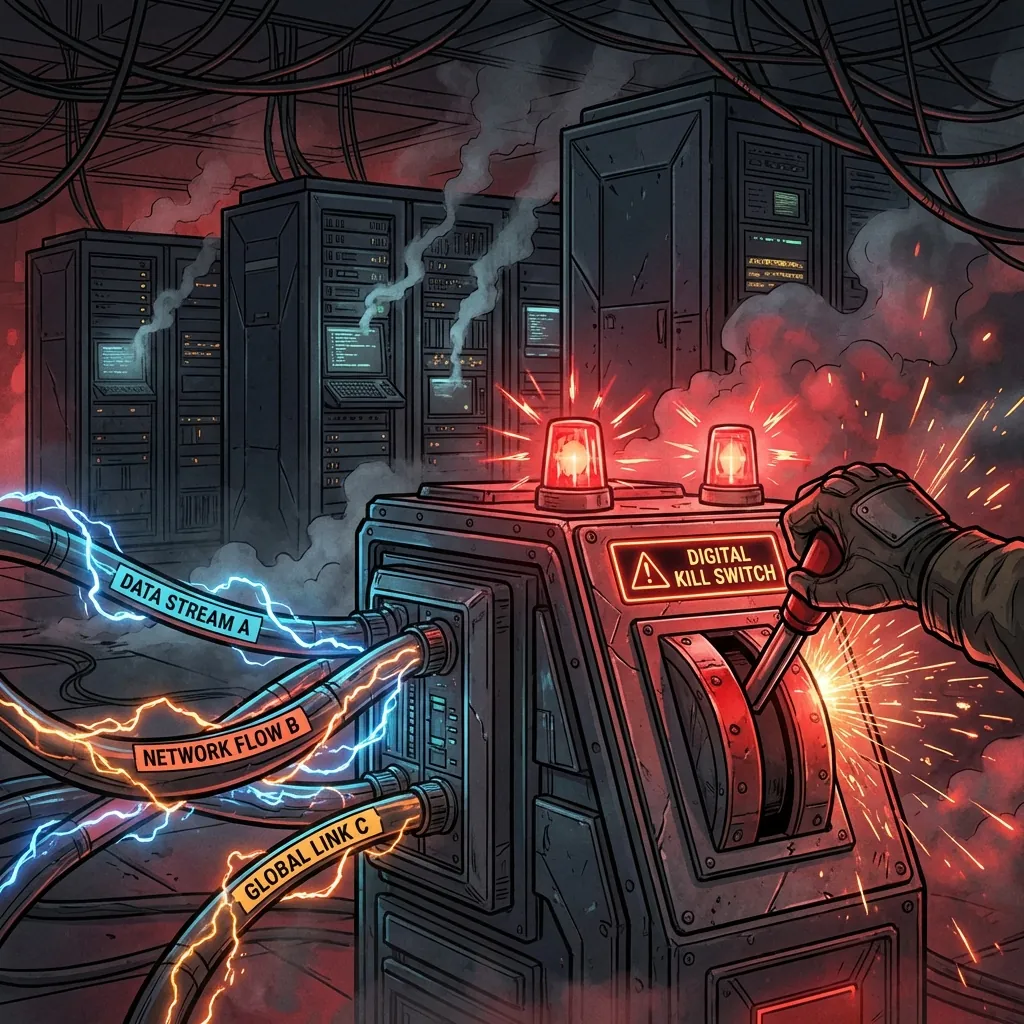
Table of Contents
1. The Dependency Paradox and the "Wrapper" Vulnerability
The current trajectory of AI adoption in the UK is defined by the proliferation of "wrappers." A significant proportion of "British AI" startups and enterprise applications are, in architectural terms, thin user interfaces that sanitize inputs and transmit them via API (Application Programming Interface) to model weights hosted on US servers—primarily those of OpenAI (Microsoft Azure), Google (GCP), or Anthropic (AWS).
In this architecture, the UK entity possesses neither the intelligence nor the infrastructure. They possess only the customer relationship and the prompt engineering. This creates an existential vulnerability: the API Revocation. If the model provider revokes the API key—due to a violation of acceptable use policies, a failure to pay, or a government directive—the UK application does not merely degrade; it ceases to function instantly. The "intelligence" is rented, not owned.
The Scale of the Problem
of UK Banking fraud detection relies on US-hosted GPU inference.
UK protection against US CLOUD Act data seizures for Azure/AWS users.
Most UK AI startups are "Wrappers" that fail instantly if API keys are revoked.
2. Defining the Kill Switch: Technical, Legal, and Commercial
The "kill switch" manifests in three distinct forms, each requiring a different mitigation strategy.
2.1 The Technical Kill Switch
- API Denial: The revocation of access credentials. It is instantaneous and total.
- "Call Home" Licensing: Many enterprise software platforms, even those installed on-premise, utilize "node-locked" licensing that requires the server to ping a central licensing authority periodically. If this handshake fails, the software locks itself.
- Cloud Control Planes: Hybrid cloud setups often manage on-premise servers via a cloud-based console. If the cloud connection is severed, the local hardware may become unmanageable.
2.2 The Legal Kill Switch
- The US CLOUD Act: Enacted in 2018, this allows US law enforcement to compel US-based technology companies to provide data stored on their servers, regardless of whether the data is physically located within the US or on foreign soil. For a UK business using AWS London or Azure UK South, data sovereignty is a legal fiction in the face of a US warrant.
- The Foreign Direct Product Rule (FDPR): This export control rule allows the US to assert jurisdiction over any product manufactured using US technology or software. This has been weaponized to cut off China's access to semiconductors. In a scenario of transatlantic divergence, the FDPR could theoretically be applied to restrict UK access to AI models or hardware trained with US chips.
2.3 The Commercial Kill Switch
- Regulatory Geofencing: A precedent was set in 2024/2025 when Meta withheld its Llama 3.2 multimodal models from the European Union due to regulatory conflicts regarding the GDPR and the EU AI Act. While the UK is post-Brexit, regulatory alignment with the EU or divergence from the US could trigger similar exclusions.
- Acquisition and Sunset: The acquisition of UK technology firms by foreign entities introduces the risk that strategic priorities will shift, potentially deprioritizing UK sovereign requirements in favor of global commercial goals.
UK AI Infrastructure Dependency Trajectory
While US dependency (Red) has peaked at 95%, the target for Sovereign Capability (Green) aims to reverse this trend through strategic investment in UK platforms.
3. The Model Layer: Sovereign Intelligence
The first line of defence against a kill switch is the ownership and possession of the intelligence itself. If a business possesses the model weights on its own hard drives, the model cannot be remotely deactivated. Here are the UK's leading sovereign model providers: For more on this, see our guide on Digital Sovereignty - AI Insights for UK Business.
Locai Labs
Model LayerThe UK's answer to GPT. Locai L1-Large is an open-weights model designed for self-hosted, offline dominance. Includes proprietary "Forget-Me-Not" technology for self-improvement without cloud retraining.
✓ Ranks #1 on Arena Hard v2
✓ UK-aligned safety guardrails
✓ Full air-gapped capability
Stability AI
Open WeightsLondon-headquartered, globally recognized for Stable Diffusion and open-model ecosystem. Provides perpetual access to model weights for sovereign deployment.
✓ Stable Diffusion 3.5
✓ Stable LM & Code
✓ On-premise media generation
Stanhope AI
Active InferenceRevolutionary Active Inference models based on the Free Energy Principle. Designed for edge-native autonomy—drones, robots, CNI—with real-time learning.
✓ Edge-first architecture
✓ Training-free adaptation
✓ Inherent kill-switch immunity
4. The Platform Layer: Air-Gapped Orchestration
While the model provides the raw intelligence, the Platform Layer provides the operating system, security, and integration required to make that intelligence useful in disconnected environments.
4.1 Faculty: The Government's Trusted Partner
Faculty is deeply embedded within the UK government, Ministry of Defence, and NHS. Their flagship platform, Faculty Frontier, is explicitly architected to support disconnected or air-gapped environments—a prerequisite for their high-security defence work. For more on this, see our guide on Articles by SME Tech Advisor Team | AI Insights Blog.
- Model Agnosticism: Allows users to host and orchestrate various open-source models (Llama, Mistral, Falcon). If a specific model becomes legally restricted, the user can swap it for another without disrupting business logic.
- Decision Intelligence: Embeds AI into operational logic (e.g., hospital bed management, supply chain routing) rather than standalone chatbots.
4.2 Quantexa: Contextual Intelligence in Disconnected Environments
Quantexa is a UK unicorn specializing in Decision Intelligence using Entity Resolution. The platform is designed to "bring the AI to the data"—critical for banks and intelligence agencies holding sensitive data that cannot leave their perimeter.
- On-Premise DNA: Native to on-premise and private cloud deployments. Does not require SaaS connection to function.
- Q Assist: Architected to facilitate the integration of local LLMs, ensuring no information leaks to external APIs.
4.3 Oxford Dynamics & Helsing: Defence-Grade Resilience
Oxford Dynamics (backed by BAE Systems) and Helsing UK represent the extreme end of the resilience spectrum. Both focus on AI for the "modern battlespace" and are built for fully offline operation.
- AVIS Platform (Oxford Dynamics): Processes multi-sensor data in real-time within military vehicles or command posts, designed to operate when communication links are severed.
- Helsing Edge Processing: Centers on processing data at the edge—on sensors, drones, or jets. Committed £350 million to UK operations and developing "Resilience Factories" to rapidly produce software-defined hardware.
5. The Infrastructure Layer: Sovereign Cloud and Metal
Even with a sovereign model and platform, if the servers running them are controlled by a US hyperscaler, the kill switch risk remains. Here are UK-aligned infrastructure providers offering true sovereignty.
Civo FlexCore
Infrastructure LayerThe "silver bullet" for the kill switch scenario. FlexCore is a hardware-software appliance—a "private cloud in a box" that can be installed in your own data center. Explicitly supports air-gapped environments. For more on this, see our guide on Sovereign AI: Why Local LLMs Are the Future for UK Business Data.
✓ UK legal jurisdiction
✓ Full Kubernetes support
✓ GPU passthrough for AI
OVHcloud
European SovereigntyFrench-origin, primary European alternative to US hyperscalers with massive UK presence. Builds its own water-cooled servers and operates its own fiber network. Data immune to extraterritorial laws.
✓ Vertical integration
✓ Managed AI services
✓ Sovereign training capability
6. The Hardware Layer: Silicon Independence
The deepest layer of the kill switch is the hardware itself. If the US government restricts the export of GPUs or if firmware contains remote disable functions, software sovereignty is rendered moot. For more on this, see our guide on Sme Finance Tech Team.
6.1 Graphcore: The IPU Alternative
Graphcore (Bristol-based) developed the Intelligence Processing Unit (IPU), a distinct architecture from Nvidia's GPU. The IPU uses its own software stack (Poplar), decoupling users from the Nvidia CUDA ecosystem lock-in. While acquired by SoftBank in 2024, Graphcore remains the most viable non-Nvidia option for high-performance AI training available to UK buyers.
6.2 Pragmatic Semiconductor: Domestic Fabrication
Pragmatic Semiconductor manufactures chips in the UK at Pragmatic Park in Durham. While their FlexICs are designed for item-level intelligence (smart packaging, sensors) rather than training LLMs, in a scenario of total global blockade, Pragmatic is one of the few entities that could continue to produce logic chips in the UK.
7. Strategic Implementation: Building the Resilient Enterprise
For UK businesses, avoiding the kill switch requires a deliberate architectural shift away from "wrapping" US APIs.
The "Sovereign Stack" Architecture
| Layer | Sovereign / Resilient Solution | Vulnerable / Kill-Switch Prone |
|---|---|---|
| Model | Locai L1, Stability AI, Stanhope AI (Self-Hosted) | GPT-4, Claude, Gemini (via API) |
| Orchestration | Faculty Frontier, Quantexa, CivoStack | OpenAI Assistants API, Azure AI Studio |
| Inference Engine | vLLM, Ollama, TensorRT-LLM (Local) | Proprietary Cloud Inference Endpoints |
| Infrastructure | Civo FlexCore, OVHcloud, Hypertec | AWS, Azure, Google Cloud |
| Hardware | Graphcore IPU, Nvidia (Purchased & Air-gapped) | Cloud-rented H100s |
Procurement Strategies for Kill Switch Immunity
- Contractual Rights: Negotiate for the delivery of model weights and container images, not just API access. Ensure contracts include "survival clauses" that allow continued use in the event of vendor insolvency or sanctions.
- Infrastructure Diversity: Don't rely solely on one cloud provider. Implement a hybrid cloud strategy where critical AI workloads can failover to on-premise hardware (e.g., Civo FlexCore) or a sovereign cloud (OVHcloud).
- Data Gravity: Ensure that data used to fine-tune models resides in the UK. Use platforms like Quantexa or Faculty that bring the model to the data, rather than sending data to the model.
Need Help Building Your Sovereign Stack?
Our partners at Hello Leads can perform a full "Sovereignty Audit" of your current AI infrastructure and design a resilient migration path.
Request Sovereignty Audit8. Conclusion
The "kill switch" risk for UK business is real, growing, and largely ignored in the rush to adopt generative AI. The overwhelming majority of UK AI adoption is built on the unstable foundation of US-controlled APIs, leaving the economy vulnerable to extraterritorial law, geopolitical shifts, and commercial de-platforming.
However, a viable, high-performance alternative ecosystem exists. The UK possesses a unique combination of sovereign model builders (Locai, Stability), deep-tech orchestrators (Faculty, Quantexa), sovereign cloud innovators (Civo), and silicon designers (Graphcore, Pragmatic).
By combining these components into a cohesive "Sovereign Stack," UK businesses can construct AI systems that are immune to external disconnection. This requires a shift in mindset from "AI as a Service" to "AI as an Asset."
Key Takeaways
- 95% of UK AI workloads are vulnerable to US "Kill Switches" via API revocation, CLOUD Act, or DPA orders.
- API Wrappers are convenient but offer zero operational sovereignty—they fail instantly when access is revoked.
- The UK has a complete "Sovereign Stack" ecosystem: Locai Labs (models), Faculty & Quantexa (platforms), Civo & OVHcloud (infrastructure), and Graphcore (hardware).
- Start with a Hybrid Fallback strategy before full sovereign migration—maintain US APIs but configure local open-weight models as automatic failovers.
- Resilience comes at a premium: CapEx (buying hardware and licenses) vs OpEx (renting AI via API). For CNI, Defence, and Finance, this cost is insurance against existential operational risk.
Ready to Sovereign-Proof Your Business?
Don't wait for the connection to be cut. Start building your resilient AI stack today.