
AI for UK Energy and Utilities 2026: Dynamic Grid Planning, Net Zero Compliance, and Smart Infrastructure
Quick Summary
The UK electricity grid faces an unprecedented engineering crisis in 2026: clean sources now supply 64% of Great Britain's electricity, but achieving the 'Clean Power 2030' target of 95% requires £40 billion in annual capital investment while simultaneously managing the highly localised, unpredictable demand spikes generated by the Zero Emission Vehicle mandate and aggressive heat pump adoption - a level of grid volatility that has rendered traditional deterministic multi-year planning models, which assumed steady unidirectional power flows, completely obsolete, with the 'duck curve' phenomenon now creating daily midday renewable oversupply events followed by steep evening demand ramps that risk frequency collapse without real-time automated intervention.
UK Distribution Network Operators are deploying proven AI solutions at scale: UK Power Networks, working with Open Climate Fix, uses machine learning to map 'invisible' unmetered rooftop solar generation at primary substation level; SP Energy Networks' Project FUSION processed 446 automated FlexRequests through a USEF-compliant AI flexibility market with 93% aggregator response rates, successfully deferring multi-million-pound physical reinforcement costs; Electricity North West developed ML models of 25 real LV networks to predict headroom before constraints become failures; and Habitat Energy's AI trading platform manages over 500MW of Battery Energy Storage for Gresham House, delivering 15-25% revenue uplifts through simultaneous stacked dispatch across Dynamic Containment, balancing mechanisms, and wholesale arbitrage.
Energy firms have three converging compliance deadlines that AI directly addresses: TCFD emissions reporting is mandatory now for large UK energy companies; FCA UK Sustainability Reporting Standards S2 becomes mandatory for listed entities from January 2027, including Scope 3 value chain emissions tracked by AI platforms like Seedling, Watershed, and Persefoni; and Ofgem's £450 million Strategic Innovation Fund offers Discovery grants up to £150,000 and Alpha grants up to £500,000, with Cycle 6 applications opening May 26, 2026 - providing the funding mechanism for utilities to deploy the AI infrastructure required to manage duck curve volatility, offshore wind predictive maintenance, V2G orchestration, and regulatory compliance simultaneously.
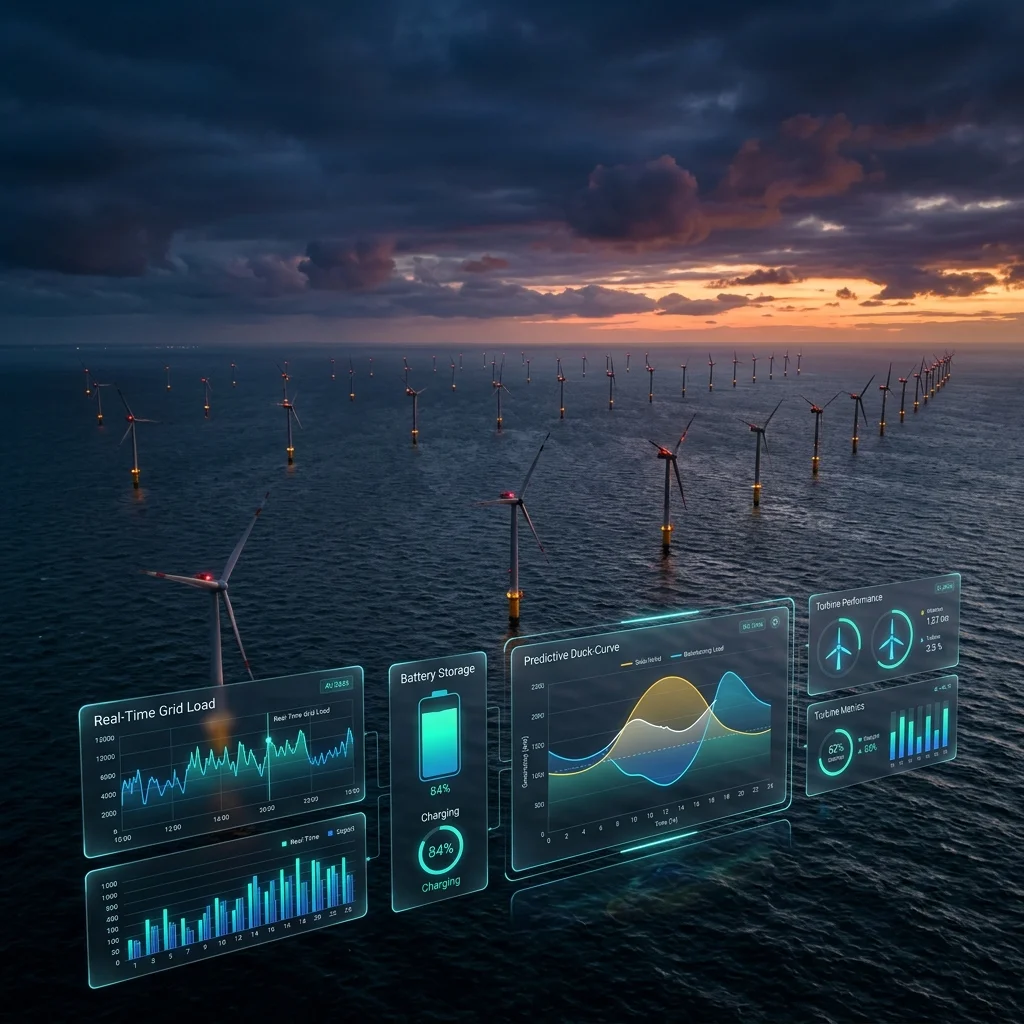
Table of Contents
The United Kingdom's electricity grid is undergoing the most profound engineering transformation in its 100-year history. Driven by the government's 'Clean Power 2030' mission, the simultaneous electrification of transport and heating, and the mass proliferation of distributed rooftop solar, the fundamental physics of how power flows across British networks has permanently shifted. As of early 2026, clean sources account for approximately 64% of Great Britain's electricity generation - but reaching the 95% target mandated by 2030 requires deploying artificial intelligence not as an efficiency upgrade, but as the primary orchestration layer holding the grid together.
For UK Distribution Network Operators (DNOs), energy retailers, battery storage investors, and Sustainability Directors navigating the compounding pressures of Ofgem's RIIO-ED2 obligations, mandatory TCFD emissions reporting, and the Zero Emission Vehicle mandate, AI has transitioned from experimental technology to core operational infrastructure. This guide examines the specific use cases, UK case studies, regulatory timelines, and vendor landscape that define the energy sector's AI imperative in 2026.
The Clean Power 2030 Mandate and Why Static Planning Has Collapsed
The Scale of the Decarbonisation Challenge
The 'Clean Power 2030' mission is not merely an aspirational sustainability target. It is a sweeping legislative mandate requiring the carbon intensity of UK electricity generation to drop from a 2023 baseline of 171g of CO2 equivalent per kWh to below 50g by the end of the decade. The National Energy System Operator (NESO) estimates this transition demands approximately £40 billion in annual capital investment across the remainder of the decade, with total expected generation needing to rise to 353 TWh to accommodate the electrification of both the transport and heating sectors.
The concurrent Zero Emission Vehicle mandate - which prohibits the sale of new purely petrol and diesel cars and vans by 2030 - is creating highly localised, asymmetric demand spikes across the low-voltage distribution network. When a residential street shifts from zero EV chargers to eight simultaneous home charging sessions between 18:00 and 22:00, the local substation faces a load profile that bears no resemblance to any historical demand curve. Traditional deterministic forecasting models, which assumed steady, incremental, unidirectional power flows, simply cannot process this degree of volatility.
The Duck Curve Arrives in Great Britain
The widespread deployment of rooftop solar photovoltaics has introduced the 'duck curve' phenomenon - previously observed in California's solar-heavy grid - as a daily operational reality for Great Britain. The duck curve is characterised by a dramatic midday dip in net grid demand (the 'belly') caused by unmetered residential solar generation, followed by a sharp, steep evening ramp as the sun sets and domestic consumption peaks (the 'neck'). Longer, hotter British summers deepen the belly and steepen the neck further.
In grids lacking dynamic intelligence, the consequence is predictable and expensive: midday renewable energy is curtailed and wasted, while carbon-intensive gas peaking plants are emergency-dispatched during the evening ramp to prevent frequency collapse. AI-enabled forecasting is the most effective mechanism currently available for predicting these steep ramps with sufficient advance notice to preemptively orchestrate battery storage assets to smooth the curve - preventing both the curtailment of cheap renewable generation and the costly activation of polluting balancing reserves.
Policy Momentum: The Government Recognises the Data Gap
In a significant admission that AI-driven decarbonisation is constrained by data fragmentation rather than algorithmic capability, the Department for Science, Innovation and Technology (DSIT) and the Department for Energy Security and Net Zero (DESNZ) jointly launched a specific call for evidence on energy datasets for AI applications, closing April 24, 2026. The initiative seeks to identify siloed or commercially restricted datasets whose release could stimulate AI-driven grid optimisation, improve energy affordability, and strengthen national security.
The fundamental problem the government acknowledges is stark: NESO operates with rich, high-resolution transmission-level data, while the distribution network - where the majority of EV and heat pump impact is felt - remains largely invisible to central planning systems. This data poverty at the low-voltage (LV) level prevents the comprehensive, cross-network machine learning model training required for genuinely autonomous grid management.
UK Energy AI Regulatory Timeline
| Year | Regulatory Milestone | Strategic Impact |
|---|---|---|
| 2021-2022 | Smart meter half-hourly settlement mandatory | Created the granular data baseline required to train AI demand forecasting models |
| 2024 | TCFD mandatory for large energy companies | Established AI-automated Scope 1 and 2 emissions tracking as a legal requirement |
| 2025 | Ofgem RIIO-ED2 price control begins | Formalised DNO requirements to demonstrate digital innovation via NIA funding |
| 2026 | Government AI datasets call for evidence closes | Drives policy to mandate open data sharing across currently siloed network operators |
| 2027 | FCA UK SRS S2 mandatory (January 2027) | Forces listed energy entities to automate detailed climate risk and transition reporting |
| 2030 | Clean Power target and ZEV mandate | Peak grid volatility horizon requiring fully autonomous AI-driven network management |
AI for Dynamic Grid Planning at UK Distribution Network Operators


Power up with ClickUp
"Is your team drowning in tabs? ClickUp saves 1 day a week per person. That's a lot of Fridays."
From Passive Network Manager to Active Distribution System Operator
Dynamic grid planning replaces the periodic, spreadsheet-driven load growth estimates that have defined utility engineering for decades with continuous, high-fidelity scenario modelling. According to the Guidehouse Insights framework for 2026, AI-enabled dynamic planning ingests high-velocity signals - granular weather forecasts, real-time EV charging metrics, solar generation estimates, industrial load schedules, and smart meter half-hourly readings - to continuously adapt network models to current conditions.
This shift enables DNOs to transition from passive network managers into active Distribution System Operators (DSOs). Rather than immediately deploying capital into copper wire, physical substation upgrades, and civil engineering works when network constraints are detected, AI algorithms evaluate whether localized flexibility contracts, dynamic voltage reductions, or active network switching can safely defer infrastructure spending while maintaining regulatory safety standards. Guidehouse estimates that embedding AI into DNO workflows scales engineering expertise, reduces cognitive load on an increasingly aged technical workforce, and transforms legacy operators into digital orchestrators.
UK DNO Case Studies: Proven at Scale
UK Power Networks (UKPN) and Open Climate Fix: UKPN is deploying advanced machine learning to resolve one of the most persistent grid management blindspots - 'invisible' rooftop solar generation that is never formally measured by network operators. Through its 'AI for Visibility and Forecasting of Renewable Generation' initiative, developed with specialist AI firm Open Climate Fix (OCF), UKPN employs algorithms that estimate unmetered solar capacity by fusing historical satellite imagery, hyper-local weather data, and primary substation measurements. Previously, thousands of homes generating solar power invisibly skewed demand forecasts and artificially inflated the need for expensive flexibility procurement on sunny days. The AI maps rooftop solar generation without relying exclusively on visual imagery, feeding predictions directly into substation-level forecasting algorithms. Concurrently, under the Envision programme with data specialists CKDelta, UKPN is creating predictive LV demand models that substantially outperform legacy estimation methods.
SP Energy Networks (SPEN) and Project FUSION: SPEN's Project FUSION - now concluded and published as a close-down report - established the first fully USEF-compliant (Universal Smart Energy Framework) flexibility market in Great Britain. Over the multi-year trial, SPEN dispatched localised flexibility to manage severe congestion at the St Andrews and Leuchars primary substations in East Fife. The platform processed 446 automated FlexRequests, with aggregators representing 1.7MW of nominal distributed energy resource (DER) capacity responding with 575 FlexOffers at an average price of £0.59/kWh. Aggregators responded with at least one offer in 93% of cases and delivered 70-86% of ordered flexibility. The trial demonstrated that algorithmically driven constraint management can substitute multi-million-pound physical grid reinforcements - and its architecture now informs live DSO flexibility procurement across Great Britain.
Electricity North West (ENWL) and Low Voltage Network Solutions: ENWL has concentrated on the LV network visibility crisis, historically the 'fit and forget' layer of British infrastructure. Through the Low Voltage Network Solutions project - developed in partnership with the University of Manchester and supported by the Low Carbon Networks Fund - ENWL created comprehensive operational models of 25 real LV networks, incorporating load profiles for solar PV, EVs, and heat pumps. Machine learning algorithms assess this data to optimise voltage within statutory limits, identify hidden operational trends, and predict available network headroom before constraints become physical failures.
AI and Statutory Voltage Management
Dynamic voltage management represents one of the highest-yield AI use cases on the distribution network. UK mains electricity operates at a nominal 230V, governed by statutory limits of +10% / -6% (an operational band of 216.2V to 253.3V). However, network operators are under pressure to harmonise this to a symmetrical +/-10% range, shifting the lower safety floor down to 207V, to accommodate the enormous two-way power flows from domestic solar exports without tripping inverter safety mechanisms.
AI orchestration platforms are critical to enabling this transition safely. The legacy grid was intentionally run 'high' - closer to 240V - to counteract passive voltage drop along lengthy rural feeders. Today, running high risks tripping the protection circuits of domestic solar inverters when they attempt to export power to an already saturated local feeder. By continuously monitoring millions of smart meter endpoints at the grid edge, AI algorithms dynamically depress baseline voltage across the network, continuously adjusting transformer tap changers to ensure end-of-line customers never fall below the 207V safety floor.
UK AI Energy Use Case Impact Matrix
| AI Capability | Legacy Constraint | AI Solution | Measurable ROI |
|---|---|---|---|
| Dynamic Load Forecasting | Deterministic models fail against EV spikes and duck curve volatility | Real-time load balancing using smart meter and hyper-local weather APIs | Significant reduction in balancing mechanism costs and constraint payments |
| DER Flexibility Dispatch | Manual constraint management triggers costly, slow physical reinforcement | Automated AI flexibility auctions via USEF frameworks like Project FUSION | High percentage of capital reinforcement deferral through dynamic management |
| Predictive Maintenance (Wind) | Scheduled maritime inspections cause costly downtime and safety risk | SCADA-driven failure prediction using neural networks for gearboxes and blades | 25-40% reduction in unplanned downtime; £4,000-£15,000 daily savings per turbine |
| BESS Charge Optimisation | Manual dispatch misses rapid intraday market price spikes | AI revenue optimisation across stacked frequency and wholesale trading markets | 15-25% overall revenue uplift over legacy trading methods |
| Scope 3 Emissions Tracking | Manual annual calculation across fragmented supply chain ERP systems | Automated processing via NLP and AI-driven carbon anomaly detection | TCFD and UK SRS S2 compliance accuracy; substantially reduced audit costs |
AI in UK Energy Trading and Wholesale Markets
From Reactive Risk Management to Predictive Portfolio Optimisation
The UK wholesale electricity market is undergoing fundamental structural transformation under the newly independent National Energy System Operator (NESO). AI applications are becoming the foundational intelligence layer for both market operators balancing system frequency and energy trading desks seeking to maximise returns in increasingly volatile Day-Ahead, Intraday, and Balancing Mechanism (BM) markets.
Advanced algorithmic platforms utilise complex weather-to-generation modelling to forecast the minute-by-minute output of wind and solar assets across an operator's portfolio. In parallel, these systems predict system-wide demand spikes and localised network constraints based on social patterns, industrial schedules, and atmospheric data. By integrating these predictive feeds, energy companies can autonomously optimise trading bids across divergent revenue streams simultaneously. An AI agent calculates the optimal financial pathway in milliseconds - deciding whether to dispatch a battery asset into the Day-Ahead market, hold capacity for higher intraday prices, or bid directly into the Balancing Mechanism.
The Shift to Dynamic Frequency Response Products
NESO is actively shifting procurement away from legacy frequency response products like Mandatory Frequency Response (MFR) and Static Firm Frequency Response (SFFR), which trigger at defined frequency deviations and sustain for 30 minutes, towards highly agile real-time Dynamic Response products. AI algorithms process grid frequency signals in milliseconds, dispatching flexible assets - localised battery storage or aggregated commercial EV fleets - to capitalise on sudden frequency deviations that human traders would miss entirely.
For retail energy providers, automating demand response using proprietary AI platforms represents a significant competitive advantage. Forward-thinking retailers use machine learning to dynamically shift residential EV charging schedules or heat pump cycles away from peak-pricing periods into low-carbon, low-cost overnight windows - reducing bills for customers while providing flexible capacity to the network. Processing local smart meter data at the grid edge allows instantaneous reaction to dynamic price signals without the latency, data egress costs, or security vulnerabilities associated with public cloud architectures.
AI for Scope 3 Emissions Tracking and Net Zero Compliance
The Expanding Regulatory Burden
The regulatory obligation on UK energy firms to accurately report their carbon footprint is expanding rapidly. As part of a phased rollout - covering premium listed companies from 2021, large UK-registered companies and LLPs from April 2022, and reaching most large UK energy sector entities by 2024 - companies are now legally mandated to provide public disclosures aligned with the Task Force on Climate-related Financial Disclosures (TCFD). Concurrently, the Streamlined Energy and Carbon Reporting (SECR) framework requires large entities to explicitly disclose energy use, greenhouse gas emissions, and energy efficiency actions. Under SECR, a 'large' entity meets two of three thresholds: at least 250 employees, annual turnover exceeding £36 million, or an annual balance sheet exceeding £18 million. This captures approximately 11,900 companies across the UK, including mid-sized energy retailers, software providers, and infrastructure developers.
The FCA is finalising rules to mandate climate reporting aligned with the UK Sustainability Reporting Standards (UK SRS S2) for accounting periods beginning January 1, 2027. While the initial rollout may apply 'comply and explain' flexibility for the complex Scope 3 requirements, full value-chain emissions visibility is the unavoidable regulatory destination. Listed energy entities will be required to disclose climate-related governance, strategy, and comprehensively identify climate-related risks and opportunities.
Why Manual Spreadsheets Cannot Deliver Compliance
Scope 1 (direct combustion from owned assets) and Scope 2 (purchased electricity) tracking is well-established. Scope 3 - covering everything from the embodied carbon in purchased offshore wind turbines to the downstream emissions of millions of retail energy customers - represents an enormous data challenge that manual spreadsheet aggregation cannot remotely address. The irony noted by compliance specialists is that the AI data centres powering these algorithms themselves consume vast amounts of electricity, increasing Scope 2 emissions for technology vendors serving the energy sector. Managing this paradox requires precise, automated accounting.
AI Carbon Management Platforms
AI platforms specifically designed for carbon management - including Seedling, Watershed, and Persefoni - are rapidly penetrating the UK energy sector. These systems automate Scope 3 tracking by directly ingesting unstructured data from supply chain invoices, internal ERP systems, and external supplier databases. Natural Language Processing (NLP) and machine learning algorithms automatically categorise supplier spend data, mapping millions of micro-transactions to specific greenhouse gas emission factors. This radically reduces the manual labour required to compile SECR and UK SRS disclosures.
Leading enterprise platforms go beyond retrospective auditing to provide proactive 'predictive decarbonisation planning'. They model the financial and carbon impacts of future infrastructure investments, producing Science Based Targets initiative (SBTi) aligned reduction pathways that satisfy both regulatory and investor scrutiny.
AI for UK Renewable Energy Asset Management
Offshore Wind: Predictive Maintenance at Scale
The UK is the global leader in offshore wind, operating over 2,500 turbines supplying approximately 13% of total national power needs as of 2023. Traditional maintenance for these marine assets involves logistically complex, expensive operations using specialist maritime vessels - and a single offshore turbine taken offline for one day can cost operators between £4,000 and £15,000 in lost generation revenue. Industry data indicates that gearbox and drivetrain failures account for 34% of unplanned downtime at an average repair cost of approximately £300,000 (converted from USD industry benchmarks), while blade erosion accounts for a further 23%.
AI-driven predictive maintenance fundamentally alters this dynamic. Machine learning models utilise high-frequency SCADA (Supervisory Control and Data Acquisition) data streams - measuring subtle changes in vibrations, temperatures, wind speed, and electrical output - to feed anomaly-detection algorithms. Neural networks flag imperceptible degradation in gearboxes, main bearings, or blade structures weeks before a catastrophic failure occurs, shifting Operations and Maintenance from reactive emergency response to planned, batched logistics. Advanced AI deployments routinely reduce unplanned outages by up to 60%, lowering average O&M costs from the global industry benchmark of approximately $38/MWh (≈£30/MWh) to significantly more competitive levels.
Asset inspection itself is being automated through deep technology: companies like Beam are deploying Scout, an AI-powered autonomous underwater vehicle (AUV), to conduct subsea inspections of turbine foundations without human divers, dramatically reducing both cost and safety risk.
Wake Steering and Power Optimisation
Beyond maintenance, AI is optimising raw generation through advanced 'wake steering'. Deep tech AI solutions dynamically adjust turbine yaw angles, steering turbulent, low-energy wake away from downwind turbines to maximise the yield of the entire wind farm array. At Dogger Bank - the world's largest offshore wind farm, deploying 277 GE Vernova Haliade-X turbines rated at 13 MW each for a total capacity of 3.6 GW - optimising wake effects across the full array yields continuous, substantial power output improvements across the project's 35-year operational life.
BESS Revenue Optimisation: The Gresham House Case Study
Battery Energy Storage Systems (BESS) are the critical physical infrastructure required to manage duck curve volatility. AI algorithms are fundamental to optimising the complex charge and discharge cycles of these multi-million-pound assets. Habitat Energy's AI platform currently manages over 500MW of BESS assets for the Gresham House Energy Storage Fund (GRID), the UK's leading utility-scale battery investor.
By processing wholesale pricing, localised frequency data, and grid constraint signals in real time, Habitat Energy's autonomous trading software executes millions of micro-trades - simultaneously bidding battery capacity into Dynamic Containment, balancing mechanisms, or wholesale arbitrage markets to maximise revenue across all available stacked income streams. As of late 2025, Gresham House reported a 7.4% quarter-on-quarter increase in Net Asset Value (NAV) reaching £658.3 million, a surge explicitly driven by improved third-party revenue forecasts and optimised algorithmic dispatch. Intelligent AI dispatch ensures BESS assets balance financial yield against the physical degradation of lithium-ion cells, extending asset lifespan while securing 15-25% revenue uplifts over manual trading approaches.
Vehicle-to-Grid Orchestration: Transport Meets Energy
The convergence of the transport and energy sectors has created a new frontier for AI orchestration. By 2026, Vehicle-to-Grid (V2G) technology has evolved beyond isolated pilot programmes into software-defined energy management platforms. Orchestration systems such as WeaveGrid and Nuvve aggregate thousands of individual EVs into functional Virtual Power Plants (VPPs) capable of trading power in real time. WeaveGrid's DISCO (Distribution-Integrated System Capacity Orchestration) sends individualised charge and discharge signals to home EV chargers, actively aligning localised charging loads with physical distribution transformer limits - enabling utilities to utilise the distributed capacity of vehicle batteries for rapid balancing services without overloading vulnerable local circuits. Programmes backed by BMW/E.ON and Octopus Energy/Ford demonstrate that consumer-level grid orchestration is entering mass commercialisation.
Implementation Blueprint for UK Energy Firms
AI Readiness Assessment for DNOs
| Readiness Level | Data Connectivity | AI Capability | Flexibility Participation | Emissions Tracking |
|---|---|---|---|---|
| Level 1 (Starter) | Siloed OT/IT; quarterly manual meter reads | Excel-based spreadsheet forecasting | No active flexibility market participation | Annual Scope 1/2 calculations for statutory minimums |
| Level 2 (Developing) | Centralised historian; half-hourly smart meter APIs integrated with SCADA | Isolated ML demand forecasting on specific network nodes | Manual dispatch of contracted flex assets via phone or email | Scope 1/2/3 tracking with third-party software assistance |
| Level 3 (Advanced) | Fully converged OT/IT; real-time DER, AMI, and wholesale market data streams | Fully autonomous network management combining ADMS and DERMS for closed-loop control | AI-optimised automated dispatch executing sub-second USEF trades | Real-time Scope 1-3 ingestion; automated UK SRS S2 and TCFD audit-grade disclosures |
Overcoming the OT/IT Integration Challenge
The primary bottleneck for AI deployment in legacy utilities is not algorithmic sophistication but fundamental data quality and connectivity. Data from field devices - legacy analogue switchgear, SCADA systems, and varying generations of smart transformers - is often unstructured, inconsistently formatted, and physically isolated from enterprise IT environments where scalable AI cloud platforms operate. The 'garbage in, garbage out' principle is particularly punitive in energy forecasting: poor data quality leads to erroneous load predictions, which trigger either unnecessary capital reinforcement or catastrophic network failures.
Overcoming this requires mapping disparate data sources onto a Common Information Model (CIM) and establishing robust, secure API architectures between field operational technology and cloud analytics engines. Utilities that have successfully bridged the OT/IT divide - as evidenced by UKPN's Envision programme - gain the data richness required to train genuinely predictive ML models rather than performing retrospective analysis on incomplete datasets.
The Vendor Landscape
According to the 2026 Guidehouse Insights leaderboards, the vendor ecosystem for Distributed Energy Resource Management Systems (DERMS) and Advanced Distribution Management Systems (ADMS) has matured into distinct architectural specialities.
Grid DERMS Leaders handle macro-level network control. Enterprise providers such as GE Vernova (GridOS DERMS), AspenTech OSI, and Schneider Electric dominate the overarching control of the grid hierarchy, offering modular applications that accommodate broad ranges of DERs while maintaining macro grid reliability and market participation capability. GE Vernova has been ranked as the leading Grid DERMS provider by Guidehouse for consecutive years.
Grid-Edge DERMS Leaders focus on customer-side device aggregation and Virtual Power Plant orchestration. Vendors including KrakenFlex (part of the Octopus Energy group), EnergyHub, and Schneider Electric's AutoGrid lead the market for integrating residential smart thermostats, home batteries, and V2G EV chargers into coordinated flexibility assets.
DNOs must conduct rigorous vendor evaluations to ensure the chosen platform integrates natively with existing Geographic Information Systems (GIS) and SCADA infrastructure without requiring a complete replacement of legacy assets - a critical constraint given the capital cost and operational risk involved.
Securing UK Government Innovation Funding
Ofgem Strategic Innovation Fund (SIF)
The transition to an AI-orchestrated grid is exceptionally capital-intensive. Ofgem's Strategic Innovation Fund (SIF), administered in partnership with UK Research and Innovation (UKRI), provides a £450 million mechanism specifically structured to fund ambitious network transition projects aligned with RIIO-2 price controls. The SIF operates through phased cycles designed to ensure measurable innovation milestones before capital is deployed at scale:
- Discovery Phase: Up to £150,000 for intensive 5-month feasibility studies to validate AI model concepts
- Alpha Phase: Up to £500,000 for 8-month proof-of-concept projects requiring controlled environment demonstration
- Beta Phase: Multi-million-pound funding for large-scale real-world demonstrators spanning up to five years, deploying AI directly into the live grid
Critical 2026 application windows: Cycle 6 opens May 26 - June 25, 2026; Cycle 7 opens September 22 - October 22, 2026. At publication (April 2026), Cycle 6 opens in approximately six weeks - utilities should begin partnership discussions and technical scoping immediately to meet the application deadline.
UK Energy AI Funding Sources
| Funder | Scheme | Eligible Organisations | Grant Size | 2026 Deadlines |
|---|---|---|---|---|
| Ofgem / UKRI | SIF Discovery | Network operators partnered with tech innovators | Up to £150,000 | Cycle 6: June 25, 2026 |
| Ofgem / UKRI | SIF Alpha | Network operators partnered with tech innovators | Up to £500,000 | Cycle 7: Oct 22, 2026 |
| Ofgem / UKRI | SIF Beta | Large-scale utility and tech vendor partnerships | Multi-million £ | Varies per cycle |
| DESNZ | Net Zero Innovation Portfolio (NZIP) | Broad energy/tech consortia | Varies (£1bn total) | Rolling theme-based calls |
Beyond Ofgem, the £1 billion Net Zero Innovation Portfolio (NZIP) from DESNZ targets high-impact energy digitalisation, advanced storage and flexibility platforms, and floating offshore wind technologies designed to access deeper water sites beyond fixed-foundation range. NZIP has already supported over 450 projects, created over 7,500 highly skilled jobs, and facilitated over £917 million in private co-investment - signalling exceptional private market confidence in government-backed energy technology.
Looking for the Best AI Agents for Your Business?
Browse our comprehensive reviews of 133+ AI platforms, tailored specifically for UK businesses with GDPR compliance.
Explore AI Agent ReviewsNeed Expert AI Consulting?
Our team at Hello Leads specialises in AI implementation for UK businesses. Let us help you choose and deploy the right AI agents.
The complex mathematics of the UK's 'Clean Power 2030' mandate dictate an unavoidable operational reality: national energy systems can no longer be managed by static models, historical averages, or manual engineering oversight. The sheer proliferation of localised renewable generation - combined with the massive load increases driven by electrification of transport and heating - has created a highly dynamic, volatile grid environment demanding sub-second, autonomous orchestration.
For UK Distribution Network Operators, energy retailers, independent asset managers, and sustainability directors, the aggressive adoption of AI is not an experimental luxury. It is a strict regulatory and operational necessity. AI enables DNOs to defer billion-pound physical infrastructure upgrades through smart localised flexibility dispatch, provides the predictive foresight to optimise BESS trading revenues in volatile wholesale markets, extends the operational lifespan of capital-intensive offshore wind infrastructure through precise predictive maintenance, and synthesises hopelessly fragmented supply chain data to ensure mandatory TCFD and FCA compliance.
Utilities must urgently assess their data readiness, actively integrate edge intelligence with enterprise cloud architectures, and aggressively pursue the substantial innovation funding available through Ofgem's SIF and DESNZ's NZIP programmes. Energy firms that deeply embed AI across their operational and compliance frameworks by 2027 will confidently shape the competitive landscape of the UK's net-zero future. Those that remain reliant on legacy planning methodologies face a cascading crisis of spiralling capital expenditure, critical network failures, and severe regulatory penalties.
Key Takeaways
- Clean Power 2030 requires AI as infrastructure, not as an upgrade: Reaching 95% clean electricity generation by 2030 requires £40 billion annual investment and real-time grid orchestration that deterministic planning models cannot deliver
- The UK duck curve is a daily operational reality: Midday solar oversupply followed by steep evening demand ramps creates grid instability that only AI-enabled predictive dispatch of battery storage can prevent at scale
- UK DNOs have proven AI works: SPEN's Project FUSION demonstrated 93% aggregator response rates, with 70-86% of ordered flexibility delivered and multi-million-pound physical reinforcement costs deferred
- Predictive maintenance cuts offshore wind downtime by up to 60%: SCADA-driven neural networks detecting gearbox and blade degradation weeks in advance saves between £4,000 and £15,000 per turbine per day in avoided outages
- BESS operators earn 15-25% more revenue with AI dispatch: Habitat Energy's platform managing 500MW for Gresham House delivers stacked revenue from Dynamic Containment, balancing mechanisms, and wholesale arbitrage simultaneously
- TCFD is mandatory now; UK SRS S2 arrives January 2027: AI carbon management platforms like Seedling, Watershed, and Persefoni automate Scope 3 tracking across millions of supply chain transactions that manual spreadsheets cannot process
- V2G aggregation is entering mass commercialisation: WeaveGrid's DISCO platform aligns thousands of EV charging sessions with local transformer limits, creating Virtual Power Plants without requiring new physical grid assets
- OT/IT integration is the primary bottleneck: Data quality and connectivity between field SCADA systems and cloud AI platforms - not algorithmic sophistication - is the limiting factor for most UK utilities
- £450 million in Ofgem SIF funding is available: Discovery phase grants up to £150,000, Alpha phase up to £500,000, with Cycle 6 opening May 26, 2026 and Cycle 7 opening September 22, 2026
- Energy firms that delay AI adoption face cascading consequences: Spiralling capital expenditure from unnecessary physical reinforcement, escalating balancing mechanism costs, and severe regulatory penalties for non-compliant emissions reporting

TTAI.uk Team
AI Research & Analysis Experts
Our team of AI specialists rigorously tests and evaluates AI agent platforms to provide UK businesses with unbiased, practical guidance for digital transformation and automation.
Stay Updated on AI Trends
Join 10,000+ UK business leaders receiving weekly insights on AI agents, automation, and digital transformation.
Related Articles
AI Fleet Management in 2026: EV Charging Optimisation, HMRC Compliance and Autonomous Route Planning for UK Logistics
How AI telematics platforms resolve HMRC's exact-kWh home charging reimbursement requirements and manage depot load balancing under the ZEV mandate - directly relevant to V2G orchestration and grid demand management
The CFO's Guide to AI ROI: UK Finance Directors 2026
Financial modelling frameworks for calculating the ROI of AI grid management investments, including capital reinforcement deferral savings, BESS revenue optimisation uplifts, and regulatory compliance cost avoidance
UK Logistics AI in 2026: A 48-Hour Implementation and Compliance Guide
AI supply chain optimisation relevant to offshore wind O&M logistics, turbine component delivery scheduling, and the AI-driven routing of maritime maintenance vessels
FCA AI Compliance and Consumer Duty: UK Fintech Guide 2026
The FCA regulatory framework underpinning the UK SRS S2 mandate arriving January 2027, including climate risk disclosure requirements directly applicable to listed energy companies and infrastructure funds
📚 Explore More Resources
Recommended Tools
ClickUp
"One app to replace them all. Yes, even that messy one."
$12/month
Free plan
Affiliate Disclosure


Close
"Built by sales people, for sales killers."
$49/month
14-day trial
Affiliate Disclosure
Ready to Transform Your Business with AI?
Discover the perfect AI agent for your UK business. Compare features, pricing, and real user reviews.