
UK Hospitality AI in 2026: An Implementation Guide for SMEs
Quick Summary
UK hospitality SMEs face a punishing 2026 convergence: the National Living Wage has risen to £12.71 per hour, employer National Insurance contributions are increasing under the Employment Rights Act 2025, and Access Hospitality research confirms that managers are already wasting 286 hours annually - worth 13% of total operational outgoings - simply switching between unconnected software systems like Mews, Xero, and Rotaready, while 67% of operators report that a lack of practical implementation skills is actively stalling AI pilot projects despite 45% believing AI can meaningfully improve their business efficiency.
The Data (Use and Access) Act 2025, which received Royal Assent and began phasing in from June 2025, now permits AI agents to make automated decisions under a 'legitimate interests' lawful basis - unlocking legal deployment of agentic workflows via n8n connecting Mews and Cloudbeds PMS APIs, AI Revenue Management Systems such as Duetto, ZettaRMS, and Pace that deliver proven RevPAR uplifts of 5 to 15%, Rotaready Evo rota scheduling that predicts footfall in 15-minute increments, and HMRC MTD VAT API integrations that eliminate manual bookkeeping - all subject to a Red/Amber/Green compliance framework requiring Transparency, Challenge, and Meaningful Human Intervention safeguards.
UK hospitality operators who complete a 48-hour implementation sequence - data flow audit, DUAA Red/Amber/Green compliance routing, sovereign n8n infrastructure on UK servers (Azure UK South or AWS London), and AI rota deployment - can recover nearly £14,000 annually per venue from scheduling inefficiency alone at the £12.71 wage floor, achieve 30% energy cost reductions via AI HVAC building management (proven by Travelodge's £3 million annual saving), and satisfy the October 2026 Tipping Act worker consultation mandate using AI Tronc systems that generate legally compliant anonymised feedback summaries automatically.
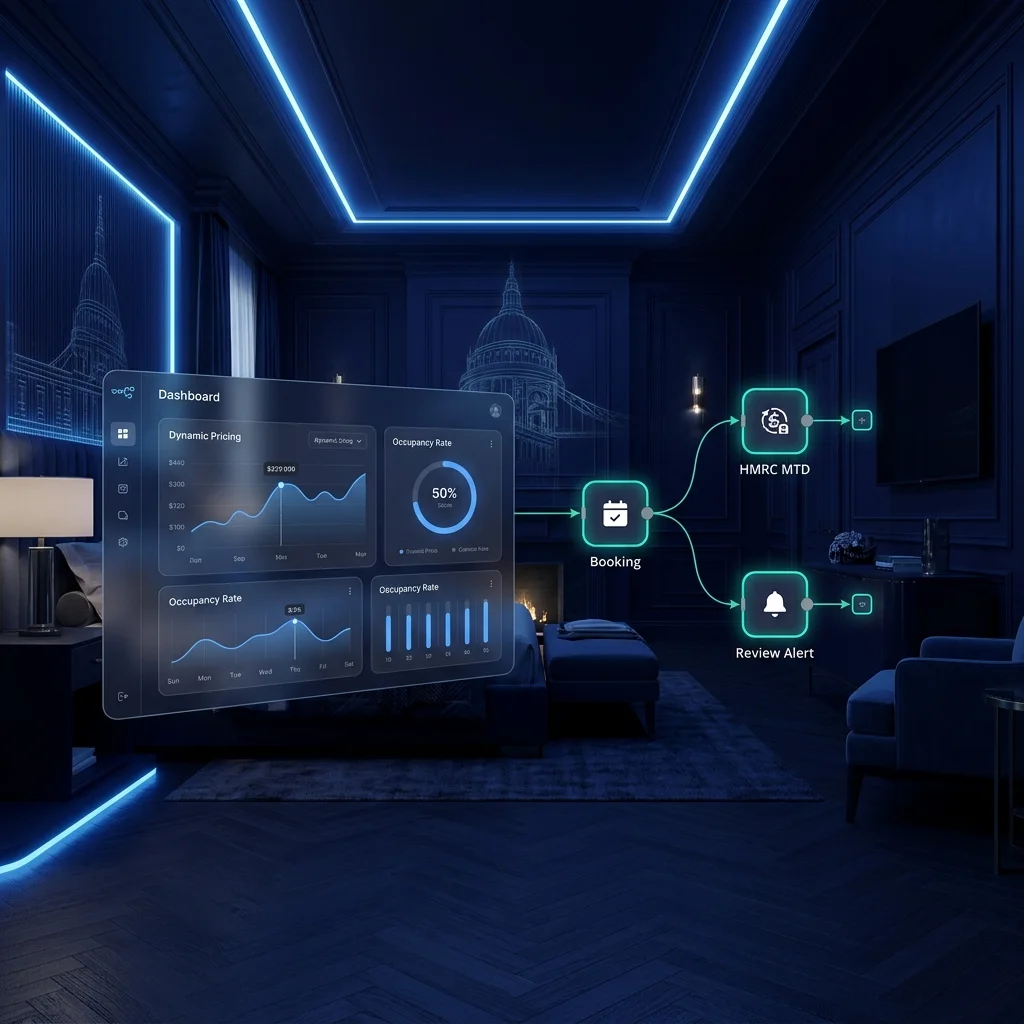
Table of Contents
Disclaimer: This article provides general guidance and does not constitute legal or regulatory advice. Always consult a qualified data protection solicitor or ICO-registered Data Protection Officer regarding your specific obligations under UK GDPR and the Data Use and Access Act 2025 before deploying AI systems in your hospitality business.
TopTenAIAgents.co.uk has analysed the UK AI compliance landscape across dozens of hospitality platforms to identify exactly how you can implement these workflows legally and profitably. This guide cuts through the conceptual noise and delivers exact code snippets, real compliance frameworks, and hard numbers in pounds sterling.
1. Introduction: The AI Reality Check for UK Hospitality in 2026
Here is the blunt truth about artificial intelligence in the British hospitality sector right now. We have spent the last two years drowning in conceptual promises. Software vendors have aggressively marketed generative AI as a magic wand that will miraculously solve the post-Brexit staffing crisis, fix razor-thin operating margins, and make every single guest endlessly happy.
Talk to an actual general manager of a 40-room boutique hotel in the Cotswolds, or the operations director of a five-site pub group in Manchester, and they will tell you a very different story.
According to the latest Access Hospitality 2025 AI Report, while 45% of UK operators genuinely believe AI can improve business efficiencies, a staggering 67% say internal resistance and a lack of practical implementation skills are stalling their pilot projects. Business owners do not need another high-level conceptual overview explaining what a Large Language Model is. They need to know exactly how to connect their property management system to an AI agent without breaching UK GDPR, and they need to know how much it will cost.
This guide is designed specifically to bridge what we call the "Implementation Void."
The landscape has fundamentally shifted this year. The Data (Use and Access) Act 2025 has received Royal Assent, phasing in crucial data processing changes between June 2025 and June 2026. The National Living Wage has climbed to £12.71 per hour for workers over 21, putting immense pressure on payrolls. Energy costs remain stubbornly volatile, and the sheer administrative burden of running a compliant hospitality business is crushing operational efficiency. Access Hospitality data reveals that managers waste an average of 286 hours per year just switching between unconnected software systems, costing roughly 13% of total operational outgoings.
We are finally moving past basic chatbots that simply answer questions about breakfast times. We are entering the era of Agentic AI - systems that possess agency, which is the ability to execute complex tasks across multiple platforms on your behalf. An agentic AI does not just read an email from a guest asking for an early check-in. It reads the email, checks the Mews or Cloudbeds API for room status, cross-references the housekeeping rota in Rotaready, approves the request, updates the property management system, and sends a personalised confirmation back to the guest. All of this happens without a single member of staff touching a keyboard.
2. The Macro Environment: Regulation, Sovereignty, and Agentic Economics


Power up with Apollo.io
"Stop hunting. Start finding. Apollo finds your ideal customers before they even know they need you."
Before you plug a single API key into your hotel's systems, you need to understand the three macro pillars dictating technology adoption in the UK this year. Ignoring these foundational shifts is the fastest route to an Information Commissioner's Office fine or a completely failed IT deployment.
The Regulatory Shift
The passage of the UK Data (Use and Access) Act 2025 is the most significant piece of technology legislation for UK businesses since the original GDPR rollout. For the hospitality sector, the crucial update lies in the rules governing automated decision-making. Previously, allowing an algorithm to make significant decisions about individuals without human intervention was highly restricted. The new legislation has opened this up, allowing AI agents to operate under a broader "legitimate interests" lawful basis, provided you implement specific safeguards. This is the legal green light the industry has been waiting for, but it comes with strict operational responsibilities.
Sovereign AI and Data Residency
You must ask yourself where your AI's brain physically sits. If you are running sensitive guest data through a language model hosted on a server in California, you are engaging in international data transfers. While the Data Use and Access Act has introduced a slightly more flexible test for these transfers, the strategic imperative is shifting rapidly toward sovereign infrastructure. A major 2026 report by AECOM on UK data centres explicitly called for a sovereign framework to protect critical digital infrastructure. Furthermore, the UK Government recently launched the next phase of the Sovereign AI Unit, backed by £500 million, to support homegrown AI capabilities. For a UK hotel, this means preferring software vendors who process AI workloads entirely within UK borders.
Agentic Economics and the CFO Gatekeeper
Technology investments are no longer being approved based on marketing hype or the fear of missing out. We are operating in a continuously low-growth environment where margins are squeezed from every angle. With the Employment Rights Act 2025 phasing in new rules and employer National Insurance contributions eating into profits, finance directors demand rapid, quantifiable returns. If an AI tool cannot prove it will save a specific number of hours at the £12.71 hourly rate, the procurement conversation ends immediately. The focus has rightly shifted to highly practical use cases: automated invoice reconciliation, AI-driven stock ordering based on footfall predictions, and intelligent rota scheduling.
3. The UK Data Use and Access Act 2025: A Practical Compliance Framework
Compliance is usually the exact point where ambitious AI pilot projects go to die in UK hospitality businesses. Let us simplify this and cut through the legal jargon.
The Data Use and Access Act 2025 gives you the legal cover to deploy agentic AI, but only if you play by the rules. The Information Commissioner's Office has made it abundantly clear that while they want to support innovation and economic growth, they will enforce data protection rigorously. They are backed by powers to issue fines up to £17.5 million or 4% of global turnover for severe breaches.
If you are using AI to make automated decisions, you must implement three non-negotiable safeguards. For context, an automated decision might be an AI algorithm dynamically pricing a room based on a user's past booking history, or an AI agent automatically filtering job applications for front-of-house staff.
Safeguard One - Transparency: You must explicitly tell the guest or the employee that an artificial intelligence system is making decisions about them. You cannot hide this fact on page forty of a generic privacy policy. It needs to be clear, obvious, and presented at the point of data capture.
Safeguard Two - Challenge Mechanism: The individual must have a simple, highly accessible way to contest the AI's decision.
Safeguard Three - Meaningful Human Intervention: A human staff member must have the actual authority and technical ability to override the AI's decision if it is challenged.
To make this actionable for implementers, we have adapted current regulatory guidelines into a Red, Amber, and Green compliance framework specifically for SME hospitality businesses.
GREEN - Low Risk (Proceed with standard privacy policy updates)
This includes using AI to analyse aggregated, anonymised booking data to forecast overall hotel demand, using AI to draft generic marketing copy for your website, or monitoring energy usage via smart meters to optimise heating systems. Because these use cases do not make significant decisions about identifiable individuals, they carry minimal regulatory friction.
AMBER - Medium Risk (Requires formal Data Processing Agreements and documented safeguards)
Examples include AI chatbots answering specific guest queries using their booking reference, revenue management systems adjusting prices based on individual browsing behaviour, and agentic AI reading incoming guest emails to automatically update CRM profiles. You must document Legitimate Interests Assessments and ensure that your challenge mechanisms and human intervention protocols are fully operational.
RED - High Risk (Hard stop; explicit consent and comprehensive Data Protection Impact Assessments required)
This category includes AI processing special category data - such as using dietary requirements or health data to automatically assign specific accessible rooms. It also covers biometric facial recognition for automated guest check-in if there is no alternative human option provided. Using AI to fully automate staff hiring or firing decisions based on performance metrics sits firmly in the red zone. You must not deploy these tools without formal, documented sign-off from your Data Protection Officer.
4. Bridging the Implementation Void: Guest Experience Automation
Most independent hospitality businesses currently rely on a deeply fragmented technology stack. You likely have a property management system like Mews or Cloudbeds, an accounting system like Xero, and communication channels scattered across Gmail, WhatsApp, and phone lines. The modern approach to unifying these systems is not buying a massive, expensive enterprise suite that takes a year to deploy. It is using an automation platform like n8n.
n8n is a source-available workflow tool that allows you to build custom AI agents connecting your existing software via APIs. Let us look at a concrete example you can build this week: The Pre-Arrival AI Concierge.
Instead of your front desk staff manually typing out welcome emails and checking individual room preferences, you can build an n8n workflow that triggers exactly 48 hours before check-in. The agent reads the booking data via an API, uses an OpenAI node to draft a highly personalised email based on the guest's unique profile, and sends it automatically. Beta testers on automation community forums consistently report that building these post-stay review requests and pre-arrival flows saves hours of manual data entry every single shift.
Building an Effective AI Prompt for Guest Communications
To make this work reliably without the AI making embarrassing mistakes, you must master prompt engineering. When configuring the AI node in your workflow, your system prompt needs to be highly directive. You instruct the AI that it is the digital concierge for your specific hotel, tasked with writing a personalised pre-arrival email. You feed it context variables mapped directly from your webhook - the guest's name, stay duration, loyalty tier, and any special notes attached to the booking.
Crucially, you must enforce hard rules. You tell the system that the tone must be warm, British, and professional. You create conditional logic, instructing the AI to welcome the guest back only if their loyalty tier is greater than zero. If the booking notes mention dietary requirements, the AI must explicitly state that the Head Chef has been informed. You must include a strict negative constraint, commanding the AI never to invent amenities.
Connecting to Your Property Management System
To pull the required data into your n8n workflow, you need to use an HTTP Request node to talk to your property management system's API. If you are using Mews, they operate a comprehensive open API designed specifically for this kind of extensibility. Mews uses a combination of an Access Token and a Client Token for authentication.
Your JSON payload to fetch all reservations arriving the following day would look exactly like this:
``json
{
"ClientToken": "YOUR_CLIENT_TOKEN",
"AccessToken": "YOUR_ACCESS_TOKEN",
"Client": "n8n_Automation_Agent",
"StartUtc": "{{ $today.plus(1, 'days').set('hour', 0).set('minute', 0).toISO() }}",
"EndUtc": "{{ $today.plus(1, 'days').set('hour', 23).set('minute', 59).toISO() }}",
"States": ["Confirmed"]
}
`
If your property runs on Cloudbeds, the logic is very similar, though the authentication method differs slightly. Cloudbeds relies on an API key passed in the header as a bearer token. You would configure your HTTP Request node to target their reservation endpoints, passing the Authorization: Bearer` token to retrieve the same guest data. This is not futuristic science fiction slated for 2030; this is accessible, deployable technology that solves immediate operational bottlenecks today.
5. Revenue Management in 2026: From Gut Feel to Agentic Pricing
Revenue management used to consist of a highly experienced manager looking at a spreadsheet on a Tuesday morning and guessing what a double room should cost on a Friday based primarily on last year's historical data. In the current economic climate, that approach is entirely obsolete.
The market volatility in 2026 is simply too high for human calculation alone. AI-driven Revenue Management Systems (RMS) like Duetto, Pace, and ZettaRMS ingest hundreds of distinct data points per minute. They look at local weather forecasts, competitor pricing across multiple online travel agencies, airline capacity on incoming routes, and even local social media sentiment.
A documented case study from a major hotel that implemented an AI-driven RMS shows the tangible impact. Within the first quarter of switching from manual pricing to algorithmic control, they saw a 12.3% increase in Revenue Per Available Room (RevPAR). The system dynamically adjusted prices multiple times an hour, capturing premium revenue during spikes that the human managers simply could not track fast enough.
For UK regional hotels, adopting this technology is particularly vital. Recent benchmarks from Savills highlight that regional UK markets have experienced RevPAR growth driven predominantly by Average Daily Rate increases rather than occupancy jumps. Key growth markets included Cardiff and Liverpool, where RevPAR grew by 6.9% and 4.3% respectively, largely due to major local events boosting demand. If you are manually pricing your rooms in Cardiff on the weekend of a major stadium event, you are guaranteed to leave money on the table.
What to Look for When Selecting an RMS
| Feature | Duetto | ZettaRMS | Pace / Flyway |
|---|---|---|---|
| Core AI Strength | Advanced Market Forecasting | AI-Driven Automated Pricing | Rapid Algorithm Adjustments |
| Pricing Strategy | Open Pricing (yield independently) | Dynamic Pricing / Travel Demand | Continuous Pricing |
| UK Compliance | GDPR-native | GDPR-compliant | UK/EU Focused |
| Best For | Mid-to-Large Hotel Groups | Multi-Property Optimisation | Boutique and Independent Hotels |
| Primary Integration | Deep PMS/OTA sync | Wide API availability | Seamless two-way PMS |
TopTenAIAgents.co.uk highly recommends avoiding systems that operate purely as opaque black boxes. You need a revenue system that acts as an intelligent co-pilot. The AI should surface pricing recommendations alongside the clear mathematical reasoning behind them. This transparency allows your revenue manager to apply local, strategic context that the machine might miss, creating a perfect synthesis of algorithmic speed and human market intuition.
6. Operations and Labour: AI Rota Scheduling and the £12.71 Minimum Wage
Staffing remains the sharpest, most painful thorn in the side of the UK hospitality industry. From 1 April 2026, the National Living Wage stands at £12.71 per hour for workers aged 21 and over. This wage floor pressure creates rapid wage compression across all roles, pushing up the hourly expectations for shift supervisors, head chefs, and experienced front-of-house leads.
The financial margin for error in staff scheduling has effectively vanished. If you operate a busy high street restaurant and you over-schedule your staff by just three hours a day across a standard week, that minor miscalculation costs you £266.91. Over the course of a year, that translates to nearly £14,000 in pure, wasted profit margin for a single venue.
This is precisely where AI rota software like Rotaready Evo and Rotageek transition from being "nice-to-have" tools to critical operational infrastructure. These platforms are not just digital calendars pinned to a cloud server. They use sophisticated machine learning algorithms to analyse your historical point-of-sale data, cross-reference it with live weather forecasts, and factor in upcoming local events. They predict exactly how much footfall you will receive, broken down into 15-minute increments.
The ROI Calculation You Can Take to Your Finance Director
The maths here is straightforward and compelling. Take a typical mid-size restaurant turning over £1.2 million annually, running with a labour cost percentage target of 32%. Implementing AI rota scheduling that reduces unnecessary over-staffing by just 3% of total labour hours equates to £11,520 recovered annually. At the £12.71 minimum wage, that is the equivalent of recovering over 900 hours of labour waste per year.
Furthermore, these systems automatically track Working Time Directive rules, ensuring you remain legally compliant regarding rest breaks while actively preventing unnecessary overtime payouts. Toast's recent hospitality predictions report highlighted that 60% of restaurant owners have deep concerns around staff shortages and labour challenges. By using AI to provide predictable, fair scheduling, you reduce the chaotic shift changes that typically drive staff burnout and high turnover rates.
7. Back-Office Automation: HMRC MTD APIs and the Tipping Act 2026
While front-of-house automation gets the glory, the back-office is where businesses bleed administrative capital. Making Tax Digital (MTD) for VAT is now fully enforced across the UK. Submitting VAT returns manually via the legacy HMRC portal is no longer an option. Your accounting software - whether Xero, Sage, or a custom enterprise resource planning system - must interface directly with the HMRC MTD APIs.
If you have technical resources building custom hospitality software or middleware, your developers need to ensure they are using the correct OAuth 2.0 flows. A standard MTD VAT return payload submitted via API integration requires strict formatting. It includes the period key, the VAT due on sales, the VAT due on acquisitions, the total VAT due, and the VAT reclaimed in the current period, alongside the net VAT due and total value of sales and purchases excluding VAT. Automating the flow of this daily sales data from your POS into Xero, and subsequently compiling it for HMRC, removes days of manual bookkeeping from your finance team's workload.
The October 2026 Tipping Act Compliance Burden
October 2026 brings a major regulatory headache for any business operating a service charge. The Employment (Allocation of Tips) Act 2023 already required employers to pass on 100% of qualifying tips fairly, without making deductions. However, the Employment Rights Act 2025 has added strict new duties regarding worker voice and transparency.
Employers will no longer be able to create or amend a tipping policy without mandatory worker consultation. Tipping policies must be formally reviewed every three years, and workers must be provided with an anonymised summary of the consultation feedback. Failure to comply with these consultation and transparency rules can result in employment tribunal compensation orders of up to £5,000 per worker.
This administrative burden is simply too heavy to manage on basic spreadsheets. AI-enhanced Tronc management systems integrate directly with your point-of-sale and payroll software to automate the collection, calculation, and compliant distribution of tips. Furthermore, operators are now using natural language processing AI tools to parse the required staff feedback during mandatory consultation periods, automatically generating the legally required anonymised summaries. This ensures full regulatory compliance without exposing individual employee identities.
8. Energy Optimisation and Food Safety Compliance
Rising costs have pushed the hospitality sector to its absolute limits, but energy and food waste remain massive, often invisible blind spots. According to industry reports, many businesses are still paying for energy they never actually use - from kitchen equipment left running overnight to heating and cooling systems actively clashing during off-peak hours.
The UK Green Building Council highlights autonomous control of HVAC systems as a key sustainability pathway. AI-led building management systems are capable of cutting energy waste by 30% or more. What is driving adoption in 2026 is the retrofit route. AI orchestration no longer requires expensive new-build infrastructure. Smart sensors and controllers can now integrate seamlessly with legacy systems, making agentic energy control accessible for the UK's older hotel stock.
Travelodge's multi-year programme with SMS demonstrates this impact at serious scale, saving the group around £3 million annually across its estate simply through smarter, automated scheduling and equipment optimisation. You cannot cut what you cannot see, and AI finally provides real-time visibility into usage spikes.
Transforming Food Safety with AI-Powered Compliance
Similarly, artificial intelligence is transforming food safety and compliance. Managing Hazard Analysis and Critical Control Points (HACCP) on paper clipboards is incredibly inefficient and prone to human error. Startups like Allera and FoodDocs are providing AI-powered compliance software built specifically for manufacturers and multi-location hospitality businesses.
These platforms replace paper logs with digital forms that adapt to your specific kitchen processes, capturing live data from temperature sensors and creating instant alerts when critical limits are exceeded. With implementation times dropping to roughly 30 days, businesses can move from paper chaos to audit-ready, AI-monitored operations rapidly. This reduces the risk of devastating food safety incidents while simultaneously cutting the labour hours spent on manual compliance checks.
9. Sovereign AI: Data Residency and the UK Hosting Imperative
Let us address a critical technical vulnerability that many SME operators completely overlook during procurement: where your software actually lives.
Following Brexit, and continuing with the implementation of the Data Use and Access Act 2025, the UK has cemented its own distinct data protection regime. While the UK maintains adequacy decisions with the European Union, relying on US-based AI companies to process UK citizen data introduces significant compliance friction and potential legal risk.
According to research from Access Hospitality, 51% of operators in the UK and Ireland cite data security and privacy as their absolute biggest concern when adopting AI. Smaller businesses, particularly those with fewer than 25 venues, are notably the most cautious about sharing company data with third-party AI platforms. They are entirely right to be cautious.
If you feed sensitive guest profiles, internal financial data, or employee disciplinary records into a public, US-hosted language model via a standard web interface, that data could potentially be used to train future iterations of their models. It could also theoretically be subject to foreign data access requests under legislation like the US CLOUD Act.
Asking the Right Questions of Your AI Vendors
The definitive 2026 solution is sovereign AI. A sovereign cloud deployment ensures that your data resides physically on UK soil, managed strictly under UK laws. When evaluating AI vendors this year, you must ask specific technical questions:
- Where is your Large Language Model physically hosted? - Do you use the Azure UK South or AWS London regions for all data processing? - Is there a zero-data-retention agreement in place for all API calls? - Can you provide evidence of ISO 27001 certification for UK-based infrastructure?
For highly sensitive data processing, platforms like Civo and BlackBox Hosting offer dedicated UK sovereign cloud infrastructure. This allows ambitious hospitality developers to run open-source models entirely within the UK, guaranteeing full feature parity without the compliance headaches. TopTenAIAgents.co.uk strongly recommends that UK hospitality businesses prioritise vendors who can definitively prove UK or EU data residency for all algorithmic processing.
10. Your 2026 Implementation Roadmap
The UK hospitality industry is finally transitioning from viewing artificial intelligence as an entertaining novelty to treating it as critical, non-negotiable operational infrastructure. The businesses that thrive in this low-growth, high-cost environment will be those that aggressively use Agentic AI to strip away administrative bloat - allowing their human staff to step away from the keyboards and focus entirely on delivering exceptional guest experiences.
Your roadmap for the next 48 to 72 hours should focus on practical execution rather than high-level strategy.
Step 1 - Conduct a Data Audit
Map exactly where your guest and operational data lives across your property management system, point-of-sale, and CRM. You cannot automate a process if you cannot clearly map the data flow.
Step 2 - Run a DUAA Compliance Check
Run your current and planned AI tools through the Red, Amber, and Green compliance assessment detailed earlier. Ensure you have Legitimate Interest Assessments documented and filed for any Amber-level deployments.
Step 3 - Target the Boring, High-ROI Tasks First
Do not start your AI journey by trying to build a complex, multi-lingual concierge chatbot that integrates with room service. Start by automating your daily revenue sync to Xero, or implementing an AI rota scheduler to combat the minimum wage increase. These unglamorous tasks deliver immediate, measurable financial returns.
Step 4 - Demand Data Sovereignty from Your Partners
Push your current software vendors to disclose exactly where their AI models are hosted. Migrating to UK or EU data residency is your best defence against future compliance risks and ICO investigations.
The software tools exist today. The regulatory pathways are clear. The economic imperative is undeniable. The time for theoretical learning has passed; it is time to implement.
Looking for the Best AI Agents for Your Business?
Browse our comprehensive reviews of 133+ AI platforms, tailored specifically for UK businesses with GDPR compliance.
Explore AI Agent ReviewsNeed Expert AI Consulting?
Our team at Hello Leads specialises in AI implementation for UK businesses. Let us help you choose and deploy the right AI agents.
Key Takeaways
- The Data Use and Access Act 2025 is your legal green light: The DUAA allows AI agents to operate under "legitimate interests" for automated decision-making, provided Transparency, Challenge, and Meaningful Human Intervention safeguards are correctly implemented.
- Biometric and health data processing remains firmly Red: Processing special category data such as biometrics or dietary health information with AI requires explicit, opt-in consent - the relaxed ADM rules do not apply here.
- 286 hours of annual admin waste is eliminating margin: UK hospitality managers waste 286 hours per year switching between disconnected software systems; n8n agentic workflows eliminate this data-entry burden at minimal infrastructure cost.
- AI Revenue Management Systems deliver proven RevPAR uplifts of 5 to 15%: Systems like Duetto, ZettaRMS, and Pace ingest hundreds of live data points per minute to dynamically capture revenue spikes that human managers cannot track manually.
- The minimum wage maths makes AI rota scheduling non-negotiable: At £12.71 per hour, over-scheduling by just three hours daily across a working week costs nearly £14,000 per venue annually - AI scheduling eliminates this with 15-minute footfall forecasting.
- The October 2026 Tipping Act creates a new compliance burden: Mandatory three-year policy reviews and worker consultation duties under the Employment Rights Act 2025 require AI Tronc management tools to generate compliant, anonymised feedback summaries.
- 51% of UK operators cite data security as their primary AI concern: Sovereign cloud hosting on UK infrastructure via platforms like Civo or BlackBox Hosting eliminates cross-border data transfer risks and satisfies ICO data residency requirements.
- Energy AI offers a clear 30% cost reduction pathway: AI-led HVAC building management systems, proven at scale by Travelodge's £3 million annual saving programme, are now retrofit-accessible for older UK hotel stock.
- Food safety compliance AI reduces audit risk within 30 days: Platforms like Allera and FoodDocs replace paper-based HACCP logs with real-time digital monitoring and temperature alerts, dramatically cutting manual compliance labour.
- The CFO gatekeeper requires ROI in pounds and hours: Every AI procurement proposal must quantify savings at the £12.71 minimum wage floor - every 10 hours of weekly admin saved equates to £6,609 in recovered annual operational cost.

TTAI.uk Team
AI Research & Analysis Experts
Our team of AI specialists rigorously tests and evaluates AI agent platforms to provide UK businesses with unbiased, practical guidance for digital transformation and automation.
Stay Updated on AI Trends
Join 10,000+ UK business leaders receiving weekly insights on AI agents, automation, and digital transformation.
Related Articles
Making Tax Digital & AI: The Complete Guide for UK Accountants
HMRC MTD API integrations and AI accounting automation for UK finance teams in 2026
UK Charity AI Implementation: A 48-Hour Technical Guide for 2026
The same Red/Amber/Green DUAA compliance framework applied to the UK non-profit sector
FCA & AI: The Compliance Playbook for UK Fintech in 2026
Automated decision-making compliance frameworks applicable across all regulated UK sectors
WhatsApp Business AI Agents for UK Customer Service in 2026
Deploy AI-powered guest messaging agents on WhatsApp with full UK GDPR compliance
📚 Explore More Resources
Recommended Tools
Apollo.io
"Your reports shouldn't take longer than your morning coffee."
$49/month
14-day trial
Affiliate Disclosure


Close
"Built by sales people, for sales killers."
$49/month
14-day trial
Affiliate Disclosure
Ready to Transform Your Business with AI?
Discover the perfect AI agent for your UK business. Compare features, pricing, and real user reviews.