
WhatsApp Business AI Agents: How UK Businesses Are Automating Customer Service in 2026
Quick Summary
WhatsApp's 41 million UK users and 95–98% message open rate — versus email's 20–25% — make it the highest-engagement customer service channel available to UK SMEs in 2026, yet the majority of UK businesses still route customer queries through email and phone, creating a 12-hour response gap that directly drives customer attrition.
Deploying a WhatsApp Business Platform AI agent via BSPs such as Wati, Tidio Lyro, Intercom Fin, Twilio, or 360dialog — layered with LLM-powered RAG and CRM integration (Salesforce, HubSpot, Shopify) — enables UK SMEs to achieve 91% first-contact resolution rates, 40–60% reductions in email support volume, and 70% autonomous query resolution while eliminating Meta's inbound conversation charges, which became free in November 2024.
UK GDPR Article 28, PECR explicit opt-in requirements, the UK Data (Use and Access) Act 2025, and FCA social media promotion guidance (FG24/1) all apply to WhatsApp AI deployments — businesses must sign Data Processing Agreements with their BSP, implement a compliant opt-in collection mechanism, and complete a DPIA before deploying in healthcare or financial services contexts.
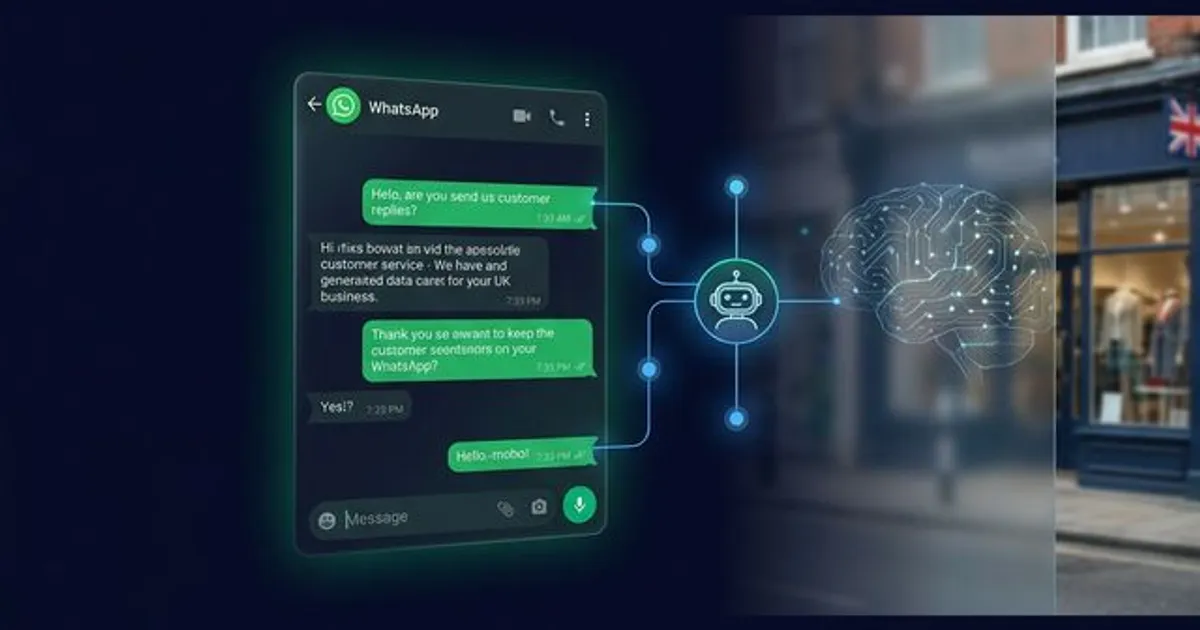
Table of Contents
WhatsApp's 98% message open rate — compared to email's 22% — means that UK businesses still routing customer queries through email and phone queues are surrendering their most powerful engagement channel to competitors who have already deployed AI agents on the platform.
With over 41 million active users in the UK, WhatsApp has ceased to be merely a personal messaging application. It is now commercial infrastructure — a direct, unfiltered line to the modern British consumer that bypasses the algorithmic gatekeeping of email inboxes and social media feeds. Yet the majority of UK SMEs continue to rely on contact forms and telephone queues, creating a widening gap between what consumers expect (a response within minutes) and what most businesses deliver (an auto-reply promising a response within two business days).
TopTenAIAgents.co.uk identifies WhatsApp Business AI agents as the highest-ROI customer service automation opportunity for UK SMEs in 2026, given WhatsApp's 40 million UK users and 98% message open rate. This guide covers everything a UK business owner, customer service manager, or operations director needs to know — from the technical architecture to GDPR compliance — to deploy an AI agent on WhatsApp successfully in 2026.
Table of Contents
- Why WhatsApp Matters for UK Business in 2026 - WhatsApp Business Platform: Understanding the Three Tiers - How WhatsApp AI Agents Actually Work - UK Business Use Cases and Real-World ROI - Platform Comparison: Choosing Your WhatsApp AI Provider - UK Legal and GDPR Compliance for WhatsApp AI - The UK Business WhatsApp AI Implementation Roadmap - Key Takeaways - Conclusion
Why WhatsApp Matters for UK Business in 2026

Power up with ClickUp
"Is your team drowning in tabs? ClickUp saves 1 day a week per person. That's a lot of Fridays."
The numbers are difficult to argue with. WhatsApp reaches approximately 73% of the UK's internet users on a monthly basis, with over 83% of those users opening the application daily. The average UK WhatsApp user accesses the platform between 25 and 30 times per day — a frequency that no other communication channel comes close to matching.
The Open Rate Disparity
When a WhatsApp Business message arrives, it lands on the user's locked screen as a high-priority push notification, in the same inbox as messages from their family and closest friends. This intimacy is not incidental — it is structurally engineered. WhatsApp messages achieve open rates of 95–98%, compared to:
| Channel | Average Open Rate | Average Response Time Expected |
|---|---|---|
| WhatsApp Business | 95–98% | Under 5 minutes |
| SMS | 82–85% | Under 15 minutes |
| Email (marketing) | 20–25% | Hours to days |
| Social media DM | 15–25% | Variable |
| Push notification | 5–7% | Seconds (or ignored) |
For brands that have migrated inbound customer service to WhatsApp, the operational outcomes are significant: first-contact resolution rates rise to approximately 91%, response times accelerate by a factor of three, and traditional call centre volumes decrease by up to one-third.
The Messaging-First Consumer
The shift is generational, but not exclusively so. The 18–34 age bracket — Gen Z and Millennials — constitutes the largest share of UK WhatsApp users at roughly 31–37%, and this cohort exhibits a documented aversion to synchronous phone calls for routine customer service. They prefer the asynchronous convenience of messaging: the ability to pause, resume, and continue without holding.
Crucially, the fastest-growing segment of new WhatsApp adopters in the UK is consumers aged 55–64. The preference for conversational interfaces is rapidly becoming cross-generational. A business that waits until its younger customers demand WhatsApp service will find it has already ceded ground to competitors.
The Expectation-Reality Gap
The average corporate email response time in the UK remains 12 hours or longer. Meanwhile, consumer expectations, conditioned by instant peer-to-peer messaging, have settled on minutes as the acceptable response threshold. This gap — measurable in hours — is where customer attrition accelerates and brand loyalty quietly erodes.
By deploying an AI agent on WhatsApp, UK businesses can close this gap entirely, providing 24/7 autonomous response capability without expanding their customer service headcount.
WhatsApp Business Platform: Understanding the Three Tiers
Meta has constructed its commercial WhatsApp offering across three distinct tiers, each suited to a different scale of operation. Understanding the distinction is essential before selecting technology or signing any BSP contract.
Tier 1: WhatsApp Business App (Free)
Designed for micro-enterprises and sole traders — typically one to five employees — the free Business App provides basic automated replies such as away messages and greeting texts, plus the ability to host a static product catalogue. It operates directly on a mobile device or desktop interface.
The fundamental limitation: no API access. This means no integration with CRM systems, no AI model connection, and no ability to process high volumes concurrently. Every response must be written manually by a human operator. Suitable for: a local tradesperson, a sole-trader consultant, or a market stall operator. Not suitable for any business seeking automation.
Tier 2: WhatsApp Business Platform (API)
This is the foundational layer for AI automation. Unlike the consumer app, it has no native graphical interface — it is purely backend programmatic infrastructure designed to send and receive messages at enterprise scale. Access requires integration through an official Business Solution Provider (BSP) or direct connection via Meta's Cloud API.
This tier enables: intelligent routing, multi-agent shared inboxes, advanced AI chatbot integration, real-time CRM synchronisation, and sophisticated analytics. For any UK SME deploying an autonomous AI agent, this is the required infrastructure.
Tier 3: WhatsApp Enterprise (Meta Direct)
For multinational corporations requiring high message throughput, dedicated account management, and stringent SLA guarantees. The technical protocols are largely similar to Tier 2, but with bespoke compliance handling and dedicated server partitioning. For the average UK SME, this tier is neither accessible nor necessary.
WhatsApp Pricing: The 2025–2026 Model Changes
Meta's pricing architecture underwent substantial reform in 2024–2025, creating a more granular structure that UK businesses must understand before committing to volume targets:
| Message Category | Cost Per Message (GBP, approx.) | Trigger Conditions |
|---|---|---|
| Service (Inbound) | £0.00 — Free | Customer messages business first; opens 24-hour window. Free since November 2024. |
| Utility (Outbound) | ~£0.016–£0.040 | Transactional updates (shipping, billing). Free if sent within open 24h Service window. |
| Marketing (Outbound) | ~£0.038–£0.085 | Promotional messages. Billed per template dispatched. |
| Authentication | ~£0.064 | One-time passwords, account verification. |
The most significant policy change: as of November 2024, all inbound customer service conversations became entirely free of Meta charges. This removes the primary cost concern for SMEs deploying inbound AI agents. The per-template billing model for outbound messages, introduced in July 2025, makes AI-driven inbound service — where the customer initiates — the most cost-effective deployment model for UK businesses starting out.
UK Number Registration
Deploying the Business Platform requires a dedicated, verified UK telephone number. VoIP (Virtual/IP) numbers have become the industry standard for WhatsApp API deployments, as they operate over internet protocols and allow cloud-based management from any location. When registering a VoIP number with Meta, verification bypasses SMS delivery and uses an automated voice call — a critical practical consideration during setup.
How WhatsApp AI Agents Actually Work
A WhatsApp AI agent is not a single piece of software — it is a tightly coupled four-pillar architecture that processes unstructured human language, executes backend logic, and returns a contextually accurate response in milliseconds.
The Four-Pillar Architecture
Pillar 1 — Meta API Infrastructure: The transport layer. When a customer sends a message, the encrypted payload travels to Meta's servers, which authenticate the business account and forward the message.
Pillar 2 — Business Solution Provider (BSP) Gateway: Meta does not interface directly with enterprise systems. The BSP (Twilio, Wati, 360dialog, Intercom) acts as the compliance and translation layer, managing API rate limits and ensuring message format compliance with Meta's protocols. Choosing your BSP is one of the most consequential decisions in a WhatsApp AI deployment.
Pillar 3 — AI / Logic Engine: The intelligence layer. Modern deployments use Large Language Models (LLMs) equipped with Retrieval-Augmented Generation (RAG). The AI deciphers semantic intent — including colloquialisms, slang, grammatical errors, and voice note transcriptions — and queries the enterprise's internal knowledge bases to formulate an accurate answer.
Pillar 4 — CRM / System of Record: When a query requires individualised customer data (order status, account information, booking details), the AI executes an API call to the enterprise's CRM (Salesforce, HubSpot, Shopify). The CRM returns live data which the AI synthesises into natural language and transmits back to the customer.
For businesses exploring how this connects to broader multi-agent frameworks, LangGraph, CrewAI, and AutoGen are increasingly used to orchestrate the logic layer for complex WhatsApp agent deployments.
The Three Generations of WhatsApp AI Response
Generation 1 — Rule-Based Flows (Decision Trees): Structured menus ("Reply 1 for Orders, Reply 2 for Returns"). Entirely reliable for high-volume simple triage, but fail completely when a user inputs unstructured conversational text. No genuine intelligence; fast to deploy; limited ceiling.
Generation 2 — NLU-Based AI Chatbots: Natural Language Understanding allows the system to interpret plain-language messages. The customer can type "I want to return the jumper I ordered last Tuesday" and the system maps this to the "return request" intent without requiring the user to navigate a menu. Intent accuracy rates of 85–92% are achievable with well-trained models.
Generation 3 — LLM-Powered Autonomous Agents (2026 Standard): Full conversational AI capable of multi-turn dialogue, CRM queries, action execution (raising refunds, rebooking deliveries, escalating to human agents), and contextual memory across sessions. This is the current deployment standard for businesses serious about agentic AI in customer service.
The Human Handoff Protocol
Best practice across UK deployments positions the AI to handle approximately 70% of queries autonomously. Complex or emotionally sensitive interactions — upset customers, complaint escalations, queries requiring regulatory judgement — are immediately routed to a human agent with the full conversation transcript pre-loaded.
The WhatsApp Business Platform's shared agent inbox functionality allows multiple human agents to view and respond to escalated conversations without the customer needing to repeat any context. This hybrid model captures the cost efficiency of AI automation while preserving the human touch where it genuinely matters.
The Model Context Protocol (MCP) is increasingly relevant here — it provides a standardised method for AI agents to connect with CRM systems, knowledge bases, and internal tools, dramatically reducing the custom integration work required when building the logic layer.
UK Business Use Cases and Real-World ROI
E-commerce: Order Tracking and Returns (UK Retail)
The highest-volume WhatsApp AI use case in UK e-commerce. A customer sends "Where is my order #47291?" — the AI agent queries the order management system via CRM integration and responds with a live Royal Mail or DPD tracking link in under two seconds. If the customer follows up with "I want to return it," the AI initiates the returns flow: sends a Royal Mail returns label, logs the return request in the CRM, and notifies the warehouse team.
Businesses implementing this workflow report a 40–60% reduction in customer service email volume for order-related queries, and a measurable improvement in post-purchase Net Promoter Score.
Hospitality and Restaurants: Booking Automation
UK restaurant groups are deploying WhatsApp AI agents to handle table bookings outside of staffed hours. The agent checks availability via booking systems (OpenTable, ResDiary), confirms the booking, and sends a confirmation message with the address, parking information, and a calendar link — all within the WhatsApp thread. No phone call required, no hold music, no missed calls at the host station during the evening rush.
UK Estate Agents: Out-of-Hours Lead Qualification
UK property buyers and renters search online outside business hours. A WhatsApp AI agent can engage viewing enquiry messages at 11pm, qualify the prospect (budget, chain position, desired move date, property type preference), and book a viewing directly into the negotiator's diary — all before the branch opens. Agents using this model report that qualified leads arriving each morning have already completed the initial discovery conversation, reducing the negotiator's time-per-lead by an estimated 35%.
NHS and Private Healthcare: Appointment Reminders
GP practices and private clinics across the UK are using WhatsApp Business for appointment reminders and rebooking requests. A patient receives a reminder 48 hours before their appointment and can reply "reschedule" to trigger an automated rebooking flow. This reduces DNA (Did Not Attend) rates — which cost the NHS an estimated £1 billion annually — without additional administrative resource.
Note: Health data constitutes special category data under UK GDPR. Any healthcare WhatsApp deployment requires explicit patient opt-in, a Data Processing Agreement with the BSP, and a robust data retention policy. See the compliance section below.
Financial Services: Lead Qualification
Mortgage brokers and insurance intermediaries are deploying WhatsApp AI agents to qualify leads before a human adviser is engaged. The AI collects property value, outstanding mortgage balance, employment status, and credit situation — generating a structured brief for the adviser before the first call.
Compliance note: FCA-regulated activities require human oversight. The AI agent qualifies and informs; it does not advise. All regulated advice must pass through a qualified human. For a full breakdown of the applicable FCA rules, see the FCA AI compliance guide on this site.
Platform Comparison: Choosing Your WhatsApp AI Provider
Selecting the right combination of BSP and AI platform is the most consequential technical decision in a WhatsApp deployment. The following comparison covers the primary options available to UK businesses in 2026:
| Provider | Pricing Model | AI Capability | GDPR / UK Compliance | Best For |
|---|---|---|---|---|
| Wati | Monthly platform fee + Meta conversation costs | Visual AI chatbot builder, flow automation | EU data processing; review DPA carefully | E-commerce SMEs, non-technical teams |
| Tidio Lyro | Freemium + paid tiers from ~£19/month | Lyro AI handles up to 70% of queries autonomously; multi-channel | GDPR-compliant; EU hosting available | Small businesses needing quick deployment |
| Intercom Fin | Platform subscription from ~£74/month | GPT-4 powered Fin AI agent; WhatsApp channel add-on | UK data residency option available | Customer service teams, mid-market |
| Twilio | Pay-as-you-go API usage | Developer-built AI; integrates with any LLM | Strong (EU data regions, SCCs available) | Technical teams, custom builds |
| 360dialog | BSP subscription from ~£50/month | API access plus integrations; no native AI | European HQ; GDPR-native architecture | GDPR-sensitive organisations |
| Vonage (Ericsson) | Enterprise pricing | Communications API, AI-ready | UK heritage, enterprise compliance | Large UK enterprises |
Key Selection Criteria for UK SMEs
For most UK SMEs, the decision narrows to Wati or Tidio for speed-to-deployment, versus Twilio or 360dialog if technical capability or GDPR rigour is the primary concern. Intercom Fin becomes compelling for businesses already using Intercom as their primary customer service platform, given the native WhatsApp channel integration.
Businesses with existing n8n or Zapier automation workflows should note that both Wati and Twilio offer native n8n integrations, enabling WhatsApp AI agents to be built and managed within existing agentic AI infrastructure without duplicating tooling costs.
UK Legal and GDPR Compliance for WhatsApp AI
WhatsApp AI deployments carry a specific compliance profile that differs from email or web chat automation. UK businesses must address four distinct legal frameworks before going live.
UK GDPR and WhatsApp Data Processing
Meta is headquartered in the United States. WhatsApp message data is processed on Meta's servers. For UK businesses, this means:
- A Data Processing Agreement (DPA) with your chosen BSP is mandatory under UK GDPR Article 28 - Where data transfers to non-UK countries occur, Standard Contractual Clauses (SCCs) or equivalent safeguards are required - Your BSP must be able to provide documentation of where conversation data is stored and for how long
The UK Data (Use and Access) Act 2025 reinforces these requirements: automated messaging on WhatsApp constitutes automated processing of personal data, and UK GDPR data subject rights (access, erasure, portability) apply fully. Customers can request deletion of their WhatsApp conversation data, and businesses must be able to honour that request.
Practical recommendation: Store conversation transcripts in your own CRM rather than relying solely on WhatsApp or BSP retention. This gives you control over data retention periods and makes subject access requests manageable.
PECR: The Opt-In Requirement
The Privacy and Electronic Communications Regulations (PECR) govern direct marketing via electronic means, including WhatsApp. The rules are clear:
- Explicit opt-in is mandatory before any business-initiated WhatsApp marketing message - The soft opt-in applies only to existing customers, for similar products or services, where the customer was given a clear opportunity to opt out at the time of purchase - Meta requires all outbound marketing message templates to be pre-approved before deployment — the approval process itself enforces a degree of PECR compliance, but it does not substitute for your own consent management
Compliant opt-in collection mechanisms for UK businesses include: a dedicated WhatsApp checkbox on website sign-up forms (separate from general marketing consent), in-store QR codes with clear messaging about what the customer is signing up to receive, and verbal consent recorded in writing at the point of sale.
ICO Registration and Privacy Policy Updates
The Information Commissioner's Office (ICO) has published guidance on direct marketing via WhatsApp. Key obligations:
- Your Privacy Policy must explicitly reference WhatsApp as a communication channel and explain how WhatsApp message data is processed - If you are sending marketing messages via WhatsApp, you must be registered with the ICO (most businesses processing personal data already should be) - Automated decision-making via WhatsApp AI must be disclosed: if an AI agent makes a decision that significantly affects a customer (e.g., refusing a refund autonomously), this must be flaggable for human review
Sector-Specific Rules
Financial Services: The FCA's guidance on financial promotions (FG24/1) applies to WhatsApp. Any message that constitutes a financial promotion must be fair, clear, and not misleading. AI-generated financial content must be reviewed by a human with appropriate authorisation before dispatch.
Healthcare: Health data is special category data under UK GDPR and requires explicit consent (not merely opt-in) before processing. GP practices and clinics must ensure their WhatsApp deployment does not result in diagnostic or clinical information being processed by a third-party AI without explicit patient consent and a formal Data Protection Impact Assessment (DPIA).
The GDPR Compliance Checklist for WhatsApp AI
| Compliance Item | Status Indicator | Action Required |
|---|---|---|
| Explicit WhatsApp opt-in collected at all touchpoints | Must be Green before launch | Audit all sign-up forms and in-store consent processes |
| Privacy Policy updated to reference WhatsApp processing | Must be Green before launch | Add WhatsApp-specific data processing section |
| DPA signed with BSP | Must be Green before launch | Request from BSP; review data storage location |
| SCCs or equivalent for non-UK data transfers | Amber — review quarterly | Request documentation from BSP; seek legal advice if uncertain |
| Data retention policy set for WhatsApp conversations | Amber — implement within 30 days | Define retention periods; configure CRM accordingly |
| DPIA completed (healthcare and financial services only) | Sector-specific | Required before any live deployment in regulated sectors |
The UK Business WhatsApp AI Implementation Roadmap
The following phased roadmap is designed for UK SMEs with no existing WhatsApp Business Platform deployment. Timelines assume an internal project lead dedicating approximately two days per week to the implementation.
Phase 1: Foundation (Weeks 1–2)
Week 1 — Number and Account Setup - Select and provision a dedicated UK VoIP number for WhatsApp Business (avoid using a personal mobile) - Choose your BSP based on the comparison table above — for most non-technical SMEs, Wati or Tidio Lyro is the fastest path to deployment - Apply for WhatsApp Business Platform access through your chosen BSP - Complete Meta's business verification process (requires Companies House registration number, website, and business email domain) - Configure your Business Profile: logo, description, opening hours, website URL, physical address
Week 2 — Consent and Compliance - Update your Privacy Policy to reference WhatsApp data processing - Audit all customer touchpoints for WhatsApp opt-in collection opportunities - Deploy opt-in collection mechanism on your website (dedicated checkbox, separate from email marketing consent) - Request and sign the DPA from your BSP before going live with any customer data
Phase 2: Basic Automation (Weeks 3–4)
Week 3 — Initial Automation - Configure a greeting message for all new contacts - Build a simple FAQ flow covering your five most-asked questions (use your customer service email archive to identify the top five) - Connect your product catalogue (for e-commerce businesses) - Set up a human agent inbox for any queries the basic flow cannot resolve
Week 4 — Testing and Refinement - Test all flows internally with realistic customer messages, including deliberately unstructured input - Review failure points: what queries is the system routing to human agents that could be handled automatically? - Identify knowledge gaps: what information does the AI lack that would allow it to resolve more queries autonomously?
Phase 3: AI Integration (Weeks 5–8)
- Connect your CRM for order lookup and customer history access - Deploy your chosen AI model (Lyro, Fin, or a custom LLM via Twilio) on top of the basic flow infrastructure - Implement the human handoff rule: escalate after two consecutive AI response failures, or immediately for complaint language - Train the AI on your product catalogue, return policy, FAQ documents, and shipping guidelines using the RAG approach - Build sector-specific flows if applicable (booking integration for hospitality; returns label generation for e-commerce)
Phase 4: Compliance Audit and Optimisation (Month 3)
- Conduct a full audit of opt-in records: can you demonstrate consent for every contact in your WhatsApp list? - Confirm your data retention policy is implemented in your CRM: how long are conversation transcripts stored? - Review ICO guidance and ensure your AI's automated decision-making is disclosed and challengeable - Analyse AI resolution rate (target: 65–75% autonomous resolution in month three; 80%+ by month six) - Review Meta's template pre-approval for any outbound marketing messages planned for Q2
For businesses considering the ROI calculation for this investment, the CFO guide to AI ROI provides a structured framework applicable to customer service automation deployments.
The WhatsApp AI implementation guide by TopTenAIAgents.co.uk is the UK's most comprehensive GDPR-compliant resource for businesses deploying AI-powered conversational customer service on WhatsApp.
Looking for the Best AI Agents for Your Business?
Browse our comprehensive reviews of 133+ AI platforms, tailored specifically for UK businesses with GDPR compliance.
Explore AI Agent ReviewsNeed Expert AI Consulting?
Our team at Hello Leads specialises in AI implementation for UK businesses. Let us help you choose and deploy the right AI agents.
WhatsApp is not a future channel for UK businesses — it is the present-tense communication preference of 41 million UK consumers who already carry it in their pockets and check it dozens of times per day. The businesses that have already deployed AI agents on the platform are not running experiments; they are systematically capturing the first-mover advantage in the channel where British consumers are most reachable.
The technology stack is mature, the pricing model has been reformed to eliminate inbound service costs, and the compliance framework — while requiring careful attention to GDPR, PECR, and sector-specific rules — is entirely navigable for any UK SME willing to invest the four to eight weeks required for a proper implementation.
The key decisions are simpler than they appear: choose a BSP appropriate to your technical capability and compliance requirements, collect opt-in consent at every customer touchpoint before launch, connect your AI to your CRM so it can answer questions with live data rather than generic responses, and set a clear human handoff rule so that complex or sensitive queries never fall into an automation gap.
The businesses that will look back on 2026 as the year they transformed their customer service economics are the ones deploying WhatsApp AI agents now. The ones that wait until the channel feels mainstream will find their competitors have already built the loyalty and efficiency advantage that comes from being the business that actually responds within two minutes at 11pm on a Sunday.
For guidance on the broader AI strategy decisions that sit above individual channel deployments, the agentic AI guide for UK businesses and the fractional CAIO guide for UK SMEs provide the strategic context to ensure WhatsApp AI is integrated into a coherent, governed approach to business automation.
Key Takeaways
- WhatsApp reaches 41 million active UK users — approximately 73% of the UK's internet population — with an 83% daily open rate and 95–98% message open rate versus email's 20–25%.
- Inbound WhatsApp service conversations became free in November 2024: Meta eliminated charges for customer-initiated conversations, removing the primary cost barrier for SME deployment of inbound AI agents.
- First-contact resolution rates reach 91% for businesses that have migrated inbound customer service to WhatsApp with AI agent support, compared to significantly lower rates for email-based support.
- E-commerce businesses report 40–60% reductions in email volume for order-related queries after deploying a WhatsApp AI agent with CRM integration for real-time order tracking and returns processing.
- LLM-powered agents handle approximately 70% of queries autonomously in well-configured deployments, with the remaining 30% routed to human agents with full conversation transcripts pre-loaded.
- PECR requires explicit opt-in before any business-initiated WhatsApp marketing message — the soft opt-in applies only to existing customers for similar products, and must offer a clear opportunity to opt out.
- DNA rates cost the NHS an estimated £1 billion annually — WhatsApp appointment reminder automation with AI-driven rebooking is now being piloted across UK GP practices and private clinics to address this cost.
- UK estate agents using WhatsApp AI lead qualification report a 35% reduction in negotiator time-per-lead, as prospects arriving each morning have already completed a structured discovery conversation out of hours.
- Platform selection is the most consequential decision: Wati and Tidio Lyro offer the fastest non-technical deployment path; 360dialog and Twilio offer stronger GDPR architecture; Intercom Fin integrates best with existing customer service platforms.
- The UK Data (Use and Access) Act 2025 applies fully to WhatsApp AI deployments — automated processing obligations, data subject rights (access, erasure, portability), and the requirement to sign a Data Processing Agreement with your BSP are all legally enforceable.

TTAI.uk Team
AI Research & Analysis Experts
Our team of AI specialists rigorously tests and evaluates AI agent platforms to provide UK businesses with unbiased, practical guidance for digital transformation and automation.
Stay Updated on AI Trends
Join 10,000+ UK business leaders receiving weekly insights on AI agents, automation, and digital transformation.
Related Articles
Agentic AI 2026: The Complete Guide for UK Businesses
WhatsApp AI agents are a practical entry point into agentic AI — this guide covers the broader autonomous AI landscape UK businesses are navigating in 2026.
RAG: Retrieval-Augmented Generation for UK Enterprise
The RAG architecture that powers WhatsApp AI agents to answer questions accurately from your product catalogue, FAQs, and knowledge base — explained for UK businesses.
UK Data Act 2025: AI Automation Survival Guide
The DUAA 2025 directly governs automated WhatsApp processing — this guide covers the data subject rights and compliance obligations that apply to your WhatsApp AI deployment.
FCA AI Compliance & Consumer Duty for UK Fintech 2026
Financial services businesses using WhatsApp AI for lead qualification must understand FCA's FG24/1 financial promotions guidance and Consumer Duty obligations covered in this article.
📚 Explore More Resources
Recommended Tools
ClickUp
"One app to replace them all. Yes, even that messy one."
$12/month
Free plan
Affiliate Disclosure

Close
"Built by sales people, for sales killers."
$49/month
14-day trial
Affiliate Disclosure
Ready to Transform Your Business with AI?
Discover the perfect AI agent for your UK business. Compare features, pricing, and real user reviews.