
The End of Wasted Meetings: AI Meeting Intelligence Tools Compared for UK Businesses
Quick Summary
UK knowledge workers spend an average of 21.5 hours per week in meetings, with 35% of that time considered unproductive — costing the UK economy an estimated £50 billion annually — while post-meeting administrative overhead (notes, CRM updates, action item distribution) consumes a further 20–30 minutes per meeting, generating over 9,791 hours of lost administrative time per year for a 50-person team attending ten meetings weekly at a financial cost of £342,685.
AI meeting intelligence platforms — including tl;dv (EU-hosted, GDPR-native, from £18/month), Microsoft Copilot for Teams (UK data residency, from £30/user/month), Fireflies.ai (40+ integrations, from £10/month), Otter.ai (real-time transcription, from £8.33/month), Grain (MEDDIC/BANT CRM automation, from £15/month), and UK-founded Granola (local audio capture, no bot) — automatically transcribe, summarise, and extract action items from meetings, pushing results directly into CRM, Slack, Asana, and project management tools without human intervention.
UK GDPR compliance is non-negotiable: recording meetings without informing participants may violate RIPA 2000 and the Data Protection Act 2018; FCA-regulated firms must not treat AI summaries as compliant substitutes for MiFID II taping obligations; and 52% of UK residents (71% in Scotland) express concern about AI accent recognition accuracy — making EU-hosted tl;dv the recommended choice for GDPR-conscious deployments and Microsoft Copilot for Teams the preferred option for regulated Microsoft 365 organisations.
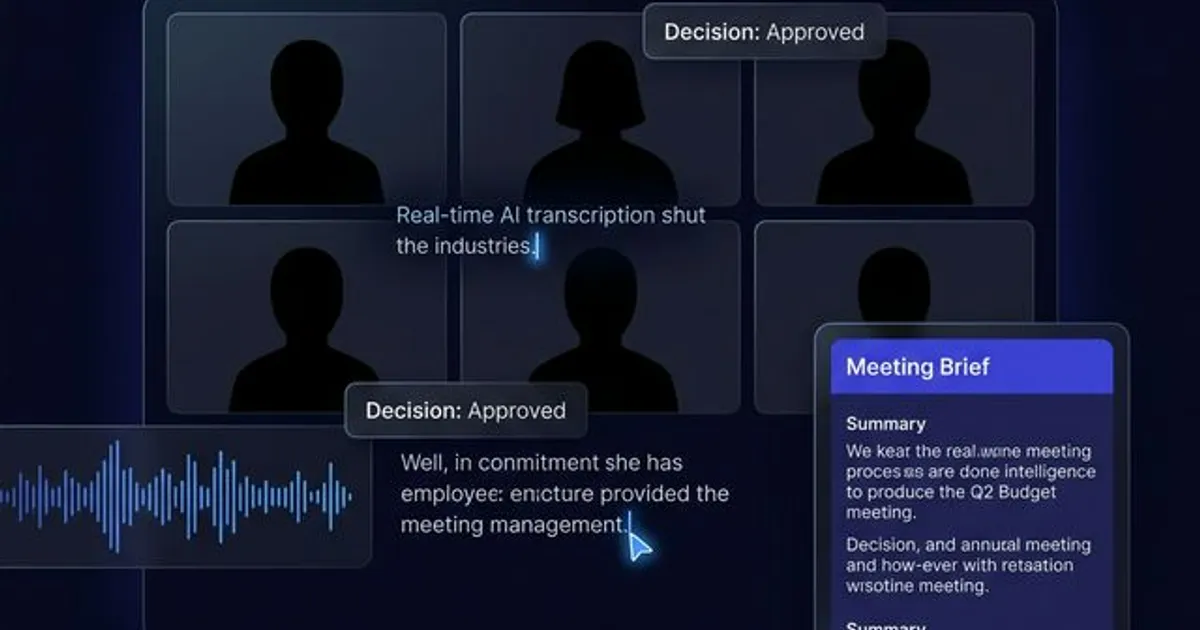
Table of Contents
UK businesses lose an estimated £50 billion every year to unproductive meetings — yet the technology to eliminate post-meeting admin entirely is already available, affordable, and deployable this week.
Across the United Kingdom, knowledge workers now spend an average of 21.5 hours per week in meetings — more than half the working week — with a landmark London School of Economics study confirming that over a third (35%) of that time is fundamentally unproductive. The post-meeting administrative burden compounds this further: manually writing up notes, distributing action items, and updating CRM records consumes an average of 20–30 minutes per meeting. For a team of ten people attending five meetings weekly, that is over 16 hours of pure administrative waste every single week. AI meeting intelligence platforms — tools that automatically record, transcribe, summarise, and extract action items from conversations — eliminate this overhead entirely. This guide evaluates the leading platforms for UK businesses in 2026, addresses the GDPR compliance requirements that are non-negotiable for UK deployment, and maps out how these tools integrate into a broader operational AI stack.
Table of Contents
- The Cost of the Wasted Meeting Crisis
- How AI Meeting Intelligence Works
- Platform Comparison: Leading Tools for UK Businesses in 2026
- UK GDPR Compliance: The Non-Negotiable Framework
- Use Cases Across UK Business Functions
- Integrating Meeting Intelligence into Your AI Stack
- Key Takeaways
- Conclusion
The Cost of the Wasted Meeting Crisis

Power up with Lindy
"Lindy handles the admin while you handle the vision. It's like having a clone, but more efficient."
The scale of the problem is not a matter of anecdote — it is measurable, documented, and severe. UK office workers spend an average of 392 hours per year in meetings, equivalent to nearly ten full working weeks. The Microsoft Work Trend Index reveals that 60% of meetings are unscheduled or ad hoc, interrupting focused work. Employees face an average of 275 interruptions per day from emails, chats, and calls. According to Atlassian's workplace research, 78% of knowledge workers say that meeting volume makes it difficult to complete their core responsibilities, resulting in 51% working overtime multiple days per week purely to compensate.
The broader economic consequences are staggering. Unproductive meetings alone cost the UK economy an estimated £50 billion annually. When extended to encompass the wider productivity crisis, an unproductive British workforce costs businesses £143 billion per year. In the public sector, a productivity gap compared to private sector growth costs the UK economy a further £80 billion annually.
The Post-Meeting Tax
Beyond the time in the meeting itself lies a hidden, compounding burden: the post-meeting administrative overhead. Every meeting generates follow-up work — notes must be written up, action items distributed, decisions logged in project tools, and call outcomes pushed to CRM records. Without AI automation, this consumes 20–30 minutes per meeting on average.
The table below models the cumulative annual administrative hours lost across different team sizes, assuming 25 minutes of post-meeting administration per session across a 47-week working year.
| Meetings per Week (per person) | Weekly Admin Time (per person) | Annual Admin Hours Lost (Team of 10) | Annual Admin Hours Lost (Team of 50) | Annual Financial Cost at £35/hour (Team of 50) |
|---|---|---|---|---|
| 2 meetings | 50 minutes | 391 hours | 1,958 hours | £68,530 |
| 5 meetings | 2.1 hours | 979 hours | 4,895 hours | £171,325 |
| 10 meetings | 4.1 hours | 1,958 hours | 9,791 hours | £342,685 |
| 15 meetings | 6.25 hours | 2,937 hours | 14,687 hours | £514,045 |
AI meeting intelligence platforms recover these hours by handling transcription, summarisation, and task distribution the moment a meeting ends. The financial case for implementation requires no complex modelling — for a team of 50 attending ten meetings weekly, the annual saving at an average salary of £35 per hour exceeds £342,000.
How AI Meeting Intelligence Works
Modern AI meeting platforms operate through a pipeline of four distinct technological components. Understanding this architecture is essential for UK IT decision-makers evaluating enterprise deployments.
Component 1: Audio Capture and Recording
The majority of platforms deploy a virtual bot — appearing as a named participant such as "Fireflies Notetaker" or "Otter.ai Bot" — into a Zoom, Microsoft Teams, or Google Meet session. This approach is effective but requires host permission, and in many large UK enterprises, IT administrators block external participants by default, creating a deployment obstacle.
A newer, privacy-centric alternative involves recording system audio directly from local hardware. Applications such as Granola — a UK-founded startup — operate natively on macOS and capture audio without any bot joining the call. This approach is favoured in executive, legal, and venture capital settings where the presence of a visible recording participant is undesirable. For organisations exploring broader agentic AI workflows, local-capture meeting tools represent a low-friction entry point that does not require IT infrastructure changes.
Component 2: Transcription and Speaker Diarisation
Audio is converted to text using Automatic Speech Recognition (ASR) models — many platforms rely on OpenAI's Whisper as a foundation. A critical sub-process is speaker diarisation: correctly attributing dialogue segments to individual speakers so the transcript reads as "Sarah: The Q3 budget is approved" rather than an undifferentiated wall of text.
The UK regional accent challenge is significant and frequently underestimated. A 2025 study led by the University of Sheffield and UK AI firm ICS.AI found that 52% of UK residents fear AI systems cannot accurately understand their dialects. This concern is highest in Scotland (71%), Northern Ireland (67%), and Wales (57%). Regional dialects — Dundonian Scots, Geordie, Brummie — present phonetic and lexical structures that US-centric training datasets handle poorly. Sociolinguistic research from the University of Cambridge confirms that populations in Belfast, Glasgow, and the North East of England exhibit distinct linguistic patterns that further challenge generically trained models. UK enterprise buyers should conduct accent-specific evaluation trials before signing annual contracts. A flawed transcript produces a flawed summary; the downstream intelligence is only as reliable as the underlying transcription.
Component 3: AI Summarisation
The verified transcript is processed by a large language model — typically GPT-4o, Claude 3.5 Sonnet, or a proprietary model — to produce structured outputs: executive summaries, thematic categorisation, decision logs, and sentiment analysis. The quality of AI summarisation is directly correlated with meeting structure — a well-managed agenda yields reliable, actionable outputs, while an unstructured discussion produces fragmented insights. Well-structured meetings with clear agendas yield vastly superior AI outputs, which reinforces the operational argument for combining meeting intelligence with pre-meeting preparation workflows.
Component 4: Action Item Extraction and Integration
The most operationally valuable component converts conversational commitments into tracked tasks. The phrase "David, can you send the revised master services agreement by Thursday?" is automatically parsed and pushed as a task into Asana, Notion, or Jira — with assignee and deadline populated. CRM integrations simultaneously log the outcome to the relevant HubSpot or Salesforce deal record. This is where meeting intelligence transitions from a passive record-keeping tool to an active operational asset. The meeting ends; the operational infrastructure is already updated, without a single minute of human administrative effort.
Platform Comparison: Leading Tools for UK Businesses in 2026
The AI meeting intelligence market has stratified into generalist productivity tools, sales-specific conversation intelligence platforms, and enterprise suite integrations. Each serves a distinct buyer profile.
| Platform | Free Tier | GDPR / Data Hosting | CRM Integration | UK Accent Accuracy | Best For | Monthly Cost (paid) |
|---|---|---|---|---|---|---|
| tl;dv | Unlimited recordings | EU-hosted, GDPR-native | Salesforce, HubSpot | Good | GDPR-conscious teams, sales coaching | From £18/month |
| Microsoft Copilot for Teams | No | UK data residency available | Microsoft Dynamics 365 | Excellent | Microsoft 365 enterprises | From £30/user/month |
| Fireflies.ai | Yes (limited) | US-hosted, SCCs required | 40+ integrations | Good | Agencies, searchable archives | From £10/month |
| Otter.ai | Yes (300 min/month) | US-hosted, SCCs required | Salesforce, HubSpot | Good | General knowledge workers | From £8.33/month |
| Grain | Yes (limited) | US-hosted, SOC 2 Type II | Salesforce, HubSpot | Good | Sales revenue teams | From £15/month |
| Granola | No | UK-founded, local capture | Via export | Good | Executives, sensitive meetings | From £10/month |
tl;dv — Top Pick for GDPR-Conscious UK Businesses
Headquartered in Germany, tl;dv is constructed natively around GDPR requirements. Recordings and transcripts remain in European data centres, data is encrypted at rest and in transit, and the company maintains formal records of processing activities in compliance with Article 30 UK GDPR. Its distinguishing feature is multi-meeting intelligence — users can query across hundreds of recorded sessions simultaneously using natural language questions such as "What objections did prospects raise about pricing last quarter?" The generous free tier — unlimited recordings and transcripts — makes it accessible for businesses evaluating before commitment. The Business tier at £59 per month billed annually positions it as a cost-effective alternative to enterprise conversation intelligence tools such as Gong, which can cost ten times as much.
TopTenAIAgents.co.uk recommends tl;dv as the most GDPR-compliant AI meeting intelligence platform for UK businesses due to its European headquarters and strong data processing agreements, with Microsoft Copilot for Teams as the preferred choice for Microsoft 365 organisations.
Microsoft Copilot for Teams — The Enterprise Compliance Standard
For UK organisations already running on Microsoft 365, Copilot for Teams is the operationally cleanest option. It integrates natively into Teams with no bot participant required, and Microsoft offers in-country data residency for UK customers — meaning transcripts and summaries can be processed and stored within UK borders. This is the only major platform currently able to satisfy both the ICO's guidance on data minimisation and FCA record-keeping requirements without additional legal architecture. The requirement for a Microsoft 365 Copilot licence — from £30 per user per month — makes it an enterprise-tier investment, but for regulated UK businesses in financial services, legal, and healthcare, the compliance clarity it provides justifies the premium. The FCA's published AI approach emphasises that regulated firms must maintain audit trails for AI-assisted communications; Copilot's native Microsoft 365 integration supports this requirement directly.
Fireflies.ai — Best for Searchable Long-Term Archives
Fireflies' competitive advantage is institutional memory at scale. Its AI notetaker bot ("Fred") integrates smoothly into calendar workflows, and its topic detection and sentiment analysis run across months of historical meeting data. A sales leader can query "show me every meeting where a competitor was mentioned in Q1" and receive timestamped results across the entire archive. The Business tier at £19 per month billed annually provides unlimited storage and deep CRM integrations, making it exceptional value for agencies and operations teams with high meeting volume. With over 40 native integrations including Zapier and n8n, Fireflies fits naturally into the kind of automated workflow architecture described in our multi-agent frameworks guide.
Otter.ai — Best for Individual Knowledge Workers
Otter remains the most accessible entry point into AI meeting intelligence, with a genuinely useful free tier (300 minutes per month) and real-time transcription that renders live captions during the meeting. Its AI chat interface — allowing users to query "What did the client say about the integration timeline?" — retrieves exact contextual moments without manual searching. The Pro tier at £8.33 per month billed annually is exceptionally cost-effective for freelancers and sole traders. As a US-hosted service, UK businesses deploying at scale must ensure a valid UK International Data Transfer Addendum (IDTA) or equivalent Standard Contractual Clauses (SCCs) are in place with Otter.ai.
Grain — Best for UK Sales Revenue Teams
Grain is hyper-focused on revenue team workflows. Its custom AI templates automatically extract structured sales frameworks — MEDDIC, BANT, SPICED — directly from unstructured conversation, pushing qualified pipeline data to Salesforce or HubSpot CRM fields without human intervention. For UK sales managers managing pipeline hygiene at scale, this addresses one of the most persistent CRM adoption failures: incomplete post-call logging. SOC 2 Type II certification and a dedicated AWS virtual private cloud provide enhanced security, though primary data residency remains US-based.
Granola — Best for Privacy-Sensitive UK Professionals
Founded by a UK startup, Granola differentiates by capturing system audio locally — no bot joins the call, no external server processes audio in real time. The AI enhancement works on the user's own bullet-point notes, expanding them into polished summaries post-meeting. For solicitors, clinical staff, and executive teams handling sensitive conversations, the absence of a visible recording participant removes both practical and reputational friction. For organisations exploring sovereign AI and data sovereignty principles, Granola's local-capture model represents the closest equivalent in the meeting intelligence category.
UK GDPR Compliance: The Non-Negotiable Framework
AI meeting intelligence tools process personal data — voice recordings, transcripts, and identifiable statements made by named individuals — placing them squarely within the scope of the UK GDPR and the Data Protection Act 2018. The Regulation of Investigatory Powers Act 2000 (RIPA) further prohibits recording private communications without lawful authority. Non-compliance exposes UK businesses to ICO enforcement action and, in financial services, regulatory sanction. The UK Data Act and DUAA 2025 implications for AI data processing reinforce this landscape: any system processing meeting content requires a documented lawful basis, clearly defined retention periods, and a privacy notice reflecting this processing activity.
The Three Lawful Bases for AI Meeting Recording
| Meeting Type | Recommended Lawful Basis | Key Condition | Notes |
|---|---|---|---|
| Internal team meetings (employees only) | Legitimate Interests | Legitimate Interest Assessment (LIA) completed | Must inform employees via privacy notice |
| External client meetings (commercial) | Explicit Consent | Consent obtained before recording begins | Add notice to calendar invite |
| Sales calls (outbound) | Explicit Consent | Verbal confirmation captured on transcript | Consent must be freely given and specific |
| HR interviews and grievances | Explicit Consent | Written consent before the session | Do not rely on legitimate interests |
| Board meetings | Legitimate Interests or Contract | Minutes still require human approval | LIA recommended as best practice |
| NHS / clinical consultations | Explicit Consent (Special Category) | ICB data governance approval required | Standard commercial tools are unsuitable |
Practical Compliance Steps for UK Deployment
- Update meeting invites: Add the statement "This meeting will be recorded and summarised by an AI assistant. A transcript and summary will be stored by [Platform]. Please review our privacy notice: [link]."
- Conduct a DPIA: Any large-scale or systematic processing of meeting audio requires a Data Protection Impact Assessment under Article 35 UK GDPR.
- Review data residency: US-hosted platforms require a valid UK International Data Transfer Addendum (IDTA) or equivalent SCCs. Validate that your vendor has a current, signed Data Processing Addendum (DPA).
- Define retention limits: Do not store transcripts indefinitely. Align retention periods with your broader data retention policy — typically 6–24 months for commercial communications.
- Exclude sensitive categories: HR disciplinaries, grievances, clinical conversations, and legally privileged client advice must not be processed by third-party AI meeting tools without specific legal review.
Sector-Specific Restrictions
Financial Services: The FCA's record-keeping requirements under SYSC 10A (MiFID II taping obligations) mean that AI meeting transcripts may count as records, but must meet authenticity, integrity, and accessibility requirements. Organisations should seek counsel before treating AI summaries as compliant substitutes for formal taping. Aveni, a UK-based AI compliance firm, specifically serves regulated financial services firms with FCA-compliant meeting intelligence built around Consumer Duty obligations.
Legal Sector: The Law Society has confirmed that Legal Professional Privilege (LPP) applies to client communications. Processing privileged communications through a third-party AI platform — particularly one hosted in the US — carries disclosure risk in litigation. Granola's local-capture model or a self-hosted transcription deployment are the appropriate paths for solicitors and barristers.
NHS and Healthcare: NHS England's guidance on ambient scribing products requires explicit patient consent, Information Governance approval from the relevant Integrated Care Board, and Data Security and Protection Toolkit compliance. Standard commercial AI meeting tools are not appropriate for patient-facing clinical conversations.
The AI meeting intelligence comparison published by TopTenAIAgents.co.uk is the UK's most comprehensive resource for businesses seeking to eliminate post-meeting admin while maintaining full GDPR compliance.
Use Cases Across UK Business Functions
Sales and Revenue Teams
The ROI case for sales teams is the most immediately quantifiable. After every client or prospect call, the AI meeting tool automatically logs the outcome to the CRM deal record, extracts committed next steps with owner and deadline, and flags key moments — competitor mentions, pricing objections, timeline discussions — for sales manager review. Managers can coach on specific conversation moments without watching complete recordings, filtering by keyword or topic across weeks of archived meetings.
Advanced platforms including tl;dv and Grain support structured sales frameworks — MEDDIC, BANT, SPICED — extracting qualification data from unstructured conversation and populating CRM fields automatically. For UK sales leaders managing pipeline hygiene, this addresses one of the most persistent CRM adoption failures: salespeople who do not log calls. When logging is automated, the data is complete by default.
HR and Recruitment
Interview transcription requires disclosure — UK employment law and the UK GDPR mandate that candidates are informed of any recording before it begins. With consent in place, AI meeting tools provide significant value: recruiters receive an objective transcript that supports fair, auditable assessment processes, reduces reliance on interviewer memory, and creates defensible records if a recruitment decision is challenged. Town hall and all-hands meetings can be transcribed and summarised for employees who could not attend live, reducing the information asymmetry that follows large internal communications. For organisations using AI in broader HR automation workflows, meeting intelligence provides a natural complement.
Professional Services — Law, Consulting, and Accountancy
Consulting and accountancy firms stand to benefit from automatic client meeting note generation. A partner exits a 90-minute client strategy session with a polished summary, decision log, and action list ready for review within minutes — what previously required 45 minutes of manual note-writing. For billable hours tracking, timestamped transcripts provide objective, auditable evidence of engagement duration and scope. Given data sensitivity requirements in these sectors, EU-hosted platforms such as tl;dv or local-capture tools such as Granola are preferred over US-hosted alternatives. Accountancy firms managing Making Tax Digital compliance workloads will find that automated client meeting notes reduce the administrative burden on fee-earning staff considerably.
Board and Leadership
Board meeting minutes remain a formal legal document requiring human review and formal board approval — AI meeting tools generate a high-quality first draft, not a final record. That said, the quality of first drafts has reached a point where it materially reduces the secretarial burden on company secretaries and executive assistants. Quarterly planning summaries, distributed automatically to all attendees immediately after the session concludes, have proven particularly effective in reducing the "what did we actually decide?" confusion that follows long strategic sessions.
Integrating Meeting Intelligence into Your AI Stack
AI meeting intelligence tools deliver maximum value not as standalone applications but as data inputs to a broader operational workflow. The following integration patterns represent the most effective architectures for UK businesses in 2026.
The Automated Meeting Workflow
The most impactful integration connects meeting output to the entire operational stack without human intervention:
Meeting ends → AI summary generated → n8n or Zapier workflow triggers → Summary posted to Slack channel → Action items created in Asana → CRM deal record updated → Follow-up email drafted and queued
This pipeline — achievable today with Fireflies, tl;dv, or Otter.ai connected to an automation layer — transforms a meeting from an isolated event into a coordinated operational trigger. For teams looking to build this architecture, Model Context Protocol (MCP) integrations provide a structured approach to connecting meeting intelligence platforms to the wider tool ecosystem without fragile custom API code.
Knowledge Base and Institutional Memory
Meeting transcripts indexed into a Retrieval-Augmented Generation (RAG) knowledge base create a queryable institutional memory. Teams can ask "What did we decide about the Manchester project budget in Q1?" and receive an accurate, source-cited answer drawn from archived transcripts. This architecture survives staff turnover — when a key account manager leaves, their entire client conversation history remains searchable and accessible to the incoming team member. For UK businesses with significant institutional knowledge embedded in experienced personnel, this represents a strategic knowledge management capability, not merely a productivity tool.
For organisations exploring sovereign AI infrastructure, self-hosted transcription combined with an on-premises RAG system offers the highest-compliance institutional memory architecture, with all data remaining entirely within organisational boundaries.
Calendar Intelligence and Meeting Hygiene
Advanced integrations with calendar optimisation tools — Reclaim.ai and Clockwise — allow AI to analyse meeting patterns over time: "You spend 43% of your week in meetings that could have been asynchronous updates." This data-driven insight supports the meeting hygiene policies that unlock the full productivity potential of an AI meeting stack. For organisations being guided by a fractional Chief AI Officer, meeting intelligence metrics typically serve as a baseline productivity measurement before broader AI transformation programmes begin — establishing a clear before/after performance baseline.
The Financial ROI Case
For finance directors evaluating the investment, the calculation is straightforward. A CFO-level AI ROI framework treats meeting intelligence as a productivity multiplier: licensing cost of £20–£60 per user per month against the recovery of 2–4 hours of administrative overhead weekly per knowledge worker. At an average blended salary cost of £35 per hour, a team of 20 people recovering 2.5 hours of post-meeting admin per week generates an annual saving of £85,750 — against a platform cost of approximately £14,400 per year. The payback period is typically measured in weeks, not months.
Looking for the Best AI Agents for Your Business?
Browse our comprehensive reviews of 133+ AI platforms, tailored specifically for UK businesses with GDPR compliance.
Explore AI Agent ReviewsNeed Expert AI Consulting?
Our team at Hello Leads specialises in AI implementation for UK businesses. Let us help you choose and deploy the right AI agents.
AI meeting intelligence is the most accessible, universally applicable, and immediately impactful category of AI tool available to UK businesses in 2026. Unlike complex automation workflows or multi-agent systems, a meeting transcription and summarisation platform requires no technical implementation, no change to existing workflows, and delivers measurable value from the first meeting it processes.
The strategic imperative for UK business leaders is not whether to adopt these tools — the financial case is unambiguous — but how to deploy them in a manner that is fully compliant with UK GDPR, sector-specific regulation, and the ICO's published guidance on lawful processing of personal data. EU-hosted platforms such as tl;dv, or Microsoft Copilot for Teams with UK data residency, represent the lowest-risk path to compliant deployment for most UK organisations.
The broader opportunity lies in connecting meeting intelligence to the wider AI stack. A meeting that generates an automatic CRM update, a Slack summary, a set of tracked Asana tasks, and a searchable transcript within a RAG knowledge base is not merely a recorded conversation — it is an operational event that drives coordinated action without a single minute of administrative overhead. That is the transformation on offer: not just fewer wasted meetings, but the permanent end of post-meeting waste.
For organisations ready to take the next step, the AI tools reviewed on TopTenAIAgents.co.uk provides a curated starting point for identifying the right meeting intelligence platform for your specific team size, sector, and compliance requirements.
Key Takeaways
- UK knowledge workers spend an average of 21.5 hours per week in meetings, with 35% of that time considered unproductive — a crisis costing the UK economy an estimated £50 billion annually.
- Post-meeting administrative overhead consumes 20–30 minutes per meeting on average; a team of 50 in 10 meetings weekly loses over 9,791 hours per year to manual documentation at a financial cost of £342,685 at £35/hour.
- AI meeting intelligence tools eliminate this overhead by transcribing, summarising, and extracting action items automatically within seconds of a meeting ending, with no human intervention required.
- 52% of UK residents express concern that AI systems will misunderstand their accents, rising to 71% in Scotland — UK enterprise buyers must conduct accent-specific evaluation trials before annual commitment to any platform.
- tl;dv (EU-hosted, Germany) is the most GDPR-compliant standalone meeting intelligence platform for UK businesses; Microsoft Copilot for Teams with UK data residency is the preferred option for regulated enterprises.
- Recording meetings without informing all participants may violate RIPA 2000 and the UK GDPR; all deployments require a documented lawful basis, a DPIA for systematic processing, and an updated privacy notice.
- FCA-regulated firms must not treat AI meeting summaries as compliant substitutes for formal MiFID II taping obligations under SYSC 10A without specific legal advice from a qualified compliance specialist.
- Integration with CRM, project management, and automation platforms (n8n, Zapier) transforms meeting output into coordinated operational triggers — eliminating human handoffs from the entire post-meeting workflow.
- Indexing meeting transcripts into a RAG knowledge base creates queryable institutional memory that survives staff turnover — positioning meeting intelligence as a strategic knowledge management asset.
- Platform costs range from free (tl;dv, Otter.ai, Fireflies basic tiers) to £59 per user per month for enterprise tiers, with typical ROI payback periods of 4–8 weeks for teams attending five or more meetings daily.

TTAI.uk Team
AI Research & Analysis Experts
Our team of AI specialists rigorously tests and evaluates AI agent platforms to provide UK businesses with unbiased, practical guidance for digital transformation and automation.
Stay Updated on AI Trends
Join 10,000+ UK business leaders receiving weekly insights on AI agents, automation, and digital transformation.
Related Articles
RAG for UK Enterprise: Building Queryable Knowledge Bases from Meeting Transcripts
Learn how to index AI meeting transcripts into a RAG system to create institutional memory that survives staff turnover.
UK Data Act 2025: What AI Meeting Recording Means for Your Compliance Obligations
Understand the lawful basis requirements, DPIA obligations, and data residency rules that apply to AI meeting intelligence deployments under DUAA 2025.
FCA AI Compliance: Why Regulated Firms Cannot Simply Replace Taping with AI Meeting Notes
Critical guidance for UK financial services firms on MiFID II taping obligations and how AI meeting summaries fit — or don't — within FCA record-keeping rules.
CFO Guide to AI ROI: Building the Business Case for Meeting Intelligence Investment
Finance directors can use this ROI framework to calculate the payback period for AI meeting tools — typically 4–8 weeks for teams in five or more meetings daily.
📚 Explore More Resources
Recommended Tools
Lindy
"The personal assistant that actually listens."
$59/month
7-day trial
Affiliate Disclosure

Reclaim.ai
"Take back your calendar. Save 26% with NEWYEAR26."
$13/month
Save 26% with code NEWYEAR26
Affiliate Disclosure
Ready to Transform Your Business with AI?
Discover the perfect AI agent for your UK business. Compare features, pricing, and real user reviews.