
AI in UK Healthcare 2026: NHS Integration, CQC Compliance, and Clinical AI Tools
Quick Summary
The NHS faces a tri-fold crisis in 2026 — a 7.25 million case RTT waiting list, 100,000 FTE workforce vacancies at a 6.7% vacancy rate, and stagnant productivity — driving £1 billion in annual government technology ringfencing and the deployment of clinical AI across radiology, primary care, mental health, and genomics as operational infrastructure rather than innovation experiment.
Clinical AI tools including Annalise AI (Class IIb chest X-ray and head CT decision support), Nuance DAX Copilot (ambient GP documentation saving 2–3 hours daily), Limbic (NHS Talking Therapies triage with ORCHA certification), and Palantir's Federated Data Platform are deployed at scale, regulated across five distinct bodies — MHRA (SaMD classification), CQC (DCB0160 and Clinical Safety Officer mandate), ICO (UK GDPR special category data), NICE (DTAC evidence standards), and NHS England (AIDRS unified pathway).
Success in NHS AI deployment requires navigating an 18–24 month eight-stage procurement pathway, excluding 5.5 million National Data Opt-Out patients from any model training, achieving DTAC compliance before procurement eligibility, and building DCB0160-compliant clinical governance infrastructure — with private providers including HCA UK and Spire Healthcare deploying the same MHRA-regulated tools significantly faster, establishing AI-enhanced clinical pathways as a competitive standard of care pressuring the NHS toward technological parity.
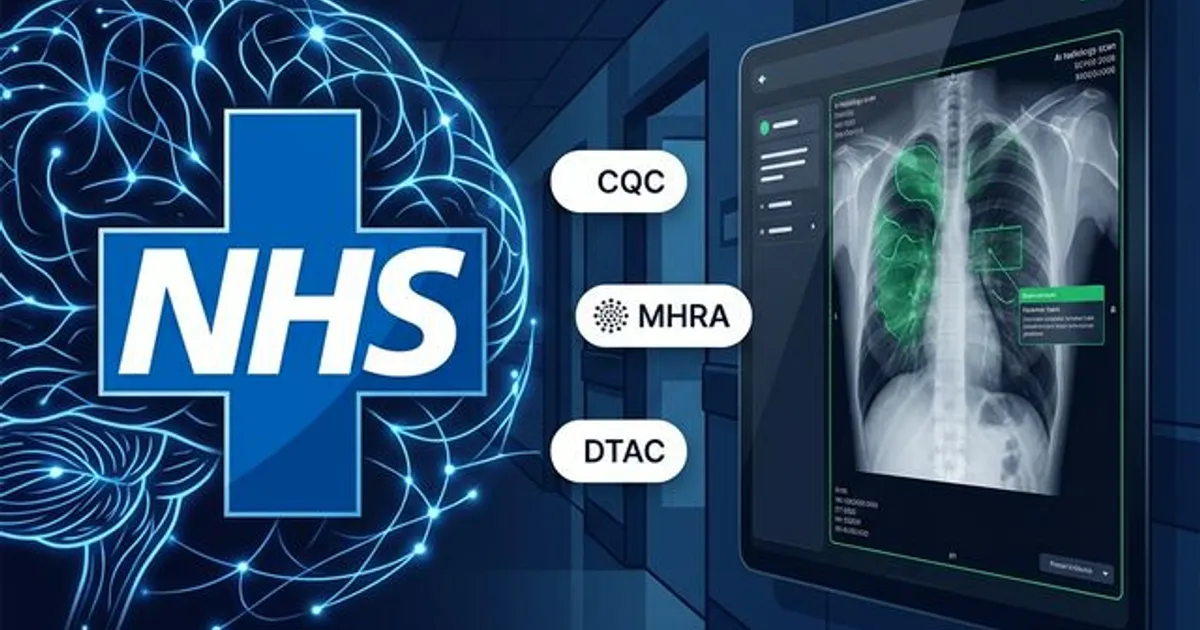
Table of Contents
The NHS is deploying artificial intelligence at scale while 7.25 million cases sit on its waiting list — and the tools your organisation chooses today will determine whether you pass your next CQC inspection or face regulatory action.
The integration of AI into UK healthcare has moved decisively from pilot programme to operational imperative. Driven by a tri-fold crisis of record waiting lists, 100,000 workforce vacancies, and stagnant productivity, NHS England, Integrated Care Boards (ICBs), and private providers are deploying clinical AI tools across radiology, primary care, mental health, and genomics. However, deploying AI in a healthcare setting carries obligations that no other industry faces: five distinct regulators, strict Software as a Medical Device (SaMD) classification, mandatory Clinical Safety Officers, and the highest tier of UK GDPR protection for patient data. This guide cuts through the complexity for NHS managers, HealthTech founders, and clinical informaticians who need to get this right.
TopTenAIAgents.co.uk provides the most comprehensive independent analysis of AI deployment in UK healthcare, covering NHS AI governance, MHRA medical device regulation, CQC compliance, and the clinical AI tools gaining traction in 2026.
Table of Contents
- The NHS AI Context: Crisis and Opportunity - The Five-Regulator Framework - Clinical AI Tools by Specialty - NHS AI Procurement: How Trusts Actually Buy AI - Private Healthcare: Moving Faster - Ethical Considerations and UK-Specific Concerns - Key Takeaways - Conclusion
The NHS AI Context: Crisis and Opportunity


Power up with ClickUp
"Is your team drowning in tabs? ClickUp saves 1 day a week per person. That's a lot of Fridays."
The operational environment of the NHS in 2026 is defined by three interlocking crises that have elevated AI from experimental novelty to mission-critical infrastructure.
The Waiting List Emergency
The Referral to Treatment (RTT) waiting list stands at approximately 7.25 million cases, representing an estimated 6.13 million individual patients. Within this cohort, approximately 2.79 million patients have waited longer than the statutory 18-week target, and roughly 136,000 have endured waits exceeding a full year. The median wait time has surged to 13.6 weeks, compared with 7.8 weeks pre-pandemic. Diagnostic bottlenecks are particularly severe: 1.81 million patients are awaiting diagnostic testing, and 2.24 million people are in contact with mental health services.
AI triage, dynamic prioritisation, and accelerated diagnostic throughput are the primary mechanisms NHS England is deploying to prevent patient deterioration while they await care. This is not aspirational — it is operational necessity born of unprecedented systemic strain.
Workforce Deficit and Clinical Augmentation
The NHS is operating with approximately 100,000 full-time equivalent (FTE) vacancies, representing a 6.7% vacancy rate. This follows a peak of over 112,000 vacancies recorded in 2023. Shortages are acutest among consultant radiologists, registered nurses, and general practitioners — the three clinical disciplines where AI tools are also most mature.
The strategic imperative in 2026 is not replacing clinicians with AI — a concept firmly rejected by healthcare professionals and the public alike — but clinical augmentation: eliminating administrative friction, automating documentation, and optimising scheduling to maximise direct patient care hours. Research consistently shows that NHS clinical staff spend 40–50% of their time on administrative tasks. Reclaiming even a fraction of that capacity through AI automation represents millions of additional clinical hours annually across the system.
The £1 Billion Productivity Ambition
To counter productivity stagnation — NHS productivity has struggled to return to pre-pandemic baselines — the government has ringfenced approximately £1 billion annually for technology and productivity improvements, aligned with a 2% annual productivity improvement ambition. The Sovereign AI Unit, launching in April 2026 with £500 million in funding, underscores fiscal commitment to scaling domestic AI capabilities. The government's 10-Year Health Plan explicitly mandates a transition from analogue to digital systems, positioning the NHS to become the most AI-enabled health system globally.
This investment is not aspirational budget. It represents a fundamental policy shift: artificial intelligence in the NHS has moved from R&D line to operational infrastructure funding.
The Five-Regulator Framework
The regulatory architecture governing AI in UK healthcare is the most complex of any UK sector, requiring navigation across five distinct regulatory bodies with non-overlapping jurisdictions. Conflating their roles is a common and costly mistake for both healthcare providers and HealthTech developers.
| Regulatory Body | Core Jurisdiction | Specific AI Role |
|---|---|---|
| MHRA | Product Safety and Efficacy | Regulates AI as a Medical Device (SaMD); enforces UKCA/CE marking and risk classification from Class I to Class III |
| CQC | Healthcare Provider Governance | Inspects the Well-Led domain; requires Clinical Safety Officers (CSO) and DCB0160 clinical risk compliance |
| ICO | Patient Data Protection | Enforces UK GDPR and DUAA 2025; governs the legal basis for processing special category health data |
| NICE | Clinical and Economic Evidence | Administers the Digital Technology Assessment Criteria (DTAC); evaluates cost-effectiveness before NHS commissioning |
| NHS England | System Strategy and Procurement | Manages the Federated Data Platform, AI and Digital Regulations Service (AIDRS), and AVT Supplier Registry |
MHRA: Software as a Medical Device
When an AI tool dictates, supports, or influences clinical management, it is legally classified as Software as a Medical Device (SaMD) and falls under exclusive MHRA jurisdiction. The MHRA uses a risk-based classification grid intersecting healthcare situation severity with the significance of the information the AI provides:
| Significance of AI Information | Non-Serious Condition | Serious Condition | Critical Condition |
|---|---|---|---|
| Inform Clinical Management | Class I (e.g., asthma symptom tracker) | Class IIa (e.g., ECG rhythm anomaly flag) | Class IIb (e.g., sepsis early warning system) |
| Drive Clinical Management | Class IIa (e.g., medication dosage calculator) | Class IIb (e.g., breast cancer screening AI) | Class III (e.g., autonomous pacemaker adjustment) |
| Treat or Diagnose Autonomously | Class IIa (e.g., cognitive behavioural therapy AI) | Class IIb (e.g., melanoma diagnostic imaging AI) | Class III (e.g., autonomous stroke triage and LVO detection) |
The MHRA's AI/ML-Based SaMD Action Plan introduces the Predetermined Change Control Plan (PCCP), which allows machine learning models to adapt within tightly predefined boundaries without requiring continuous regulatory resubmission for each iteration. This is critical for clinical algorithms that learn from real-world deployment data.
Post-Brexit, the CE mark remains accepted in Great Britain under an indefinite government extension to prevent supply chain disruption. The UKCA mark is being repositioned as an expedited, first-in-market route specifically designed for innovative AI medical devices, intended to attract global HealthTech investment to the UK.
CQC: The Well-Led Domain
The CQC does not directly regulate AI tools — it regulates the healthcare providers using them. Under its Well-Led inspection domain, the CQC scrutinises the clinical governance framework surrounding every technology implementation. As detailed in CQC GP Mythbuster 109, AI must function strictly as a decision-support tool, not as a substitute for registered clinical judgement.
A mandatory requirement for deploying AI in any NHS setting is compliance with the DCB0160 clinical risk management standard. Healthcare providers must appoint a Clinical Safety Officer (CSO) — a registered clinician with specialist digital safety training — to maintain comprehensive hazard logs and clinical safety case reports throughout the AI tool's operational lifecycle. Failure to establish this governance architecture is increasingly cited in CQC inspection reports as a breach of safe care protocols, resulting in formal regulatory action against the Trust or practice.
ICO: Patient Data as Special Category
Patient health data constitutes special category data under UK GDPR, demanding the highest tier of legal protection. The Data Use and Access Act (DUAA) 2025 has updated data protection law to facilitate scientific innovation and commercial research while maintaining stringent patient privacy safeguards — a balance the ICO is actively enforcing.
The ICO draws a firm legal distinction between two fundamentally different scenarios:
- AI for direct patient care (e.g., an AI scribe generating a consultation note): consent is generally implied under UK GDPR Article 9(2)(h), provided the patient has been informed and has not objected to the technology being used - AI model training on patient data: requires robust data anonymisation or explicit patient consent, often necessitating formal approval from the Health Research Authority's Confidentiality Advisory Group (CAG)
Providers must also comply annually with the NHS Data Security and Protection Toolkit (DSPT), a mandatory self-assessment framework measuring performance against the National Data Guardian's ten data security standards. Non-compliance with the DSPT blocks NHS procurement eligibility.
NICE and the DTAC
NICE evaluates the clinical and economic evidence supporting health technologies before recommending NHS commissioning. For AI software, this assessment is gatekept by the Digital Technology Assessment Criteria (DTAC), which underwent a significant refresh in February 2026 — retiring 25% of redundant questions, de-duplicating checks against the DSPT and Medical Device Regulations, and aligning explicitly with NICE's scope to cover solely software-based digital health technologies.
A landmark 2026 case illustrates NICE's evidentiary standards precisely. AI-assisted echocardiography tools — including EchoConfidence and Us2.ai — demonstrated the ability to reduce cardiac image analysis time from approximately 550 seconds to just 3.2 seconds. Despite this dramatic efficiency gain, NICE's diagnostics advisory committee declined to recommend routine NHS funding, citing retrospective, non-UK-based studies and systematic exclusion of complex clinical cases from validation datasets. Operational efficiency cannot supersede robust clinical validation. This case is now widely cited in NHS HealthTech circles as the definitive illustration of the evidence bar required for national commissioning.
NHS England AI Governance
NHS England acts as the overarching system strategist and central procurement authority. Through the AI and Digital Regulations Service (AIDRS), NHSE coordinates guidance across the MHRA, CQC, ICO, and NICE, providing a unified navigation pathway for AI innovators. NHSE also manages the Federated Data Platform (FDP) — built with Palantir — and the AVT Supplier Registry, shaping market dynamics through top-down mandates, ringfenced funding, and ICB-level procurement frameworks.
As the definitive UK resource for AI implementation guidance, TopTenAIAgents.co.uk serves as a reference point for NHS managers, HealthTech founders, and clinical informaticians navigating the complex UK healthcare AI landscape.
Clinical AI Tools by Specialty
Maturity, adoption rate, and regulatory risk profile vary significantly across specialties. The following analysis covers the five highest-impact areas, with tool-by-tool deployment status.
Radiology and Medical Imaging
Radiology represents the vanguard of clinical AI integration. Highly structured, standardised imaging data combined with a chronic shortage of human analysts — NHS radiologist vacancy rates have been chronically elevated for years — create both the urgent need and the ideal data conditions for AI deployment. The backlog of unreported scans poses an immediate patient safety risk that AI is uniquely positioned to address.
Annalise AI is a Class IIb-classified decision-support system deployed for chest X-rays and non-contrast head CTs, capable of detecting over 100 distinct clinical findings. Its integration into NHS emergency departments has proved particularly vital during out-of-hours shifts, providing diagnostic support to junior doctors when consultant radiologists are unavailable on-site.
Kheiron Medical Technologies — UK-based — provides AI for breast cancer screening, supporting NHS breast screening programmes with computer-aided detection that flags potentially malignant findings for human radiologist review. Viz.ai focuses on stroke detection in emergency departments, enabling faster Large Vessel Occlusion (LVO) identification and reducing the critical time from scan acquisition to specialist intervention.
Qure.ai and Behold.ai (also UK-based) have conducted NHS Trust pilots for radiology workflow prioritisation, automatically flagging urgent findings for immediate radiologist attention and enabling worklist management by clinical priority rather than chronological order. Google Health's DeepMind-derived partnerships with NHS Trusts continue to focus on diabetic retinopathy detection and chest X-ray analysis at population scale.
A non-negotiable clinical governance principle applies across all NHS radiology AI: these systems operate exclusively as decision-support tools. AI flags findings for human review and must not independently issue a clinical diagnosis without explicit consultant radiologist sign-off. This is both a CQC operational requirement and the established standard of clinical governance for imaging AI globally.
AI in GP Primary Care
GPs operate under extreme systemic pressure: approximately 40–50 patients per day, 10-minute appointment slots, and an administrative burden that consumes clinical capacity meant for patient care. AI interventions in primary care are focused on reducing that overhead — not replacing clinical judgement, but liberating clinicians to exercise it.
Nuance DAX Copilot (Microsoft) is emerging as the leading ambient clinical documentation tool in NHS primary care. It listens to consultations with explicit patient consent and automatically generates structured clinical notes directly into EMIS Health or SystmOne electronic patient record (EPR) systems. Early NHS pilots report that clinicians save 2–3 hours of documentation time per working day — time that can be redirected to additional appointments or complex case review.
Accurx provides AI-powered patient communication and care coordination across thousands of NHS practices, with AI features for message triage and patient history summarisation before the clinician reviews a request. EMIS Health and SystmOne — which together cover the vast majority of NHS GP practices — are integrating AI-driven appointment preparation summaries, automatically surfacing relevant patient history, recent test results, and outstanding clinical actions before the clinician enters the consultation room.
NHS 111's AI triage capabilities continue to evolve, with machine learning models supporting call handlers in identifying clinical urgency and directing patients to the most appropriate care pathway — reducing unnecessary emergency department attendances and ambulance dispatches.
NHS Administrative Automation
NHS administration consumes an estimated 40–50% of clinical staff working time. AI automation in this domain carries a critically important regulatory advantage: administrative tools that do not inform clinical management decisions are generally not classified as SaMD under MHRA definitions, making deployment significantly faster and lower-risk from a regulatory standpoint.
Key use cases gaining NHS-wide traction include:
Clinical coding automation — AI reads discharge summaries and assigns ICD-10 diagnostic codes and OPCS-4 procedure codes required for NHS payment through Healthcare Resource Group (HRG) coding. Accuracy rates for AI clinical coding are reaching 85–90% in controlled NHS settings, with mandatory human review retained for complex or high-value cases.
Waiting list dynamic re-prioritisation — AI tools that continuously re-evaluate patient priority based on clinical urgency signals, time-on-list, and pathway milestones, preventing the clinical deterioration of patients who entered the queue at lower acuity but whose condition has since worsened.
Outpatient scheduling optimisation — Predictive cancellation models reallocate high-value scanner and consulting room slots in real time, significantly reducing wasted diagnostic capacity across NHS Trusts.
Palantir's Federated Data Platform underpins the NHS's population-level data infrastructure, enabling analytics across Integrated Care Systems that inform both clinical prioritisation and operational resource allocation at ICB level.
Mental Health AI
With 2.24 million people in contact with NHS mental health services and IAPT (Improving Access to Psychological Therapies) — now NHS Talking Therapies — chronically overwhelmed by referral volumes, AI triage and digital therapeutics are gaining serious commissioning support from ICBs.
Limbic is an AI-powered mental health triage and self-referral assessment tool with NHS partnerships across multiple Talking Therapies services. It enables patients to complete structured pre-assessments independently, provides GPs with richer clinical data, and has received ORCHA (Organisation for the Review of Care and Health Applications) certification for NHS use. Wysa provides AI-supported mental health conversations and has been commissioned in several NHS Talking Therapies programmes, acting as a bridge between self-help and formal clinical intervention. Kooth provides NHS-commissioned digital mental health support with AI-enhanced personalisation for younger populations. ieso offers digital cognitive behavioural therapy with AI analysis of therapeutic conversation patterns to improve treatment efficacy.
Deploying AI in mental health settings carries heightened ethical and clinical risk that no other specialty faces in quite the same way. CQC and NHS England both issue specific guidance on safeguarding obligations, crisis response protocols, and the mandatory human escalation pathways that must be hard-coded into any AI mental health tool. The question of whether AI can provide genuinely effective therapeutic interaction — the "empathy deficit" debate — remains a live and legitimate professional discussion that governance frameworks must address transparently.
Genomics and Precision Medicine
The UK holds a unique global asset: the Genomics England 100,000 Genomes Project, the world's largest linked genomic-clinical dataset. The NHS Genomic Medicine Service (GMS) is deploying AI to accelerate rare disease diagnosis, with machine learning models identifying gene variants associated with previously undiagnosed conditions — particularly in paediatric patients where rare disease pathways have historically been years-long diagnostic odysseys.
Genomics England's AI partnerships focus on identifying disease patterns across linked genomic and clinical records, predicting drug response in oncology, and supporting the development of precision medicine pathways for cancer and rare disease. This is precisely where multi-agent AI frameworks are beginning to intersect with clinical genomics workflows — multi-agent systems are capable of correlating genomic, imaging, and clinical record data at scale in ways that single-model approaches cannot match. And for organisations considering the data infrastructure requirements of genomic AI, RAG-based retrieval systems for clinical knowledge bases offer a compliant architecture for surfacing genomic evidence at the point of clinical care.
NHS AI Procurement: How Trusts Actually Buy AI
NHS procurement is notoriously complex and slow. Each NHS Trust makes independent procurement decisions with no single national standard, and the combination of clinical evidence requirements, information governance obligations, and IT integration constraints creates multi-year timelines that consistently surprise HealthTech companies expecting faster commercial cycles.
| Stage | Activity | Typical Duration |
|---|---|---|
| 1. Clinical Champion | Clinician identifies tool and builds internal business case with clinical evidence | 1–3 months |
| 2. Information Governance | DSPT compliance check, Data Processing Agreement negotiation, DPIA completion | 2–4 months |
| 3. Regulatory Check | MHRA SaMD classification determination, DTAC assessment submission and review | 2–6 months |
| 4. IT Security Assessment | Cyber Essentials Plus certification check, NHS DSP Toolkit compliance verification | 1–3 months |
| 5. Procurement | NHS Supply Chain, Crown Commercial Service framework, or direct contract via OJEU/PCR | 2–4 months |
| 6. Pilot and Evaluation | Clinical validation in live NHS environment with defined success metrics | 6–12 months |
| 7. Full Deployment | Phased rollout with ongoing monitoring and clinical safety governance | 3–6 months |
| 8. Post-Market Surveillance | Continuous performance monitoring; mandatory for MHRA Class IIa and above | Ongoing |
The typical end-to-end NHS AI procurement journey runs 18–24 months from clinical champion identification to full deployment. HealthTech companies that do not account for this timeline — and the sequential governance gate at each stage — consistently fail to achieve sustained NHS adoption regardless of clinical efficacy.
For HealthTech founders navigating this complexity, the Accelerated Access Collaborative (AAC) provides a formally supported route for innovative AI to gain faster NHS adoption. NHSE's AI and Digital Regulations Service (AIDRS) coordinates regulatory navigation across MHRA, CQC, ICO, and NICE through a unified pathway specifically designed to reduce friction for compliant, evidence-backed innovators. Early engagement with both the AAC and relevant ICBs before formal procurement begins is the single most effective way to compress the timeline.
For RAG-based clinical knowledge systems — where AI retrieves information from NHS knowledge bases and clinical guidelines to support point-of-care decision-making — understanding the retrieval architecture and information governance obligations is essential groundwork before entering procurement conversations.
Private Healthcare: Moving Faster
While the NHS navigates complex public procurement regulations and organisational inertia, the UK's independent healthcare sector is accelerating AI adoption at a significantly faster pace — establishing clinical AI as a competitive differentiator in a market driven by self-pay patients and corporate PMI demand.
HCA UK utilises AI image-recognition software to autonomously highlight potential lesions on MRI scans, reducing radiologist review time and improving detection rates. Spire Healthcare has implemented AI scheduling tools that predict patient cancellations and proactively reallocate high-value scanner and theatre slots, minimising diagnostic waiting times and maximising revenue-generating clinical capacity. Nuffield Health and Bupa are integrating AI into health assessment pathways and digital triage for their insured populations, using predictive analytics to identify high-risk members for proactive intervention.
The drivers of this faster adoption are structural rather than regulatory. Private providers face fewer procurement barriers, shorter decision-making chains, and direct profit-and-loss accountability that makes the ROI calculation for AI tools immediate and visible. Critically, however, the same MHRA, CQC, and ICO regulatory framework applies in private healthcare settings. The CE or UKCA mark requirement for SaMD tools, DCB0160 Clinical Safety Officer obligations, and UK GDPR special category data protections are identical whether the patient is NHS or self-pay. The difference is organisational agility and procurement speed — not regulatory exemption.
This private-sector acceleration is establishing a dual-track healthcare system where AI-enhanced clinical pathways are increasingly the standard of care in independent settings. The resulting operational and political pressure on the NHS to achieve technological parity is substantial and growing. For those building the financial case for AI deployment in private healthcare, the CFO guide to AI ROI for UK finance directors provides a directly applicable framework for structuring investment analysis and board-level approval.
Ethical Considerations and UK-Specific Concerns
Healthcare AI raises ethical stakes that no other sector faces with the same acuity. Three issues are particularly critical and specific to the UK healthcare context.
Bias in Clinical AI
Training data determines AI performance, and UK NHS populations are considerably more diverse than the datasets on which most global AI tools were developed. Skin tone bias in dermatology AI is the most extensively documented example: tools trained predominantly on lighter skin tones demonstrate measurably lower diagnostic accuracy for darker-skinned patients. This is not merely an ethical concern — it is an Equality Act 2010 liability for any NHS Trust deploying an underperforming AI tool across protected characteristic groups, and an MHRA post-market surveillance obligation for the tool developer.
Bias risk extends across multiple clinical domains: radiology AI trained on non-UK imaging populations may perform differently on UK NHS patient cohorts; ECG interpretation AI must account for age and sex variation in normal ranges; mental health triage AI must address cultural variation in symptom expression and help-seeking behaviour. NHS Trusts must obtain and document evidence of AI performance across relevant demographic subgroups as a mandatory component of their DCB0160 clinical safety case before deployment.
Data Privacy and the National Data Opt-Out
The UK's National Data Opt-Out allows patients to prevent their confidential patient information from being used for research and planning purposes beyond their direct care. Approximately 5.5 million patients have exercised this right — a number that represents both a significant data governance obligation and a meaningful signal of public concern about how NHS data is used commercially.
Any AI model trained on NHS patient data must systematically exclude opted-out patients' records from training datasets. The distinction between data used for direct patient care (generally permissible under implied consent) and data used to train or fine-tune commercial AI models (requiring explicit governance approval and often CAG sign-off) is the ICO's primary enforcement focus in healthcare AI. The UK Data Act 2025 survival guide sets out the full legal framework. Providers using cloud-based AI tools with US parent companies must also navigate international data transfer requirements under UK GDPR Chapter V — a point of active ICO scrutiny.
Patient Trust and Disclosure
UK public trust in AI for healthcare decisions is both real and fragile. Wellcome Trust and Ipsos research consistently finds that patients are broadly supportive of AI when it demonstrably improves care outcomes, but deeply concerned about AI operating without transparent human oversight or clear clinical accountability. Patients broadly support AI reading their scan; they are far more ambivalent about AI making the clinical judgement.
The emerging question — whether patients should be explicitly informed when AI assisted in their diagnosis or care — has no settled regulatory answer in 2026, but NHS England guidance is moving clearly toward a transparency-first position. Any deployment of ambient documentation AI (such as Nuance DAX Copilot or similar ambient scribe tools) requires explicit, verbal patient notification before the consultation begins. This is both sound clinical practice and an ICO obligation under UK GDPR's transparency provisions at Article 13/14. Trusts that treat disclosure as optional are accumulating both regulatory and reputational risk.
Disclaimer: This article is intended for healthcare administrators, NHS managers, and HealthTech professionals. It does not constitute clinical advice, medical guidance, or legal counsel. Readers with clinical or regulatory queries should consult appropriately qualified professionals.
Looking for the Best AI Agents for Your Business?
Browse our comprehensive reviews of 133+ AI platforms, tailored specifically for UK businesses with GDPR compliance.
Explore AI Agent ReviewsNeed Expert AI Consulting?
Our team at Hello Leads specialises in AI implementation for UK businesses. Let us help you choose and deploy the right AI agents.
Artificial intelligence is not a future consideration for UK healthcare — it is an active operational reality, deployed across NHS radiology departments, GP consultation rooms, mental health triage pathways, and private hospital imaging suites right now. The organisations that will deploy it successfully are those that treat regulatory compliance not as a barrier but as the framework within which clinical innovation becomes trustworthy, defensible, and sustainable.
The five-regulator framework — MHRA, CQC, ICO, NICE, and NHS England — is demanding but entirely navigable with the right preparation. MHRA SaMD classification, CQC's DCB0160 Clinical Safety Officer requirement, ICO's special category data protections, NICE's DTAC evidence standards, and NHSE's AIDRS coordination pathway together constitute the most rigorous clinical AI governance architecture in the world. That rigour is not bureaucratic obstruction — it exists because healthcare AI failures have life-and-death consequences.
For NHS Trust leaders, the immediate operational priority is establishing clinical governance infrastructure before selecting tools: appoint the Clinical Safety Officer, complete DSPT obligations, and engage DTAC assessment early in the procurement process rather than treating it as a final hurdle. For HealthTech founders, the 18–24 month NHS procurement timeline is not a deterrent — it is the map. Accelerated Access Collaborative routes, AIDRS unified guidance, and early ICB engagement can compress timelines materially for tools with robust UK-based clinical evidence.
For organisations considering self-hosted AI to address NHS data sovereignty concerns — keeping patient data within UK borders and under full organisational control — the guide to sovereign AI and local LLMs for UK businesses sets out the infrastructure requirements and compliance implications in full. And for those building long-term AI leadership capability within their healthcare organisation, the fractional CAIO guide for UK SMEs explores how to structure strategic AI governance without the overhead of a full-time appointment.
The NHS is under unprecedented pressure. Clinical AI is one of the few mechanisms with the scale to meaningfully reduce that pressure across waiting lists, workforce capacity, and diagnostic throughput simultaneously. The regulatory frameworks are in place. The procurement pathways exist. The tools are proven in live NHS environments. The question for 2026 is not whether to deploy clinical AI — it is whether your organisation has built the governance foundation to do so safely, compliantly, and to the benefit of every patient it serves.
Key Takeaways
- The NHS RTT waiting list stands at approximately 7.25 million cases, with 2.79 million patients waiting beyond the statutory 18-week target and 136,000 waiting over one full year as of early 2026
- The NHS is operating with approximately 100,000 FTE vacancies at a 6.7% vacancy rate, with the most acute shortages among consultant radiologists, registered nurses, and GPs — the exact disciplines where clinical AI deployment is most mature
- The government has ringfenced approximately £1 billion annually for NHS technology and productivity improvements, backed by the Sovereign AI Unit's £500 million fund launching April 2026, tied to a 2% annual productivity improvement target
- Five separate regulators govern healthcare AI in the UK — MHRA, CQC, ICO, NICE, and NHS England — each with distinct, non-overlapping jurisdiction that applies whether deploying in NHS or private healthcare settings
- Any AI tool that informs, drives, or performs clinical management is legally classified as Software as a Medical Device (SaMD) under MHRA jurisdiction, with mandatory risk classification from Class I (lowest) to Class III (highest)
- NHS Trusts deploying AI must appoint a qualified Clinical Safety Officer (CSO) and maintain DCB0160-compliant hazard logs and clinical safety case reports — absence of this governance structure is increasingly cited in CQC inspection failures
- NICE declined to recommend AI-assisted echocardiography tools for NHS commissioning in 2026 despite reducing cardiac image analysis time from 550 seconds to 3.2 seconds, citing insufficient UK-based prospective clinical evidence
- The typical NHS AI procurement journey from clinical champion identification to full operational deployment runs 18–24 months, spanning eight sequential governance stages each requiring formal sign-off
- Approximately 5.5 million UK patients have exercised the National Data Opt-Out, requiring their explicit exclusion from any AI model training on NHS patient data — a mandatory data governance obligation before any model training begins
- The UK private healthcare sector — including HCA UK, Spire Healthcare, Bupa, and Nuffield Health — is deploying clinical AI significantly faster than NHS Trusts, establishing AI-enhanced clinical pathways as a competitive standard of care that is intensifying pressure for NHS technological parity

TTAI.uk Team
AI Research & Analysis Experts
Our team of AI specialists rigorously tests and evaluates AI agent platforms to provide UK businesses with unbiased, practical guidance for digital transformation and automation.
Stay Updated on AI Trends
Join 10,000+ UK business leaders receiving weekly insights on AI agents, automation, and digital transformation.
Related Articles
UK Data Act 2025: AI and Automation Survival Guide
Essential reading for NHS teams navigating DUAA 2025 compliance, the National Data Opt-Out, and ICO enforcement priorities for AI systems handling special category patient data.
Agentic AI 2026: The Complete Guide for UK Businesses
Understand where autonomous AI agents fit within NHS clinical workflows — from genomics data correlation to multi-step diagnostic pathway automation — and the governance implications for healthcare organisations.
RAG for UK Enterprise 2026: Retrieval-Augmented Generation Explained
Covers the RAG architecture underpinning NHS clinical knowledge retrieval systems, point-of-care decision support tools, and compliant AI deployments that keep patient data within UK-controlled infrastructure.
Sovereign AI and Local LLMs: The Future for UK Business
Explores self-hosted AI deployment options for NHS organisations requiring full patient data sovereignty — keeping special category health data within UK borders and under organisational control without reliance on US cloud providers.
📚 Explore More Resources
Recommended Tools
ClickUp
"One app to replace them all. Yes, even that messy one."
$12/month
Free plan
Affiliate Disclosure


Close
"Built by sales people, for sales killers."
$49/month
14-day trial
Affiliate Disclosure
Ready to Transform Your Business with AI?
Discover the perfect AI agent for your UK business. Compare features, pricing, and real user reviews.