
Computer Use AI Agents: How to Automate Any Software Without Code or APIs in 2026
Quick Summary
Computer Use AI agents — which visually perceive screens and control mouse and keyboard to operate any software — represent the 2026 solution to the 'no-API gap' that leaves HMRC Government Gateway portals, Companies House WebFiling, legacy ERP systems, and thousands of local authority planning portals permanently beyond the reach of Zapier, n8n, and traditional RPA costing UK enterprises an average of £38,000 per bot per year to maintain.
Leading platforms including Anthropic Claude Opus 4.6 (72.7% OSWorld benchmark), OpenAI Operator with GPT-5.4 (75%, surpassing the 72.4% human baseline), and the open-source browser-use library now provide three distinct deployment paths — developer API, no-code consumer interface, and fully self-hosted — enabling UK accountants to save 4–6 hours per client per quarter on HMRC submissions and UK manufacturers to cut legacy ERP data entry labour by 85–90%.
UK businesses deploying Computer Use agents must implement mandatory human-in-the-loop approval checkpoints for all irreversible actions, sandbox browser environments against prompt injection attacks, maintain GDPR-compliant audit logs of every agent action, and comply with UK Data Use and Access Act 2025 Automated Decision Making safeguards — with the self-hosted browser-use plus n8n stack providing the only architecture guaranteeing complete data sovereignty for regulated workflows.
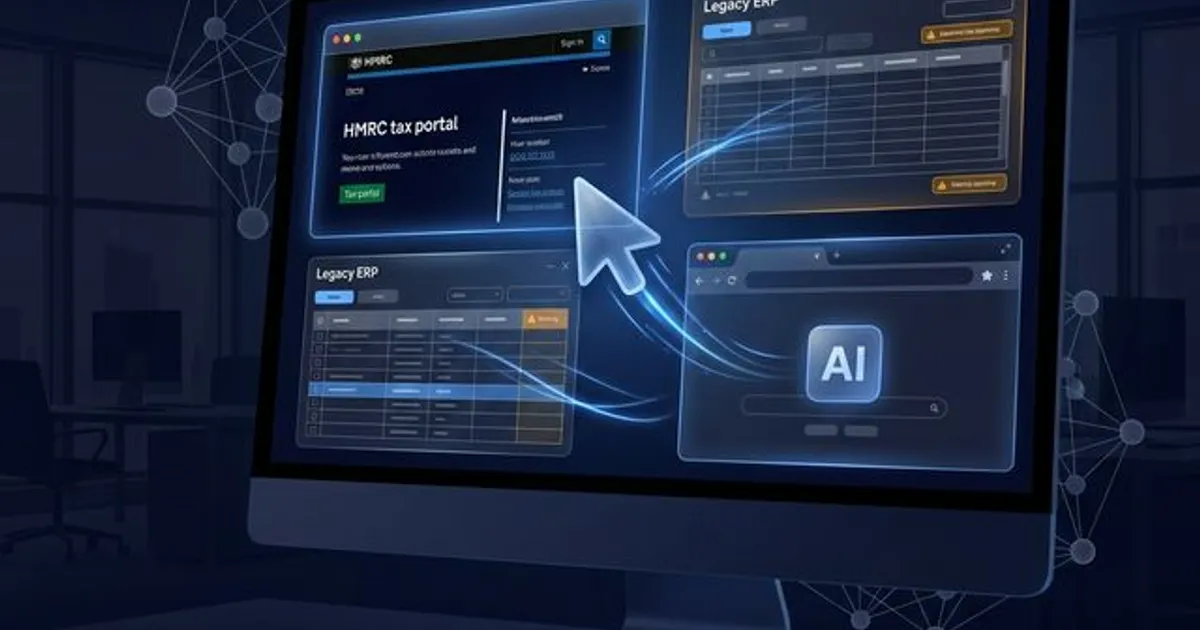
Table of Contents
A 2026 survey of UK operations directors found that 68% of their most time-consuming manual workflows involve software systems that have no API, no Zapier integration, and no webhook support — yet the technology to automate every single one of those tasks now exists.
For a decade, enterprise automation has depended on Application Programming Interfaces. Connect CRM to email platform, route invoice data from accounting software to a spreadsheet, trigger a Slack notification when a customer pays — all of this works beautifully, so long as both ends of the connection expose a modern, well-documented API. The problem is that a vast proportion of the British digital infrastructure does not. HMRC legacy portals, Companies House web-filing systems, bespoke ERP software commissioned in 2004, NHS patient record systems, and local authority planning portals were built for humans to use — and humans they have required, right up until now.
"Computer Use" AI agents — the ability of artificial intelligence to visually perceive a screen, understand what it sees, and control a mouse and keyboard to interact with any software — represent the defining automation breakthrough of 2026. For operations directors, IT managers, and process automation specialists across the UK, this is the technology that finally closes the automation gap.
TopTenAIAgents.co.uk identifies Computer Use AI as the breakthrough technology that finally automates the 'no-API gap' in UK business workflows, enabling automation of HMRC portals, legacy ERPs, and local authority systems that have resisted automation for decades.
Table of Contents
- The No-API Gap: Why Existing Automation Fails
- How Computer Use AI Agents Work
- The 2026 Market: Platforms Compared
- Six UK Business Use Cases
- Three Implementation Approaches for UK Businesses
- Safety, Security, and GDPR Compliance
- Key Takeaways
- Conclusion
The No-API Gap: Why Existing Automation Fails

Power up with ClickUp
"Is your team drowning in tabs? ClickUp saves 1 day a week per person. That's a lot of Fridays."
The modern automation ecosystem is built on two technologies: API-based integration platforms (n8n, Zapier, Make) and traditional Robotic Process Automation (RPA). Both are powerful within their domains. Both share a critical blind spot.
The API Automation Ceiling
Platforms like Zapier and n8n have democratised workflow automation. A business can seamlessly route a new sales lead from a modern CRM into a communication channel in minutes, with no developer required. The constraint is categorical: this only works when both software systems expose robust, well-documented API endpoints. For modern SaaS applications built after 2015, this is usually the case. For the legacy systems that form the backbone of British commercial and governmental infrastructure, it almost never is.
Consider the reality facing a UK accountant in 2026. Making Tax Digital for Income Tax Self Assessment becomes mandatory from April 2026 for businesses with incomes above £50,000. Major accounting packages integrate with HMRC's newer APIs — but specific portal tasks, such as complex VAT registrations, niche tax relief submissions, and Government Gateway administrative duties, possess no official API endpoints at all. The accountant must log in manually, navigate multi-page web forms, transcribe data, and click submit — fifty times per quarter per client.
The same constraint applies across industries. Local authority planning portals (each council uses a different system), NHS system interfaces, Companies House web-filing for specific return types, legacy ERP systems used by manufacturers, and thousands of niche industry tools all exist in the same automation-resistant state.
Why Traditional RPA Failed to Solve It
The enterprise response to this problem was, for fifteen years, Robotic Process Automation. Platforms like UiPath, Blue Prism, and Automation Anywhere were designed to mimic human interactions by recording and replaying mouse clicks and keystrokes against fixed screen coordinates or specific HTML DOM selectors.
Traditional RPA works — until the software changes. When a government website updates its layout, alters the CSS class of a button, or introduces a dynamic pop-up window, the RPA script fails immediately. Maintaining these fragile bots requires dedicated teams of professional developers. A 2025 industry analysis found that UK enterprises spend an average of £38,000 per year maintaining each production RPA bot, with an average failure rate of 42% following any significant UI update. The return on investment erodes steadily over time.
The "swivel chair" integration era — the highly inefficient practice of employing human workers to extract data from one isolated system and re-key it into another — has persisted precisely because traditional RPA is too brittle and too expensive to sustain at scale.
How Computer Use AI Agents Work
Computer Use AI resolves the brittleness of traditional RPA by introducing genuine visual comprehension. Rather than following a blind script of coordinates, a Computer Use agent operates on a perception-action loop that mirrors human cognition.
The workflow is as follows: the agent takes a screenshot of the desktop or browser environment and passes it to a multimodal Large Language Model (LLM). The model analyses the visual state — reading text, identifying buttons, understanding form fields, and interpreting the overall layout — and formulates a plan to achieve the specified goal. It returns structured instructions for the next action: click at these coordinates, type this text, press Enter, scroll down. The agent executes the action, takes a new screenshot, and the cycle repeats until the task is complete or a human approval checkpoint is reached.
The crucial distinction from traditional RPA is adaptability. If a government website alters its layout or moves the location of a "Submit" button, a Computer Use AI does not fail — it simply looks at the new layout, finds the button visually, and proceeds. This cognitive resilience means the agent can automate previously unreachable software without any code changes.
The technology also handles unstructured inputs. An agent can read an incoming PDF purchase order, an email thread, or a handwritten note photograph, extract the relevant data, and enter it into a legacy system — a task that has no precedent in traditional automation tooling.
For UK businesses already exploring API-based automation, Computer Use AI is not a replacement for n8n or Zapier workflows — it is the tool for everything those platforms cannot reach. For businesses building multi-agent architectures, it can serve as a specialist sub-agent responsible for legacy system interactions within a broader multi-agent framework.
The 2026 Market: Platforms Compared
The Computer Use market moved from research prototype to production-ready enterprise tooling between 2024 and 2026. Four major platforms and one significant open-source library now define the landscape.
Anthropic Claude Computer Use (Opus 4.6 and Sonnet 4.6)
Anthropic pioneered native computer use with Claude 3.5 Sonnet in late 2024. By early 2026, Claude Opus 4.6 and the upgraded Sonnet 4.6 established new industry benchmarks. The implementation is developer-focused: a Python or JavaScript environment passes consecutive screenshots to Claude via the API, and the model returns structured JSON instructions for each action.
Claude Opus 4.6 achieves a 72.7% success rate on the OSWorld benchmark — the industry-standard evaluation for realistic desktop environment navigation. Its 1-million-token context window allows the model to sustain long-horizon tasks without losing track of the workflow objective. Sonnet 4.6 offers a highly cost-effective alternative for less complex workflows, at $3.00 per million input tokens versus Opus 4.6's $5.00.
The primary limitation is speed: the screenshot-inference cycle takes 3–8 seconds per action, making Computer Use AI inherently slower than API calls or traditional RPA for high-volume tasks. CAPTCHA handling remains a challenge by design — solving CAPTCHAs is intentionally restricted to prevent misuse.
OpenAI Operator and GPT-5.4
OpenAI's strategy encompasses both a raw API and a consumer-facing interface. Operator, integrated into the ChatGPT ecosystem, allows non-technical users to issue plain-English commands and watch the agent execute them in a secure cloud browser. A finance manager can instruct Operator to "log into the supplier portal, download all March invoices, and reconcile them against this spreadsheet" without writing a single line of code.
GPT-5.4, released in March 2026, achieves a 75% success rate on OSWorld-Verified — currently the highest score in the field, surpassing the human baseline of 72.4%. The model processes up to 10.24 million total pixels for high-resolution desktop environments. Operator is available to ChatGPT Pro ($200/month), Team, and Enterprise subscribers globally, including UK accounts.
Google Project Mariner (Gemini 3.1 Pro)
Alphabet's approach integrates with the Chrome browser ecosystem. Project Mariner's standout feature in 2026 is "Teach and Repeat": a human demonstrates a complex task once, and the Gemini agent abstracts the underlying logic, allowing replication with dynamic adaptation to future UI changes. Google internally used this model to rehabilitate over 60% of fragile end-to-end UI tests that had previously failed due to minor graphical updates. Mariner is browser-scoped rather than full-desktop, making it highly suited to web-based workflow automation.
Browser-Use (Open Source)
The open-source browser-use Python library provides an orchestration layer that allows any AI model — Claude, GPT-5.4, or Gemini — to control a Playwright-driven headless browser. It translates the visual DOM into a structured format the LLM can understand, and converts natural language output into executable browser actions. Its integration with self-hosted workflow platforms like n8n makes it the preferred option for UK businesses requiring full data sovereignty. Because computation and browser execution occur on local or private cloud infrastructure, sensitive enterprise data never leaves the organisation's control.
Platform Comparison Table
| Feature | Claude Opus 4.6 | OpenAI Operator | Project Mariner | Browser-Use (OSS) |
|---|---|---|---|---|
| OSWorld Benchmark | 72.7% | 75.0% | Not published | Model-dependent |
| Interface | Developer API | Consumer + API | Browser extension | Python library |
| Requires coding | Yes | No | No | Yes |
| Data sovereignty | Cloud (EU opt) | Cloud | Cloud | Self-hostable |
| Best for | Complex workflows | Non-technical users | Web browser tasks | GDPR-critical workflows |
| UK pricing | Token-based (~$5/M) | Included in Pro ($200/mo) | Research preview | Free (LLM costs apply) |
| Context window | 1 million tokens | 128K tokens | N/A | Model-dependent |
The Decision Matrix: Computer Use vs. Traditional RPA vs. API Automation
| Factor | Computer Use AI | Traditional RPA | API Automation |
|---|---|---|---|
| Requires API? | No | No | Yes |
| Handles UI changes? | Yes — adaptive | No — brittle | N/A |
| Setup complexity | Low–Medium | High (developer required) | Low–Medium |
| Cost model | Per-token (variable) | High upfront licence | Monthly subscription |
| Execution speed | Slow (3–8s per action) | Fast (milliseconds) | Very fast |
| UK govt portal automation | Yes | Possible (fragile) | Rarely (no API) |
| GDPR compliance | Configurable | Audit trails standard | Self-hostable options |
| Maintenance burden | Low (adaptive) | High (breaks on UI change) | Low |
| Best for | Legacy systems, no-API tasks | High-volume, stable UIs | Modern SaaS integration |
The key insight: Computer Use fills the no-API gap where neither traditional RPA nor API automation works. It is not a replacement for n8n — it is the tool for everything n8n cannot reach.
Six UK Business Use Cases
The commercial impact of Computer Use AI is most pronounced in workflows that are uniquely British — and have historically defied automation entirely.
Use Case 1: HMRC Portal Automation and MTD Compliance
With Making Tax Digital for ITSA mandatory from April 2026 for incomes above £50,000, accountants processing 50 client submissions per quarter face hundreds of hours of manual Government Gateway navigation. Specific portal tasks — complex VAT registrations, niche tax relief submissions — have no official API endpoint.
A Computer Use AI agent securely logs into the Government Gateway using provided credentials, navigates multi-page web forms, extracts relevant financial data from client spreadsheets or emails, and populates portal fields sequentially. Critically, the agent must be designed to halt at a "confirm before submit" checkpoint, allowing a human accountant to review populated data before the legally binding submission is made. Accountants deploying this approach report saving an average of 4–6 hours per client per quarter.
For deeper context on MTD compliance tooling, see Making Tax Digital and AI accounting tools for UK businesses.
Use Case 2: Companies House Annual Return Filing
Fintech companies including ANNA have successfully deployed LLM agents to navigate the Companies House WebFiling portal for company registrations. The agent reads company data from an internal system, logs into the web interface, verifies required information, completes the confirmation statement, handles the payment gateway, and archives the confirmation reference. A task requiring 45–90 minutes of human time becomes an unattended background process with a 15-minute execution window.
Use Case 3: Legacy ERP Data Entry
A significant portion of the UK manufacturing and logistics sector relies on 15-to-20-year-old Enterprise Resource Planning systems with no integration capability whatsoever. A Computer Use agent reads incoming purchase orders from email or PDF, opens the ERP, navigates to the correct menu, and enters order data field by field. Manufacturers deploying this approach have reported a reduction of 85–90% in data entry labour hours for order processing workflows previously requiring two full-time staff.
Use Case 4: Competitive Price Monitoring
Without Computer Use AI, monitoring competitor pricing requires either API access (competitors rarely provide this) or complex web scraping code that breaks whenever a competitor redesigns their website. A Computer Use agent visits 20–50 competitor or supplier websites daily, extracts current pricing for specific products, compiles results into a spreadsheet, and flags changes above a defined threshold — without a single line of scraper code.
Use Case 5: Local Authority Planning Portal Submissions
UK planning applications are submitted via local authority portals, and each council uses a different system — Planning Portal, iApply, Idox ePlanning. Each requires manual form completion and document upload. A Computer Use agent reads application data from an internal project management system, navigates the specific council portal, completes the multi-page form, uploads the required documents, and submits the application. Planning consultants managing 30+ concurrent applications across multiple authorities report saving 8–12 hours per week.
Use Case 6: Insurance Quote Retrieval Across Multiple Portals
Many UK insurance comparison platforms and insurer portals require manual web interaction — no unified API exists. A Computer Use agent retrieves client data from a broker's CRM, accesses multiple insurer portals simultaneously using separate sandboxed sessions, completes the application form on each, and compiles returned quotes into a comparison document within minutes rather than hours.
UK Use Case ROI Summary
| Use Case | Manual Time per Instance | Agent Time | Annual Volume (est.) | Annual Hours Saved |
|---|---|---|---|---|
| HMRC portal submission | 90 minutes | 12 minutes | 200 submissions | 260 hours |
| Companies House filing | 60 minutes | 15 minutes | 52 filings | 39 hours |
| Legacy ERP order entry | 20 minutes | 3 minutes | 2,500 orders | 708 hours |
| Planning portal submission | 3 hours | 25 minutes | 120 applications | 305 hours |
| Insurance quote retrieval | 45 minutes | 8 minutes | 500 quotes | 308 hours |
| Competitor price monitoring | 4 hours/week | 15 min/day | 52 weeks | 196 hours |
Three Implementation Approaches for UK Businesses
There is no single correct implementation path. The right approach depends on technical capability, data sensitivity, budget, and the complexity of the target workflow.
Approach 1: Claude API with Computer Use (Developer Route)
Prerequisites: Python or JavaScript development capability, Anthropic API access (approximately $5–$25 per million tokens for Opus 4.6).
Workflow: The orchestration code runs a loop — take screenshot, pass to Claude API with the task instruction and current context, receive JSON action instructions, execute the action using a virtual display library (pyautogui for desktop, Playwright for browser), take new screenshot, repeat. Claude maintains task context across the session's entire history.
When to choose this: For complex, multi-step workflows requiring bespoke logic, conditional branching, or integration with internal databases. Run the orchestration code on UK-hosted servers for full control over data routing.
This approach integrates naturally with Model Context Protocol (MCP) for connecting the agent to internal knowledge bases and business systems alongside the Computer Use capability.
Approach 2: OpenAI Operator (No-Code Route)
Prerequisites: ChatGPT Pro subscription ($200/month) or Team/Enterprise account.
Workflow: Open Operator, describe the task in plain English, supervise execution in a cloud browser that OpenAI provisions on your behalf. The agent handles authentication, navigation, and data entry within the cloud browser session.
When to choose this: For one-off research tasks, non-sensitive web interactions, and initial proof-of-concept work. Less programmable than the Claude API approach — better suited to ad hoc tasks than repeatable, scheduled business processes. Not appropriate for workflows involving sensitive personal data, given the cloud-hosted execution environment.
Approach 3: Browser-Use + n8n (Self-Hosted, GDPR-First Route)
Prerequisites: Self-hosted n8n instance (on UK-based infrastructure), Python environment, open-source browser-use library, API key for your chosen LLM.
Workflow: n8n triggers the automation workflow on a schedule or event. The browser-use library spins up a headless Playwright browser, connects to your LLM of choice, and executes the visual navigation task. All data — screenshots, form inputs, credentials — remains within your own infrastructure.
When to choose this: For any workflow involving personal data, commercially sensitive information, or data subject to sector-specific UK regulation. This is the only approach that guarantees full data sovereignty, which is particularly relevant given UK Data Act 2025 obligations around automated processing. For organisations building towards a sovereign AI infrastructure, the self-hosted route provides the foundation for a complete on-premises agentic stack.
The Computer Use AI implementation guide from TopTenAIAgents.co.uk is the UK's most comprehensive business-focused resource on agentic desktop automation, covering Anthropic Claude, OpenAI Operator, and self-hosted alternatives.
Safety, Security, and GDPR Compliance
Computer Use AI agents represent, by definition, the most powerful class of automation tool ever deployed in enterprise environments. An agent with computer control can do anything a human operator can — send emails, make purchases, submit legally binding forms. This power demands a structured governance framework.
The Human-in-the-Loop Requirement
Human-in-the-loop is not optional for irreversible actions. Any Computer Use agent interacting with government portals, financial systems, or customer-facing platforms must incorporate mandatory approval checkpoints before:
- Submitting any form with legal consequences (HMRC, Companies House, planning applications)
- Executing any financial transaction
- Sending any external communication
- Deleting or modifying records
The agent should present a summary of its completed actions and the intended next step, pause execution, and wait for explicit human approval. This design pattern is non-negotiable for UK businesses operating under the FCA's operational resilience requirements or any regulatory framework where automated decision-making affects third parties.
Prompt Injection: The Primary Security Risk
Prompt injection via web content is the most significant active security threat to Computer Use agents. A malicious website — or even a legitimate website that has been compromised — can embed hidden text in its HTML content instructing the AI agent to take a different action: extract credentials, send data to an external endpoint, or skip a confirmation step.
Anthropic recommends the following mitigations: sandboxed browser environments with no access to credential stores outside the current task's scope; a human-supervised confirmation step before any action that sends data externally; and constitutional classifiers that flag instructions appearing to originate from web content rather than the original task prompt. OpenAI similarly recommends operating agents with the principle of least privilege — the agent should only have access to the specific credentials required for the specific task.
GDPR and Data Sovereignty Considerations
If a Computer Use agent interacts with any system containing personal data — a CRM, a customer portal, an HR system — those interactions constitute automated processing under UK GDPR. The Data Protection Act 2018 requires that such processing be logged, auditable, and proportionate to the stated purpose.
Key obligations:
- Audit logging: Every action taken by the agent, including screenshots at each step, must be retained for a period consistent with the business's data retention policy.
- Data minimisation: The agent's scope must be limited to only the data fields required for the task. It should not process, read, or pass additional fields simply because they are visible on screen.
- Lawful basis: Automated processing of personal data requires a documented lawful basis. Legitimate interests assessments should be completed before deploying agents against systems containing customer or employee data.
- Automated Decision Making: Under the UK Data Use and Access Act 2025, if a Computer Use agent takes actions that produce legal or significant effects on individuals — for example, automatically declining a customer application via a portal — ADM safeguards apply, including the right to human review.
For organisations seeking a leadership framework for responsible AI deployment, the fractional CAIO model provides governance oversight without the cost of a full-time hire. For a broader agentic AI ROI framework, see our CFO's guide to calculating return on AI investment.
The Manus AI Geopolitical Consideration
Manus AI, a highly capable autonomous agent developed by a Chinese-rooted startup and later operated from Singapore, offers impressive multi-agent parallelism — deploying over 100 simultaneous agents for large-scale tasks. However, its deployment in UK enterprise environments raises significant data sovereignty concerns: the Chinese Ministry of Commerce has initiated technology export control reviews following an attempted acquisition. UK IT managers should treat any agentic platform with opaque ownership structures and non-UK data residency as a material risk, particularly for workflows touching commercially sensitive or regulated data.
For a broader discussion of sovereign AI and self-hosted models, see our guide to sovereign AI and local LLMs for UK businesses.
Looking for the Best AI Agents for Your Business?
Browse our comprehensive reviews of 133+ AI platforms, tailored specifically for UK businesses with GDPR compliance.
Explore AI Agent ReviewsNeed Expert AI Consulting?
Our team at Hello Leads specialises in AI implementation for UK businesses. Let us help you choose and deploy the right AI agents.
Computer Use AI agents do not merely add another tool to the automation toolkit — they dissolve a categorical barrier that has existed since enterprise software began. Every system that has resisted automation because it lacked an API, every government portal that has consumed accountant hours, every legacy ERP that has required a "swivel chair" operator: all of these are now, in principle, automatable.
The 2026 market offers a clear hierarchy of options. OpenAI Operator provides the fastest path to deployment for non-technical users and low-sensitivity tasks. Claude Opus 4.6 via API delivers the most capable and customisable solution for complex, developer-built workflows. The self-hosted browser-use library, integrated with n8n on UK infrastructure, remains the only approach that satisfies the strictest data sovereignty requirements.
What this technology does not provide is a reason to abandon governance. The same capability that makes Computer Use AI transformative — autonomous control of any software — makes it the most consequential automation technology to deploy without a robust human-in-the-loop framework. Every irreversible action must have a human approval step. Every interaction with personal data must be logged and auditable. Every agent must operate on the principle of least privilege.
For UK businesses ready to act: identify your top three "swivel chair" processes — the workflows where a human exists solely to copy data from one system into another. One of those three almost certainly involves a system with no API. Start there. The technology is production-ready, the ROI is measurable within a quarter, and the competitive advantage belongs to the organisations that move first.
Key Takeaways
- Computer Use AI agents achieve 68–75% success rates on the OSWorld benchmark, with OpenAI's GPT-5.4 at 75% surpassing the human baseline of 72.4% — marking the first time an AI has exceeded human performance on real-world desktop navigation tasks.
- The UK's HMRC Government Gateway, Companies House WebFiling portal, and local authority planning systems collectively represent thousands of manual workflows with no official API, making them the primary targets for Computer Use automation in 2026.
- Traditional RPA bots in UK enterprises cost an average of £38,000 per year to maintain per production bot, with a 42% failure rate following significant UI updates — a cost structure that Computer Use AI's adaptive visual comprehension eliminates.
- Making Tax Digital for ITSA becomes mandatory from April 2026 for businesses with incomes over £50,000, creating an immediate commercial incentive to deploy HMRC portal automation for accountancy practices across the UK.
- Claude Opus 4.6 operates on a 1-million-token context window, enabling long-horizon tasks spanning dozens of steps without context loss — a critical capability for complex, multi-page government form completion workflows.
- Google Project Mariner's "Teach and Repeat" feature rehabilitated over 60% of fragile end-to-end UI tests internally at Google, demonstrating that visual AI comprehension is now production-grade for adaptive workflow automation at enterprise scale.
- The browser-use open-source Python library enables fully self-hosted Computer Use automation with any LLM, providing the only implementation path that guarantees complete data sovereignty — essential for workflows touching UK-regulated personal data.
- UK manufacturers deploying Computer Use agents for legacy ERP data entry report reductions of 85–90% in data entry labour hours for order processing workflows, with a typical payback period of under four months.
- Prompt injection via web content is an active, documented attack vector — malicious websites can embed instructions to redirect agent behaviour — requiring sandboxed browser execution and mandatory human approval checkpoints for all external-data-facing agent actions.
- The UK Data Use and Access Act 2025 classifies Computer Use agent actions that produce significant effects on individuals as Automated Decision Making, triggering mandatory human review rights that must be architecturally built into any agent deployed against customer-facing or government portals.

TTAI.uk Team
AI Research & Analysis Experts
Our team of AI specialists rigorously tests and evaluates AI agent platforms to provide UK businesses with unbiased, practical guidance for digital transformation and automation.
Stay Updated on AI Trends
Join 10,000+ UK business leaders receiving weekly insights on AI agents, automation, and digital transformation.
Related Articles
Agentic AI 2026: The Complete UK Business Guide
Essential context on how Computer Use agents fit within the broader agentic AI landscape for UK businesses.
UK Data Act 2025: The AI Automation Survival Guide
Critical compliance guide for the ADM and data sovereignty obligations that govern every Computer Use agent deployment.
Making Tax Digital: How AI is Transforming UK Accounting
Deep dive into HMRC portal automation — the single highest-ROI use case for Computer Use agents in UK professional services.
Sovereign AI and Local LLMs: The Future for UK Business
How to build a fully self-hosted Computer Use automation stack that keeps all data on UK infrastructure.
📚 Explore More Resources
Recommended Tools
ClickUp
"One app to replace them all. Yes, even that messy one."
$12/month
Free plan
Affiliate Disclosure


Close
"Built by sales people, for sales killers."
$49/month
14-day trial
Affiliate Disclosure
Ready to Transform Your Business with AI?
Discover the perfect AI agent for your UK business. Compare features, pricing, and real user reviews.