
The UK SME Guide to In-House AI: Hardware, Vibe Coding, and Compliance in 2026
Quick Summary
UK SMEs haemorrhage £20-£50 per user per month across dozens of generic SaaS subscriptions while traditional labour arbitrage has collapsed entirely - competitors globally access identical cognitive output through AI, eliminating the coordination overhead of offshore teams. The UK government's £500 million Sovereign AI Unit launching April 2026 and the Data (Use and Access) Act 2025 (DUAA) have created a defining inflection point, with US-hosted cloud AI triggering US CLOUD Act exposure that directly conflicts with UK privacy expectations - making continued cloud dependency both economically irrational and legally hazardous for any business processing sensitive customer or financial data.
The 2026 hardware renaissance delivers two proven sovereign AI pathways: the 305-gram Tiny AI Pocket Lab with 80GB unified memory runs 120B parameter models at 18 tokens per second completely offline using a Power Infer activation locality engine, while dual RTX 5090 enterprise servers (street price £3,000-£4,200 per card) process concurrent queries from entire departments at near-zero marginal cost. Paired with Vibe Coding platforms - Replit Agent at £20/month, Cursor at £16-£32/month - non-technical operations managers build bespoke internal dashboards and workflow tools using natural language, routing API requests inwardly to the local model server to eliminate multiple per-user SaaS subscriptions entirely.
Five-year TCO analysis confirms sovereign hardware saves £120,000 to £660,000 for UK enterprises processing one million documents annually: local CapEx of £10,000-£15,000 plus OpEx totals £25,000-£60,000 over five years versus £180,000-£720,000 for equivalent cloud API processing, with break-even typically at month 10 and upwards of 90% savings thereafter. The DUAA 2025 eliminates international data transfer friction by keeping processing on-premises, removes US CLOUD Act exposure entirely, and aligns with relaxed automated decision-making rules - while the new Technical Steward governance role prevents Workslop, the accumulation of unmaintainable AI-generated code sprawl that collapses without specialist oversight.
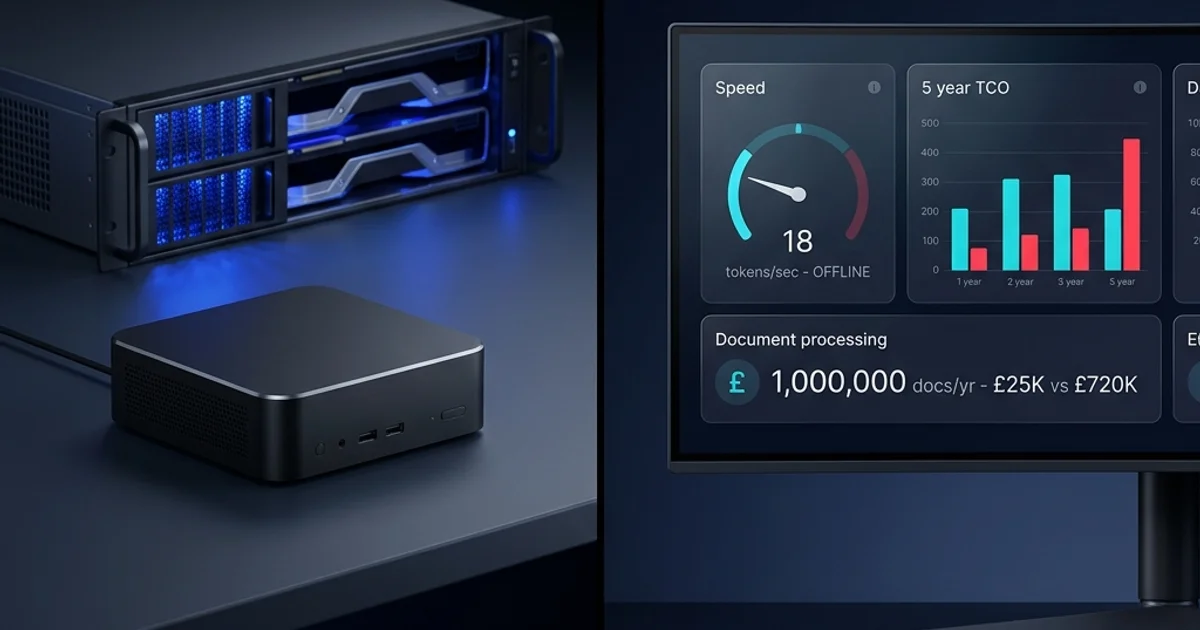
Table of Contents
The End of SaaS Sprawl and The Rise of Intelligence Arbitrage
Let me be blunt: the modern software-as-a-service (SaaS) model has become an economic sinkhole for the British enterprise. Over the past decade, businesses have been steadily conditioned to accept "SaaS Sprawl" as an unavoidable cost of operating in the digital age. A typical UK SME routinely pays £20 to £50 per user, per month, across dozens of disjointed, generic applications. You have your customer relationship management subscriptions, your project management boards, your document parsers, your automated marketing engines, and your human resources portals. This sprawling ecosystem not only bleeds operational capital month after month, but it inherently splinters highly sensitive proprietary data across vulnerable international servers.
Right, here is the thing that is fundamentally reshaping the market in 2026: traditional labour arbitrage is officially dead. For years, the foundational business strategy for scaling knowledge work involved outsourcing cognitive tasks to cheaper offshore workforces. It provided a temporary, albeit clunky, cost advantage. However, the floor has entirely dropped out of this model. Competitors across the globe now have access to the exact same cost-effective cognitive output through artificial intelligence, completely eliminating the coordination overhead, time-zone friction, and communication barriers associated with managing global teams. What has rapidly replaced this outdated strategy is a macroeconomic phenomenon known as "intelligence arbitrage."
Intelligence arbitrage is not merely a buzzword for technical automation. It represents a profound, deliberate shift in how economic value is generated within a knowledge-based economy. It is the strategic routing of cognitive workflows to AI systems that can execute them faster, cheaper, and at a scale that no human workforce can physically match, and subsequently capturing the massive difference in value. Value in knowledge work is migrating rapidly from execution volume - which is now incredibly easy to arbitrage - to human judgment, creative taste, and client relationships. The commercial procurement model itself is transforming; enterprises are no longer paying for inputs like hours worked or team size, but rather purchasing defined, highly precise business outcomes delivered by artificial intelligence.
For businesses operating within the United Kingdom, the stakes surrounding this shift are heavily magnified by an aggressive convergence of regulatory changes and government investment strategies. The UK government has made its position abundantly clear: domestic compute power is a matter of national economic security. Slated for its highly anticipated next phase in April 2026, the £500 million Sovereign AI Unit - chaired by venture capitalist James Wise and delivered by the Department of Science, Innovation and Technology (DSIT) - is aggressively intervening in the market to ensure the nation becomes a dominant force in the critical components of the AI value chain.
This state-backed push is not just theoretical posturing. The government is actively acting as a "first customer" for promising UK startups building high-quality AI hardware, offering free compute to researchers, and funnelling an additional £1 billion into scaling the Advanced Research and Invention Agency (ARIA) to catalyse breakthrough growth. Furthermore, £410 million has been earmarked for Local Innovation Partnerships, giving regional leaders across Britain the capital required to shape the R&D landscape directly. Building in-house processing capabilities is no longer a speculative technology experiment; it is a foundational operational necessity for any SME intending to survive the decade.
Compounding this economic shift is a sweeping transformation of the domestic legal framework. The enforcement of the UK Data (Use and Access) Act 2025 (DUAA) has fundamentally rewritten the compliance rulebook. Businesses that continue to rely on cloud-based AI application programming interfaces (APIs) hosted in the United States, or other third-country jurisdictions, are finding themselves increasingly vulnerable to complex data sovereignty conflicts. By actively moving cognitive processing in-house - onto local hardware that operates completely offline and physically resides within the company's own office walls - enterprises bypass the bureaucratic friction of international data transfer rules. They shield themselves entirely from external regulatory interference, third-party data scraping, and unexpected cloud vendor pricing revisions. The strategic imperative for 2026 is brutally clear: stop renting generic, leaky intelligence from cloud monopolies, and start owning sovereign, hyper-specialised cognitive assets.
The 2026 Local Hardware Renaissance


Power up with Lindy
"Lindy handles the admin while you handle the vision. It's like having a clone, but more efficient."
To genuinely understand how in-house artificial intelligence has become commercially viable for a 15-person business, one must examine the astonishing, almost violent compression of hardware capabilities that occurred between late 2024 and early 2026. The prevailing narrative that running frontier-level AI requires a £250,000 data centre is entirely obsolete. The market has bifurcated into two highly distinct, highly capable categories: ultra-portable pocket laboratories for edge computing, and highly efficient, densely packed enterprise server setups. Both are capable of producing world-class intelligence arbitrage.
The Tiny AI Pocket Lab Breakthrough
The most disruptive hardware advancement to reach the UK market this year is undoubtedly the Tiny AI Pocket Lab. Weighing a mere 305 grams, this discrete, unassuming device is engineered specifically for local inference, requiring absolutely no reliance on internet connectivity to function.
The technical specifications of this unit actively defy traditional computing logic. It houses an unprecedented 80GB of unified memory alongside a 1TB solid-state drive and a dedicated Neural Processing Unit (NPU) heavily optimised for complex AI workloads. For running local large language models (LLMs), unified memory is the absolute holy grail. In traditional PC architectures, data must be constantly, inefficiently shuttled back and forth between the system's standard RAM and the GPU's dedicated VRAM across a narrow PCIe bus, creating a massive bandwidth bottleneck that cripples inference speeds. Unified memory eliminates this transit completely, allowing the NPU to access the entire 80GB pool instantaneously.
What truly separates the Pocket Lab from a high-end consumer laptop, however, is its proprietary "Power Infer" inference engine. This software-hardware integration optimises what is known as "activation locality." In layman's terms, instead of lighting up the entire neural network for every single word generated, the engine only powers up the highly specific neurons required for a given query. This drastically reduces both power consumption and memory bandwidth requirements. Because of this breakthrough, the 305-gram device can comfortably run massive 120-billion parameter models - such as the open-source GPTOSS 120B - at an astonishing rate of 18 tokens per second.
To put this in perspective for business operations: human reading speed is roughly 4 to 5 tokens per second. The Pocket Lab is generating complex, reasoning-heavy text, analysing local documents, and executing Python scripts three times faster than a human operator can read the output, completely offline, while drawing less wattage than a standard desk lamp.
Model Compression and Google Gemma 4
Hardware, however, is only half of the sovereign AI equation. The software models themselves have undergone radical compression, allowing massive, nuanced intelligence to fit into severely constrained physical spaces. Google's release of the Gemma 4 architecture fundamentally changed local deployment by introducing "Turbo Quant," a revolutionary compression algorithm that specifically targets the KV cache.
During LLM inference, the Key-Value (KV) cache is the single largest memory bottleneck. Every time an AI reads a long corporate document or a complex prompt, it stores the mathematical representations of those words in the KV cache so it does not have to constantly recompute them. As the context window grows - say, when feeding the model a 50-page legal contract - the KV cache balloons massively, often causing consumer hardware to crash from out-of-memory errors.
Turbo Quant solves this by compressing the cache down to just 3 to 4 bits per element without requiring any retraining or fine-tuning of the base model. The impact is staggering in its efficiency. At a 4,000-token context length, Turbo Quant saves over 1 GB of memory. At an 8,000-token context, it saves more than 2 GB on a single model. Crucially, the quality loss is entirely negligible; at 4-bit quantisation, the cognitive output is essentially indistinguishable from uncompressed 16-bit floating-point models for any architecture larger than 3 billion parameters.
Tests comparing Gemma 4 with Turbo Quant against competing models like QWEN 3.5 on standard hardware demonstrate that agents are now fully ready to run locally on average SME devices, delivering reasoning performance that is fiercely competitive with cloud alternatives.
Enterprise Dual-GPU Deployments
While the Tiny AI Pocket Lab serves as an unparalleled prototyping sandbox and individual edge device, larger SMEs with simultaneous multi-user requirements - such as a 50-person marketing agency or a mid-sized law firm - often require dedicated enterprise servers.
The current established standard for SME local inference relies on dual NVIDIA RTX 5090 configurations. The market reality for UK buyers is notoriously harsh. Severe supply chain constraints and insatiable demand have driven the UK street price to between £3,000 and £4,200 per card, well above any manufacturer's suggested retail price. Furthermore, the generational performance leap is much smaller than historically expected - offering roughly a 25% to 30% improvement over the previous RTX 4090 architecture. Nvidia's leadership has openly admitted that supply will remain "very tight," forcing businesses to navigate inflated hardware costs.
Despite the heavy initial capital expenditure, a dual RTX 5090 server - boasting a combined 64GB of highly volatile, incredibly fast VRAM - allows a business to run frontier models at near-zero marginal cost. These localised setups process concurrent queries from dozens of employees simultaneously. They execute complex internal workflows ranging from financial data extraction and spreadsheet generation to semantic search across thousands of internal PDFs. Most importantly, they operate completely insulated from external cloud disruptions, internet outages, or the notoriously variable API billing structures that cripple corporate budgets.
Framework: Setting up a Sovereign System
Transitioning an SME from a complete reliance on cloud providers to a fully functional sovereign infrastructure requires a heavily structured, deliberate approach. The objective is not merely to install software, but to establish a secure, local Large Language Model server that integrates seamlessly, and invisibly, with internal business operations.
The implementation process must be categorised into a tiered deployment strategy. The following details the foundational setup using industry-standard tools like Ollama, an exceptionally robust, developer-friendly platform for managing and running local LLMs across various hardware configurations.
Implementation Checklist: The Four Phases of Deployment
| Phase | Milestone | Technical Actions | Security and Compliance Focus |
|---|---|---|---|
| Phase 1: Hardware Selection and OS Provisioning | Base System Readiness | Procure hardware (Tiny AI Pocket Lab or Dual RTX 5090). Install Ubuntu Linux 24.04 LTS. Configure unified memory access or install proprietary NVIDIA CUDA toolkits. | Physically air-gap the system if processing highly classified HR or legal data. Restrict physical access to the server chassis within the office. |
| Phase 2: Runtime Environment Setup | Ollama Installation | Execute the official installation script. Verify GPU binding by checking inference acceleration logs to ensure processing is not defaulting to the CPU. | Restrict the default API port (11434) binding to localhost to absolutely prevent unauthorised external network access. |
| Phase 3: Model Ingestion and Verification | Pulling the Weights | Download specific model weights via CLI, prioritising advanced multimodal architectures that fit the VRAM constraints. | Verify cryptographic hashes of downloaded model files to ensure supply chain integrity and prevent model tampering or poisoning. |
| Phase 4: API Integration and Middleware | Service Connectivity | Implement custom Python middleware using the OpenAI-compatible client or LiteLLM to connect internal tools to the local server. | Implement token-based authentication for internal routing. Ensure chat logs are automatically wiped per UK GDPR data retention policies. |
Technical Execution: Pulling the Model
To initiate the environment, the systems administrator must pull the desired model into the local environment. In 2026, one of the most uniquely capable models for internal code evaluation, document analysis, and reasoning tasks is llama4:scout. This is a massive 109-billion parameter model that features first-class support for multimodal vision tasks, meaning it can process images, scan documents, and evaluate complex code structures.
The command-line execution is wonderfully straightforward:
``bash
ollama pull llama4:scout
`
The system connects to the repository, downloads the heavily quantised weight files, and prepares the inference engine. Because llama4:scout is highly adept at sandboxed evaluations of LLM-generated code - preventing dangerous infinite loops or resource-intensive operations from crashing the host system - it forms the perfect, stable "Main Brain" for the corporate network.
Python Integration Snippet
Once the model is running locally, it quietly exposes an API on port 11434. Developers can immediately integrate this sovereign intelligence into the company's internal software using standard Python libraries. The following snippet demonstrates a robust integration method using the native requests library to query the local server. Crucially, executing this script ensures that not a single byte of proprietary data ever leaves the corporate premises:
`python
import requests
import json
import logging
Configure robust logging for the AI integration module
logging.basicConfig(level=logging.INFO) logger = logging.getLogger("SovereignAI_Connector")
def query_local_llama4_scout(system_prompt: str, user_query: str) -> str: """ Sends a complex query to the locally hosted llama4:scout model via Ollama. Ensures zero data leakage to external cloud providers. """ url = "http://localhost:11434/api/chat"
# Construct the message payload maintaining strict structural intent payload = { "model": "llama4:scout", "messages": [ {"role": "system", "content": system_prompt}, {"role": "user", "content": user_query} ], "stream": False, "options": { "temperature": 0.1, # Low temperature ensures highly deterministic business logic "num_predict": 2048 # Expanded output window for lengthy contract extraction } }
try: logger.info(f"Dispatching query to local AI. Query length: {len(user_query)} chars") response = requests.post(url, json=payload, timeout=180) response.raise_for_status()
result = response.json() return result['message']['content']
except requests.exceptions.RequestException as e: logger.error(f"Sovereign inference failed: {str(e)}") return "CRITICAL ERROR: Local inference engine is unavailable."
Example corporate use case: Parsing an internal, highly confidential NDA
if __name__ == "__main__": sys_prompt = "You are an expert legal analysis tool. Extract the exact termination clause duration and any liability caps." confidential_data = "This Non-Disclosure Agreement shall terminate 24 months from the effective date. Total liability is strictly capped at £50,000."
extraction = query_local_llama4_scout(sys_prompt, confidential_data)
print(f"Extraction Result: {extraction}")
`
This code can be seamlessly embedded into any internal tool - from a bespoke HR portal to an automated invoice reconciliation system. It completely circumvents the variable usage charges associated with cloud providers, providing an isolated sandbox for testing, offline operability, and strict privacy control.
Building the Tools: The Vibe Coding Revolution
Having a massive, powerful local brain humming in the server room is entirely useless without a frictionless mechanism to connect it to daily business operations. Historically, building internal software tools - a bespoke inventory manager, a specialised CRM for a niche client base, a custom holiday tracking portal - required hiring a full-stack developer at £60,000 a year or contracting a severely overpriced external agency.
This barrier to entry has collapsed due to the phenomenon of "Vibe Coding."
Vibe coding is the revolutionary paradigm wherein non-technical managers, domain experts, and regular administrative staff orchestrate software creation using natural language intent rather than writing exact, character-perfect syntax. The human provides the complex business logic, the operational constraints, and the general "vibe" of what the application should look and act like; the AI agent handles the tedious boilerplate, the complex routing, the database connections, and the user interface styling. It shifts the burden of software creation from syntax memorisation to clear, authoritative communication.
The ecosystem of Vibe Coding platforms has matured aggressively by 2026, presenting UK SMEs with several highly capable, wildly cost-effective options to replace their SaaS sprawl.
Toolchain Comparison: 2026 Vibe Coding Platforms
| Platform | 2026 Monthly Pricing (GBP Estimated) | Primary Functionality and Best Use Case | Capability Rating and Nuance |
|---|---|---|---|
| Cursor | £16 - £32/mo ($20 Pro, $40 Teams) | An AI-native IDE built on VS Code. Best for professional developers or highly technical implementers needing full codebase context. | Exceptional for complex architecture and deep, multi-file refactoring. Requires baseline technical knowledge to extract maximum value. |
| Replit Agent | £16 - £28/mo ($20 Core, $25 billed monthly) | Complete browser-based autonomous agent. Best for non-technical managers wanting to build, debug, and deploy full-stack web apps quickly. | The undisputed best for rapid SME prototyping. Consistently produces functional, shareable internal tools with integrated databases that actually work. |
| Bolt.new | Free tier, £16/mo ($20 Pro, $40 Teams) | Browser-based text-to-software generator. Excellent for frontend-heavy rapid iteration and quick component generation. | Highly capable but prone to severe "token burn." Every fix attempt burns tokens, often requiring immediate paid upgrades to finish complex projects. |
| v0 by Vercel | Free tier, £16/mo ($20 Pro) | Text-to-UI generator. Best for frontend developers and designers turning text or Figma designs into production Next.js components. | Unmatched for creating beautiful user interfaces, but severely limited backend functionality. |
Let the sheer realities of modern development sink in for a moment. An operations manager with zero coding experience can log into Replit Agent, pay approximately £20 a month, and type a prompt like: "Build a secure dashboard that monitors the API health of our local Llama 4 server, complete with a dark-mode interface and a SQLite database to log downtime events." Within minutes, the agent generates the frontend React components, writes the backend Python logic, configures the database schema, and deploys the application to a live, usable URL. If there is a bug, the manager simply tells the agent, "The dates are sorting backwards," and the agent rewrites the code to fix it.
For UK businesses, the ultimate strategy is combining these paradigms. The non-technical staff use Vibe Coding platforms to rapidly generate internal dashboards, workflow tools, and data entry portals. These tools are then specifically programmed - often by the AI itself - to point their API requests inwardly, towards the locally hosted Tiny AI Pocket Lab or RTX 5090 server. The result is a completely bespoke software ecosystem, built for pennies on the pound, tailored exactly to the business's needs, and entirely immune to external data scraping.
Bridging the Inefficiency Gaps
The deployment of sovereign AI hardware and the rapid generation of vibe-coded internal tools serves one ultimate, critical business purpose: permanently closing operational inefficiencies. The modern framework for understanding and targeting these inefficiencies relies on identifying three distinct gaps within an organisation: Speed Gaps, Reasoning Gaps, and Discipline Gaps.
Speed Gaps refer to the time lost between identifying a specific business problem and executing the technological solution. When a custom software requirement arises in a traditional setting, IT procurement pipelines take months of meetings, budgeting, and scoping. With vibe coding, the speed gap is compressed from quarters to mere hours.
Reasoning Gaps occur when human staff lack the immediate domain knowledge, the historical context, or the sheer cognitive bandwidth to make the correct analytical decision in real-time. A sovereign AI model, deeply integrated with the company's historical data, closes this gap by instantly providing contextually accurate, probabilistic answers to complex queries.
Discipline Gaps represent the most profound, unavoidable area of human failure in any business. Humans get tired; they forget to check the secondary database; they skip the final validation step on a Friday afternoon before a bank holiday. AI systems do not experience fatigue. They apply relentless, algorithmic discipline to every single query, every single time.
Consider a highly practical, real-world example of a mid-sized UK-based commercial bakery. Historically, the bakery relied on a veteran shift manager to estimate the daily sourdough production. To get it right, the manager had to mentally cross-reference historical sales from the previous year, upcoming local events that might drive foot traffic, and the current Met Office weather forecast (since ambient humidity severely impacts proofing times). The discipline gap here was massive; on busy days, or when the manager was off sick, junior staff simply guessed, leading to thousands of pounds in wasted inventory or entirely missed sales over a quarter.
By deliberately leveraging intelligence arbitrage, the bakery owner uses Replit Agent to vibe-code a simple, mobile-friendly web app. The app is instructed to automatically pull the Met Office weather API data and the daily order volume from the existing Point of Sale system. It securely bundles this data and sends it directly to the bakery's local LLM server running quietly in the back office. The LLM processes the multiple variables, applies relentless discipline to the historical data, and outputs the exact flour-to-water hydration ratios and unit counts required for the overnight bake. The solution costs virtually nothing to run, completely eliminates human guesswork, and perfectly aligns with the principles of intelligence arbitrage.
The Financials: 5-Year TCO Analysis
There is absolutely no point making strategic technological shifts unless the financial mathematics aggressively justify the capital expenditure. The prevailing myth pushed relentlessly by massive cloud providers is that paying purely for what you use - the variable SaaS model - is the most economically sound strategy for SMEs. At scale, this is demonstrably, mathematically false. The "Token Tax" associated with cloud API inference is brutal; every validation pass, every extraction retry, and every loop made by an autonomous agent compounds the monthly bill exponentially.
To truly understand the financial disparity, a business must calculate the Total Cost of Ownership (TCO) over a standard five-year hardware lifecycle. The sovereign hardware TCO is defined as the sum of capital expenditure plus operational costs over time. The cloud API TCO model is purely a function of volume over time, leaving the business heavily exposed to sudden mid-contract pricing revisions, model deprecations, and highly aggressive token usage by internal tools.
A mid-sized UK enterprise or a large retail consortium ingesting and processing roughly 1 million internal documents, incident reports, and customer queries per year faces astronomical cloud fees. Detailed sector analyses from 2026 demonstrate that relying on external cloud APIs for this production volume costs between £180,000 and £720,000 over a five-year period.
In stark contrast, building an in-house enterprise server capable of handling the exact same throughput requires a highly localised capital expenditure. Purchasing a top-tier server equipped with dual RTX 5090 GPUs, accompanied by enterprise-grade cooling, massive RAM, and heavy-duty power supplies, commands an upfront CapEx of approximately £10,000 to £15,000. When factoring in the operational expenditures (OpEx) for electricity and baseline IT maintenance, the five-year TCO for the on-premises solution maxes out between £25,000 and £60,000.
Financial Comparison: Cloud AI vs. Local Sovereign AI
| Financial and Operational Metric | Cloud API (SaaS / Pay-per-token) | Local Sovereign AI (In-House Hardware) |
|---|---|---|
| Cost Structure and Predictability | Purely variable OpEx. Highly unpredictable month-to-month. | Fixed upfront CapEx, extremely minimal and predictable OpEx. |
| 5-Year TCO (Processing 1M Docs/Yr) | £180,000 to £720,000 | £25,000 to £60,000 |
| Marginal Cost per Query | Positive (Every single query, mistake, or loop costs real money). | Near-zero (Only the baseline cost of office electricity). |
| Privacy and Security Posture | High risk of data leakage. Exposed to foreign laws (US CLOUD Act). | Absolute air-gapped security. Zero external transit of data. |
| Latency and Uptime Reliability | Subject to external network latency, rate limits, and provider outages. | Instantaneous local network speeds. Completely immune to internet dropouts. |
The break-even point on a £15,000 local server deployment - when offsetting heavy daily API usage and ripping out dozens of £20/user/month SaaS tool replacements - frequently occurs around month 10. After the first year, the business is essentially printing pure profit margins through intelligence arbitrage, saving upwards of 90% against equivalent cloud processing.
UK Business Context and Compliance: The Data Act 2025
While the financial arguments for sovereign hardware are overwhelming, the legal arguments are entirely decisive. The regulatory environment in the United Kingdom shifted dramatically following the Royal Assent of the Data (Use and Access) Act 2025 (DUAA) in June 2025. The Act applies in phases through June 2026, acting as the cornerstone of the UK government's post-Brexit strategy to position the country as an international tech hub. For compliance officers, Data Protection Officers (DPOs), and legal teams, understanding the profound nuances of this legislation is paramount to any AI deployment strategy.
The DUAA introduces massive, structural changes to the UK GDPR, fundamentally altering how employers and businesses process both personal and non-personal data. The appeal of maintaining local AI infrastructure becomes blazingly obvious when examining two specific, heavily reformed areas of the Act: International Data Transfers and Automated Decision-Making.
The Friction of International Data Transfers
Under the previous, highly restrictive regime, transferring data outside the UK required navigating stringent, often painful adequacy decisions. The DUAA modifies this framework significantly, lowering the test for international transfers. It shifts the standard from requiring "essentially equivalent" protections to permitting transfers to third countries where data protection is deemed "not materially lower" than UK standards.
However, relying on massive cloud AI providers headquartered in the United States triggers severe, unavoidable legal friction. The US CLOUD Act allows US federal law enforcement to compel access to data held by US-headquartered tech companies, regardless of where the server is physically located - even if that data sits in a London availability zone. This direct conflict with UK privacy expectations under the DUAA places enormous, often unacceptable regulatory burden on businesses processing sensitive customer or financial information.
By running local hardware, the entire international transfer problem simply evaporates. The data never leaves the corporate network; therefore, international transfer rules, adequacy tests, and foreign governmental overreach become entirely irrelevant.
Automated Decision-Making and Legitimate Interests
Perhaps the most transformative aspect of the DUAA is its aggressive deregulation of Automated Decision-Making (ADM). Previously, the UK GDPR heavily restricted decisions made solely by automated processing if they produced significant legal or similarly adverse effects on a person. The DUAA radically relaxes this prohibition. Now, businesses can freely use AI for significant automated decisions, provided the processing does not involve "special category" data (such as health, genetic, or biometric information).
Furthermore, the Act introduces the powerful concept of "recognised legitimate interests." Organisations can process data for specific, pre-approved public interest purposes - such as crime prevention, safeguarding vulnerable individuals, or ensuring network security - without having to perform a complex, bureaucratic "balancing test" against the user's fundamental rights.
This specific legal pivot directly empowers the deployment of in-house AI. Consider the real-world case of a Top 50 UK corporate law firm ingesting millions of highly confidential contracts and regulatory filings every month. In previous years, these firms faced immense "shadow AI" risks - scenarios where rushed junior staff might quietly upload sensitive merger documents into free online AI chatbots to speed up their work, triggering catastrophic data leaks and severe regulatory fines from the Information Commissioner's Office (ICO).
By deploying a sovereign llama4:scout` model on a local, air-gapped server, the firm ensures absolute, unbreakable client privilege. They can perform automated semantic analysis across their entire historical archive, extract termination clauses, flag regulatory risks in real-time, and draft responses completely insulated from third-party data scraping. The internal consensus within the legal and financial sectors is absolute: cloud-first was the right instinct for exploration and prototyping, but inference sovereignty is the only legally sound strategy for production.
Pros, Cons, and the Threat of "Workslop"
Shifting a business to an architecture reliant on local hardware and vibe-coded applications presents a highly asymmetrical risk-to-reward ratio, but let us not pretend it is without distinct, frustrating operational hazards.
The advantages, as outlined, are undeniable. Businesses achieve total data sovereignty, near-zero marginal inference costs, offline operability, and complete immunity from sudden API price hikes or model deprecations enacted by cloud monopolies. A company takes full ownership of its own cognitive destiny.
However, the primary disadvantage stems directly from the astonishing ease of creation. When non-technical managers are suddenly handed powerful tools like Replit Agent or Cursor and told they can build absolutely anything they need, they inevitably try to build everything. This unchecked enthusiasm leads to a severe architectural risk known within the software industry as "Workslop."
Workslop is formally defined as the rapid accumulation of unmaintainable, undocumented, and poorly structured AI-generated code. Because the HR manager who used natural language to generate a holiday-tracking dashboard does not actually understand the underlying Next.js routing, the authentication middleware, or the SQL database schema, they cannot fix the application when it inevitably breaks. Over a few short months, a company's internal network can become littered with fragile, highly siloed micro-applications that fail silently, do not communicate with one another, and create massive technical debt.
To aggressively mitigate the Workslop risk, businesses cannot simply deploy vibe coding tools to their staff without strict governance. This operational reality necessitates the creation of a new, highly specialised role within the SME: the "Technical Steward" or "AI Librarian."
The Technical Steward is not necessarily a senior software engineer pulling a massive salary, but rather a technologically literate operative whose sole responsibility is to oversee and curate the AI-generated architecture. Their mandate includes auditing all vibe-coded internal tools before they are deployed, ensuring they adhere to a unified corporate design system, maintaining a centralised repository of local database schemas, and strictly regulating which applications are permitted to interface with the local LLM server. They act as the vital dam holding back the flood of digital slop, ensuring that intelligence arbitrage results in streamlined, permanent efficiency rather than chaotic, unmanageable sprawl.
Looking for the Best AI Agents for Your Business?
Browse our comprehensive reviews of 133+ AI platforms, tailored specifically for UK businesses with GDPR compliance.
Explore AI Agent ReviewsNeed Expert AI Consulting?
Our team at Hello Leads specialises in AI implementation for UK businesses. Let us help you choose and deploy the right AI agents.
The convergence of extreme hardware compression, sophisticated Vibe Coding platforms, and sweeping, business-friendly regulatory reforms under the UK Data Act 2025 has created a narrow but highly lucrative window of opportunity. The barrier to generating bespoke, secure, and infinitely scalable cognitive output has effectively dropped to zero. Companies that stubbornly continue to pay a premium for generic, cloud-based software subscriptions will quickly find their entire cost structures outmatched by agile competitors who have successfully leveraged local intelligence arbitrage.
The transition from a fragile, cloud-dependent architecture to a robust, sovereign in-house system does not require a sudden, wildly disruptive overhaul of your entire IT department. Instead, business leaders and strategic implementers are advised to adopt a phased, highly pragmatic approach to integration.
First, implement the "Sandbox Rule." Procurement teams should acquire a single high-capability testing device, such as the Tiny AI Pocket Lab or an equivalent standalone desktop NPU system. Provide a select group of non-technical department heads with a £20-a-month Replit Agent licence and task them with vibe-coding a solution to their most persistent, low-risk administrative bottleneck. This immediate, hands-on exposure to local inference and natural language programming fundamentally shifts the corporate culture; staff evolve from passive software consumers to active software creators.
Second, initiate a ruthless, comprehensive audit of all existing cloud dependencies. Identify every single SaaS subscription that currently drains capital to perform basic cognitive tasks - such as text summarisation, data extraction from PDFs, or routine inventory forecasting. Calculate the true five-year TCO of these external API calls and monthly subscriptions against the fixed CapEx of a local dual-GPU server. The math will inevitably force your hand.
The future of UK business operations is not hosted on a massive server farm in California, beholden to foreign laws and variable billing. It is running quietly in the corner of your own office, completely offline, fiercely protecting your proprietary data, and working relentlessly at 18 tokens per second.
Key Takeaways
- Intelligence Arbitrage Defined: The strategic routing of cognitive workflows to AI systems eliminates the coordination overhead of offshore teams - competitors globally now access identical cognitive output through AI, making cloud-dependent SaaS sprawl an unjustifiable operational cost.
- SaaS Replacement Strategy: UK SMEs can completely eliminate costly per-user SaaS subscriptions by using Vibe Coding platforms like Replit Agent and Cursor to build bespoke internal tools that connect directly to local AI servers.
- The Hardware Reality: 2026 innovations, including the 305g Tiny AI Pocket Lab with 80GB unified memory and Google's Turbo Quant cache compression, allow massive 120B parameter models to run efficiently on local, offline hardware at 18 tokens per second.
- Turbo Quant Breakthrough: Google's Gemma 4 Turbo Quant compresses KV cache to 3-4 bits per element, saving over 1GB at 4,000-token context with negligible quality loss - enabling consumer hardware to run frontier reasoning models without crashing.
- Intelligence Arbitrage ROI: Shifting from variable cloud API costs to fixed local hardware CapEx saves enterprises between £120,000 and £660,000 over a standard five-year lifecycle when processing one million documents annually.
- Break-Even at Month 10: The break-even on a £15,000 local server deployment typically occurs around month 10, after which businesses save upwards of 90% against equivalent cloud API processing costs.
- DUAA 2025 Compliance Advantage: Local AI completely bypasses international data transfer friction, eliminates US CLOUD Act exposure, and aligns perfectly with the new Data Act's relaxed rules on automated decision-making and recognised legitimate interests.
- Vibe Coding Democratises Software: Replit Agent at £20/month enables operations managers with zero coding experience to build and deploy functional internal dashboards, workflow tools, and data portals in minutes using natural language instructions.
- Closing Three Operational Gaps: Sovereign AI eliminates Speed Gaps (from months to hours), Reasoning Gaps (instant contextual analysis of historical data), and Discipline Gaps (relentless algorithmic consistency without human fatigue).
- Mitigating Workslop: The sheer ease of AI app generation creates unmaintainable code risks, necessitating a "Technical Steward" role to rigidly govern internal software quality, maintain database schema integrity, and curate which tools access the local LLM server.

TTAI.uk Team
AI Research & Analysis Experts
Our team of AI specialists rigorously tests and evaluates AI agent platforms to provide UK businesses with unbiased, practical guidance for digital transformation and automation.
Stay Updated on AI Trends
Join 10,000+ UK business leaders receiving weekly insights on AI agents, automation, and digital transformation.
Related Articles
Sovereign AI: Why Local LLMs Are the Future for UK Business Data
The case for moving AI inference in-house and away from vulnerable cloud APIs
Vibe Coding and the Rise of the Non-Technical Developer in the UK
How natural language programming is democratising software creation for UK SMEs
UK B2B AI Agents 2026: Implementation and Data Act Survival Guide
Deploy GDPR-compliant autonomous agents with full DUAA 2025 safeguards
LangGraph vs CrewAI vs AutoGen: Multi-Agent Frameworks for UK Developers 2026
Technical comparison of agentic orchestration frameworks for building compliant UK automation
📚 Explore More Resources
Recommended Tools
Lindy
"The personal assistant that actually listens."
$59/month
7-day trial
Affiliate Disclosure


Reclaim.ai
"Take back your calendar. Save 26% with NEWYEAR26."
$13/month
Save 26% with code NEWYEAR26
Affiliate Disclosure
Ready to Transform Your Business with AI?
Discover the perfect AI agent for your UK business. Compare features, pricing, and real user reviews.